
Before I begin, I have to acknowledge that my Entrepreneurs Organization (EO) Forum Process is by no means an original work on my part. Rather, it is a mashup of what I have learned from Robert Fritz (Path of Least Resistance), Eric Ries (Lean Startup), Kim Scott (Radical Candor), Ian Chisholm (Roy Group), Dan Sullivan (Strategic Coach), all of my past forum members, and forum training from Mark Sanna (ForumSherpa) and Jesús de la Garza.
There are many ways of participating in an EO Forum, and what I have described below is what I prefer as of this point in time. I am constantly tweaking and fine-tuning it, and it definitely evolves over time. To be clear, I am not saying my way is the best way. Rather, I am sharing it here in the hopes that some piece of this might be useful for you in your EO Forum. Please take what works, if anything, and enjoy your journey with EO.
Why did I join EO, why do I participate in a Forum, and why did I take the time to come up with a process for how I do this? I am here to improve, and all of this greatly increases my chances of doing just that. I use my EO Forum meeting as my monthly reconciliation of where I am at in life versus where I want to be, and I consider my Forum members to be my board of directors to whom I have to report. In return, I give back to them as much, or more, than I take. I have to reciprocate and be a fully engaged and informed director on their board.
So how do I do this? Before I get to prepping for a forum meeting, there is homework that must be done to maximize the value from that meeting and all that follow it.
Life By Design
The homework begins with defining what it is that I want out of my time on this earth. Given that there are many aspects to life, I have found it helpful to group my goals around what I call my life Pillars. This is a take on the classifications that EO uses for "snapshot ratings" at the start of a meeting. These typically include Business, Family, Personal/Self, and Forum, and sometimes Community. I think these are all great, but for me I believe there is a difference between what is happening with my Family and what is happening within my Relationship, so I have added one more Pillar:
- Relationship
- Family
- Personal
- Business
- Community
- Forum
I don't think this is a one-size-fits-all system. My Pillars don't necessarily make sense to someone else, and they shouldn't. The deciding factor in how I organize them is what I expect from that Pillar in my life. Community for me is made up of my friends and entrepreneurs. I want to be spending time with both and meeting interesting people who are doing exciting things. Therefore, the expectations for both are the same, and as such I am comfortable grouping them together as Community.
For each Pillar, I define my goal as to what I want to have in that aspect of my life. I make my goals aspirational, out of reach, but achievable if I put in the effort and do not quit.
My definitions for the goals of each Pillar are as objective and quantifiable as possible. However, this isn't always possible, therefore when the goal for a Pillar is not a quantifiable result in itself and more of what I would call an aspirational statement – I end it with "As measured by...". I come up with some metric of validating my progress towards the subjective description that I have set as the target.
Why do this? When goals are subjective my monthly evaluation of my progress towards achieving them is in turn subjective. Which means that my mood is my deciding factor in evaluating my progress. If I am feeling good, that subjective target "feels good" and if I am feeling bad then the exact opposite happens.
When my Pillars are highly objective, it is very easy for me to point to them and say that is where I am going. From that informed position, I can contrast where I am at versus the goal. If the end goal is some subjective description of a wish that I might have, then comparing it to my current situation and mapping the discrepancies between each is pretty much impossible—or worse, very susceptible to lying to myself about the reality of my life.
This is the homework that I think needs to be done up front so that there is a baseline from which to compare the current situation to the goals when preparing Updates for a forum meeting.
Forum Meeting Prep
At least a week ahead of a forum meeting, I start taking stock of where I am at. I like to do a little bit each day leading up to the meeting and then use the time in between to let my subconscious ruminate on my discrepancies and the emotions that I feel about them.
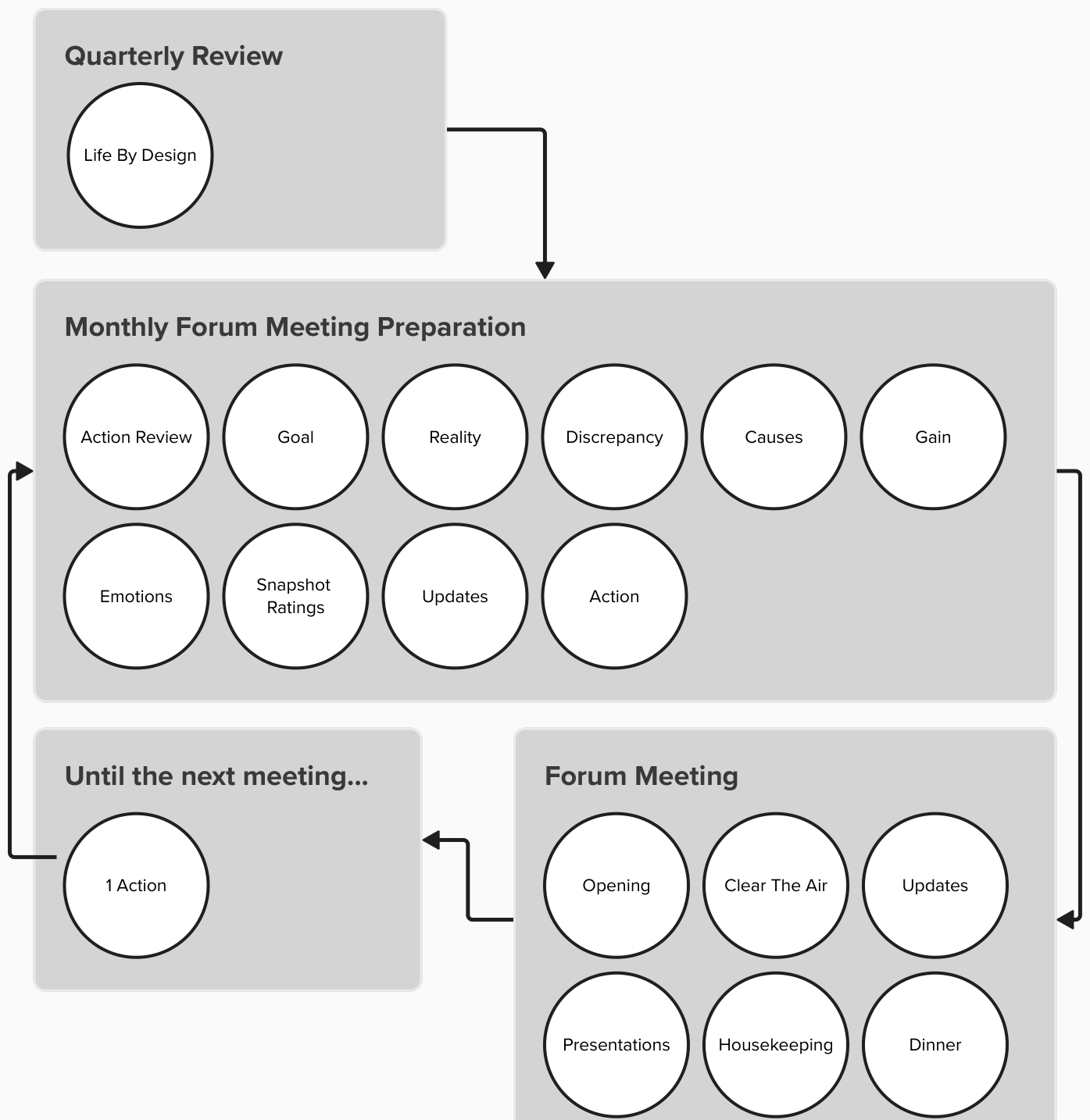
I follow the same sequence every month: review last month’s Action and what I learned; compare each Pillar’s Reality to its Goal; define the Discrepancy and likely Causes; use Dan Sullivan’s Gap and the Gain to protect my confidence; name the Emotions I’m feeling; choose 3 situations as Updates; choose 1 of those to Present on; and define 1 Action, with a clear Measure of Success, for the month ahead.
Last Month’s Action
My prep always starts with last month, before I let myself dream up anything new. I go back to the one Action that I committed to at the previous meeting and ask, in order:
Did I complete my Action from last month?
This is binary. Yes or no. No partial answers, no “mostly”, no clever justifications. Either I did it, or I did not.
If no, what caused me to fail?
Here I am not beating myself up; I am diagnosing. Was the Action vague? Was I avoiding a conversation? Did I simply not care enough about the outcome? Did I overload my month? If I have failed on the same Action for more than one month, that pattern is usually more important than the Action itself. I write these causes down.
If yes, did it achieve my Measure of Success?
I compare what actually happened to the Measure of Success I defined last month. If the measure was objective, the answer again is yes or no. Sometimes the Action was completed, but the impact was smaller than I hoped, or it created a different outcome than I expected. I note that.
What did I learn – and should that learning shape this month?
The point of this review is learning, not scorekeeping. If I failed, I want to understand why. If I succeeded, I want to understand what worked and whether it is repeatable. If the result surprised me, I want to update how I see the situation. I then ask: should these lessons be applied to what I am considering for this month? If the answer is yes, I write down how.
Only after I have closed the loop on last month’s Action do I move on to the current state of my life.
Reality Sucks (Honest Assessment)
Now I review where I am at as compared to the goals for each Pillar in my life.
For each Pillar I restate the Goal – what I said “good” looks like – and then describe Reality as it stands today, as objectively and specifically as possible. When Goal and Reality match, I celebrate and consider raising the bar. When they don’t, I write down the Discrepancy – the distance between what I want and what I have – and list the likely Causes. Some Causes are external, many are internal; I’m not trying to be perfect, just honest.
My working paper for each Pillar is now: Goal → Reality → Discrepancy → 1 or more Causes.
This process breaks the overwhelming “I am so far from where I want to be, I give up” feeling into discrete problems with identifiable causes.
Measure Backwards
Dan Sullivan of Strategic Coach calls this Gap and Gain. As entrepreneurs we tend to stare at the gap between where we are and a moving target, which slowly erodes confidence. To counter that, I explicitly measure backwards. For each Pillar I compare where I am now to a meaningful point in the past – often a year ago – and list the Gain I have made, then take a moment to acknowledge it. Sometimes the Gain is a clear result; sometimes it’s simply that I can now see a pattern that used to be invisible. I then add “→ Gain” to the chain for that Pillar: Goal → Reality → Discrepancy → 1 or more Causes → Gain. I still see the Discrepancy clearly, but I am no longer using it as proof that I am failing; it becomes the remaining distance to travel.
Emotions
At this point the facts of each Pillar are clear. Emotions are where I check whether the story I’ve written is actually true. For each Discrepancy I name 2–5 emotions I’m feeling about this area of my life, using tools like Gloria Willcox’s Feelings Wheel to get specific. I use those emotions for three things.
First, reconciliation. I verify and reconcile the analysis I’ve completed on this Pillar. If the emotions don’t match what I’ve written, I’m probably missing something: maybe the Goal isn’t aligned with what I truly want, maybe I’m sugar-coating Reality, or maybe there’s a deeper Cause I haven’t named. I use questions like “Is that it? What don’t I want to talk about? What’s behind this? Why?” to go a level deeper until the facts and the feelings line up.
Second, Updates. Where the emotions are the strongest – both good and bad – is where there is good subject matter for the Updates that I will bring to the forum. Updates are not just about problems. This is also the time where I can give back to the group by sharing what is positive and working for me, in the hope that my forum mates may see opportunities for themselves. I use the energy level of the emotions on each Pillar to filter out what could be my Updates.
Third, Sharing. By reconciling my emotions and getting to the root causes of my situation, my eventual Updates give my forum the best possible chance of sharing relevant experiences with me. My true emotions give them a gateway to empathize with my situations. If the emotions I am putting down are red herrings, the experience shares I receive will be of far less value. I will have wasted my time and the time of my forum.
At this point, for each Pillar in my life I have: Goal → Reality → Discrepancy → 1 or more Causes → Gain → 2 to 5 Emotions.
Snapshot Ratings
Once I’ve done this work, I know exactly where I am with each Pillar and how I feel about it, so I give each Pillar a whole-number Snapshot Rating out of 10 without overthinking it. Then I compare the scores to the homework: if a rating doesn’t reconcile with the underlying analysis, I adjust one or the other until they match. The scores give me a quick dashboard; the emotions tell me where to look first.
Presentation
Now I step back and look across all the Pillars for the strongest emotions, both good and bad. From those, I pick 3 situations where the emotional energy is highest and the stakes feel real. Each of these 3 Updates is anchored in the full chain for that Pillar: Goal → Reality → Discrepancy → 1 or more Causes → Gain → Emotions.
From those 3 Updates I then choose 1 that I would like to Present on this month. This isn’t necessarily the most dramatic or impressive situation; it’s the one where my forum can help me most and where I’m willing to be vulnerable enough to let that happen.
Updates
For each of my three Updates, I begin with the Emotions—up to three of them. I then write a brief Headline that succinctly describes the situation, and then I write out the Significance—why this matters to me.
The structure is:
Emotions → Headline → Significance.
I keep asking “why is that important?” to dig into the underlying feelings and reconcile them back to the emotions I wrote down. Through this process, the emotions may change as I discover what is actually under the surface of what I thought was my Update.
My preference is to write out my Updates and let them sit overnight. I revisit them once or twice more before the meeting. My subconscious keeps thinking through the situation once it is on paper, and when I come back to it I usually have more clarity and can better communicate my Update to the group.
Example Update structure:
Emotions: Frustrated, Overwhelmed, Anxious
Headline: My key employee gave notice and I have no succession plan
Significance: This exposes how dependent my business is on individual people rather than systems. It makes me realize I’ve been avoiding the hard work of documenting processes because I’m afraid it will expose gaps in my own understanding of the business.
Behind every Update is a specific Pillar with a clear chain of Goal, current Reality, Discrepancy, 1 or more Causes, Gain, and the Emotions I’m feeling about that gap. Emotions → Headline → Significance is simply how I package that chain so my forum can understand it quickly and share relevant experiences.
When I have three Updates written in this format, I then pick one that I want to Present on this month.
For the one Update I’ve chosen to Present on, I now define one Action that I will take between now and the next meeting to improve that specific situation in a meaningful way. The Action must directly address the issue I’m presenting on and be easily binary – either I did it, or I did not.
Along with the Action, I define how I will Measure the Success of that Action.
Format:
By completing {Action} by the next forum meeting, I will achieve {Measure of Success} by {date}.
Every Action has a Measure of Success that quantifies the return on the investment of doing it. The Action must be done before the next forum meeting, and ideally the Measure of Success is something I can observe in that same period of time—even if the full impact will take longer.
If I define an Action and cannot come up with a significant Measure of Success that actually makes a dent in the issue I am presenting on, that is a red flag. It usually means I am avoiding the real issue and not taking a meaningful step to correct it. In that case, I go back and redefine the Action.
One last comment on the one Action to take: there is only one. I am defining the one priority that I will complete this month to improve the situation I have described. Priority is not plural.
Write It Down
To maximize the attention given to each other at the forum meeting, I prefer to turn all electronics off from start to finish, breaks included. This eliminates distractions and helps everyone be completely focused and present.
Given this, I write my prep down on good old-fashioned paper and bring it with me:
– Snapshot Ratings out of 10 for each of my Pillars.
– Last month’s Action, whether I did it, whether I achieved the Measure of Success, and what I learned (and whether that learning shapes this month).
– Three Updates: for each, the Emotions, Headline, and Significance, grounded in the chain of Pillar Goal, Reality, Discrepancy, Cause, Gain, and Emotions.
– Which Update I want to Present on, and the one Action and its Measure of Success that I am committing to complete between now and our next forum meeting.
When I show up with this done, my forum is getting the best version of me, and I am giving myself the best possible chance to actually change.
The Meeting
With the preparation done, you are ready for the forum meeting itself. This is how the meeting flows and how the roles, structure, and tools all work together.
Roles
Forum roles can be many: Moderator, Timekeeper, Retreat Planner, Mindset Monitor, Treasurer, Parking Lot Manager, Scribe, and more. The 2 roles that matter most for a consistent, high-value meeting are Moderator and Timekeeper.
The Moderator creates and manages the agenda, protects the constitution, keeps energy high, and makes sure the group stays in experience-share mode rather than advice-giving.
The Timekeeper is the lynchpin. Meetings must run on time so that the needs of all members are addressed. The Timekeeper watches the clock and interrupts when someone is lost in the story, repeating themselves, or taking more time than their share. They also make the call when an issue is so critical that the group should flex the schedule to address it. This is not an easy job, especially with more than 5 members, so show a lot of appreciation to whoever takes it on.
Opening
I prefer an afternoon meeting starting with lunch together at 1:00 p.m. This gives everyone a chance to catch up and socialize before the formal start. Think of lunch as a soft start. Ideally everyone makes it, but it isn’t mandatory.
The forum meeting itself starts at 2:00 p.m. sharp. Hard start. Not optional. In my ideal world, if you are late by a minute, you buy dinner for the group. If you miss the meeting, you are out of the group and have to reapply. Some will see this as “hardcore,” but in my view, strict start rules are how you show respect for everyone’s time and maintain continuity of discussion. Your forum may choose to soften this; the principle is that time and commitment matter.
All Technology Off
The meeting opening takes 10 minutes or less. All technology goes off and stays off until the meeting ends at 6:00 p.m., breaks included. Once people start checking messages, they are distracted and out of the mindset needed for a fully productive forum. The point of the day is to be fully present for each other.
Confidentiality Reminder
At the start of every meeting, the Moderator reminds everyone of the core rule: what happens at forum stays at forum. Every discussion from the first greeting to the end of the day is confidential and may not be discussed with anyone outside the group.
If this trust is broken, in my view the member should leave the group and reapply if they want to return. This level of seriousness is what allows people to share honestly.
Barometer
The Moderator asks for a one-word barometer. Each person, round-robin, shares a single emotion that best describes how they are feeling right now. This gives everyone a quick read on the emotional temperature in the room before any content begins.
Clear The Air
Next is what I believe to be the most important moment in the Forum Meeting: Clear The Air. To keep the group healthy, it is critical to identify anything that is limiting participation as early as possible. Clear The Air is not about solving problems or fixing behaviour in the moment. It is about naming the emotions that are affecting how we show up for each other so that those emotions do not quietly erode trust over time.
If a member believes that the issue they have is unsolvable and that they simply need to live with it, they will not bring it up. Over time, resentment grows and it will impact the dynamic of the group. By contrast, when we create a predictable space every month to name what is getting in the way of full participation, we give ourselves a chance to address small misalignments before they become structural.
The Moderator facilitates Clear The Air by asking the group, out loud:
“Let’s clear the air: is anyone feeling anything about the group—or a member—that’s reducing how fully you’re showing up today?”
Then, going round-robin, each member answers “Yes” or “No.” Once the round is complete, the Moderator asks each member who replied “Yes” to share the emotion, the trigger, and the present impact.
A simple template:
“I feel [emotion] when [situation/behaviour], and it’s causing me to [impact].”
Keep it crisp. Speak only for yourself. Stay with one issue at a time.
For example:
“I feel frustrated when Beth and Julie have side conversations and it pulls me out of the discussion.”
“I feel angry when Tom shows up late and refuses to buy dinner as per our constitution, and it makes me question why I bother to put in so much effort.”
“I feel frustrated by Alice missing meetings and needing catch-up every time; it makes me question why I reschedule everything to make sure I show up.”
“I am questioning whether I can meet the level of commitment the group demands and I am considering resigning.”
“I am questioning the value of EO and won’t be renewing my membership.”
All members listen without defensiveness. They acknowledge what they have heard. If they truly need clarity, they may ask 1 brief question to better understand the feeling or the trigger—not to argue the facts or relitigate the story. The Moderator makes sure that Clear The Air does not become a place to score points, diagnose someone else, or prove who is “right.” The focus stays on impact, not intent, and on “I” statements, not “you” statements.
From here the Moderator has a few choices. Sometimes the issue is one of simple consideration. The person or people whose behaviour is the trigger acknowledge their part and commit to be more considerate going forward. In that case, the Moderator can consider the issue closed for now.
Sometimes the emotion points to a deeper personal situation that clearly deserves more space. In that case, the Moderator may suggest that the member do a full Presentation on it at a future meeting so the group can explore it in depth.
Sometimes the issue sits between 2 or more members and is better handled outside the room. If those members commit to meet offline and resolve the problem before the next meeting, the Moderator can consider the issue resolved for the purposes of today’s agenda.
Sometimes the problem is complex, charged, or clearly impacting the whole group. In that case, the Moderator may choose to pause the regular agenda and have the full group work through it. The originally scheduled content is important, but not as important as the health of the group. However long is required to address the issue is given to that discussion; whatever time remains afterwards is used for the rest of the meeting.
Confirmation that an issue is closed happens automatically at the next Clear The Air. If the member who raised it now has nothing to clear, the problem has been addressed. If they still have something to clear on the same issue, the group and the member must decide if it is actually solvable. If it is not, and the pattern continues, the person should resign or the group should remove them.
For this reason, I believe the constitution of the group must allow a unanimous-minus-1 decision to remove a member if necessary. The health of the group comes before the needs or preferences of any individual.
Member Updates
Going round-robin, each member presents their updates.
They begin with their Snapshot Ratings out of 10 for each Pillar of their life, as of that moment.
They then share a simple yes/no on whether they completed last month’s Action, and a yes/no on whether it achieved the Measure of Success they defined. One short sentence on what they learned ties it back to the monthly review process.
They then deliver their 3 Updates. For each Update, they start with the emotions (up to 3), then the headline, and then the significance—why this matters. The work here is already done in the monthly prep; they are simply walking the group through it.
At the end of their 3 Updates, they tell the group which update they want to present on this month, the one Action they are considering taking to address it before the next meeting, and the corresponding Measure of Success.
Assuming the homework is done, all of this can be completed in about 7 minutes per person.
Blind Spots
After a member’s Updates, the group looks for blind spots. The goal is not to tell the presenter “you have a blind spot,” but to ask questions that might reveal what they have not seen. If the presenter says, “No, that isn’t a blind spot for me,” that is the answer. It is not the group’s job to insist.
Possible blind spots include:
- The 3 Updates share a common theme that has not been explicitly named and may be the real issue to present on.
- The significance described does not match the emotions that were shared; the group may ask the presenter to reconcile this, which often reveals a deeper layer.
- The issue is a repeating pattern: the same or similar update has appeared several times, suggesting the real presentation should be on why it continues.
- The Updates do not address the lowest Pillar score in the Snapshot Ratings, which may mean something important is being avoided.
- The presenter is choosing to present on an update that does not seem to be their most pressing issue.
Once blind spots have been checked, the presenter confirms which update they will present on. If there are no obvious blind spots, do not go digging; move on to resonance.
Resonance
While the member is presenting, the rest of the group listens, empathizes with the emotions, and recalls times when they felt the same way in similar circumstances. Those prior experiences are what they will later share.
What the group does not do—though it is very tempting for entrepreneurs—is solve the problem. If you are listening with the goal of crafting questions that help you solve the problem, you are doing it wrong. If you are listening for the emotions so you can relate to them, you are doing it right. Questions to clarify emotions and significance should already have been asked in the blind-spot phase.
From this mindset, each member shares their resonance with the presenter: “I resonate with [this update] because of a time in my life when I had a similar experience and felt the same way.” These shares alone can often help the presenter move their issue forward even before the formal presentation and coaching.
The core rule: share, don’t tell. If you find yourself saying “You should…” or any variation, you are giving advice, not sharing. Reframe as “In my case…” or “What happened to me was…”. If you do not have a shared experience, say so and stay silent. That is more valuable than making something up.
A simple prompt when someone drifts into advice is to quietly knock on the table, a cue to bring it back to experience share.
Resonance, once practiced a few times, should take about 3 minutes per member after their Updates.
Total time for a member to present their Updates, surface blind spots, and receive resonance is about 10 minutes. Then you move round-robin until everyone is done.
Presentation Order and Assignments
Once all Updates and resonance are complete, you take about 10 minutes to define the order of priority for the coaching sessions. If you have 7 members and a 4-hour meeting, and you have stayed on schedule, you can do 7 coaching sessions. In reality, something may slip, so you sort presentations by priority: who needs it most first.
For each presentation, assign a coach. Who coaches whom can follow a simple rotational list so everyone both coaches and is coached over time.
Break Time
Assuming a 1:00 p.m. lunch and a 2:00 p.m. hard start, you will typically hit the first break around 3:25 p.m. Take 10 minutes to recharge and then come back ready for focused coaching.
Coaching
The first presentation begins with the assigned coach. Their job is not to solve the problem or give advice. Their job is to help the presenter clarify what the update is really about, whether it addresses the root cause, whether blind spots have been named, and whether the emotions match the significance.
A simple coaching sequence:
- Recap your emotions and headline for this update.
- What is the background leading up to this? How has it shown up in the past?
- What is the current situation? How is it showing up now?
- How could this show up in the future?
- What action are you considering taking, and what impact (Measure of Success) do you expect it to have?
If the presenter is already very clear—because the prep work has been done—this can be quick. In that case the coach can move directly to asking what perspective the presenter would like from the forum.
Some coaching techniques to bring clarity when things are fuzzy: talk as little as possible; remember W.A.I.T. (“Why Am I Talking?”). Use clean language and mirror the presenter rather than adding your own charge. Focus on one thread at a time. Pay attention to metaphors; when someone uses a metaphor, they may be trying to describe something they cannot explain directly, which is worth exploring. If the presenter shifts into “we,” “us,” or “they,” bring them back to “I” and “me.” Avoid blunt “why” questions and use “what” and “how” instead: “What else is behind that?”, “Is that cause or effect?”
I have written more on a framework for coaching should you want to explore other tools that can be used in these discussions.
If everything is already clear, none of this is needed. It is not the coach’s job to dig for something that is not there. A coaching segment that wraps in 1 or 2 minutes can be a sign that both presenter and coach are on point and the forum has what it needs.
Coaching should take about 5 minutes.
Coaching: Member Listening
While the presenter is being coached, other members listen with the same resonance mindset as earlier. They are not solving the problem. If their questions are about technical details or the “story,” they are likely drifting into problem-solving.
Good questions, when appropriate, are those that help the presenter reconcile emotions and significance: “You mentioned being really upset about X, but you say the problem is Y; can you help us understand that?” These belong more in blind-spot work or in formats like Cloaking or Brainstorming than in the default coaching loop.
Feedback
Once the coach has confirmed the issue, emotions, significance, and candidate Action, they ask the presenter what perspective they want from the forum. Options include:
- Experience Share. Members describe a time when they felt the same way in similar circumstances, what happened, and what they did, always in “I / me / we / us” language.
- Walk In My Shoes. Used when people lack direct experience but still want to offer perspective. “I am not you, but if I were in your shoes, I would…” It is still framed as what I would do, not what you should do. This is a backup tool when Experience Share is not available.
- Cloaking. The presenter turns their back to the group while the group discusses the situation openly “behind their back,” including critiques and recommendations. This requires a very high-trust, mature forum and should be used sparingly. Without care, it can become divisive.
- Brainstorming. The group generates options. Even here, the frame is “X is an option,” not “You must do X.”
- Digital Decision Making. Robert Fritz’s framework for binary decisions, used when the presenter is stuck between a small number of clear choices and wants a structured way to think them through.
The presenter chooses the format; the group does not impose it.
Coaching: Member Questions
Assuming the presenter has asked for Experience Share (with Walk In My Shoes as backup if needed), each member may ask one clarifying question to better understand the emotion and significance so they can share more precisely. If your question is aimed at solving the problem, it is probably not needed.
Keep it to one question per person. Do not bury multiple questions inside one long sentence. Do not have follow-ons. If you have many questions, you are likely drifting into problem-solving. “Pass” is always acceptable if you don’t need to ask anything.
Questions should wrap in about 5 minutes.
Coaching: Member Feedback
Each member then provides their feedback according to the requested format, ideally in under a minute each.
Coaching: Conclusion
The presenter thanks the group and states the Action they are going to take and the Measure of Success they are committing to. If they need time to digest what they heard and refine the Action, they commit to sharing their final Action and Measure of Success with the group within one week.
Housekeeping
To wrap up the meeting, the group covers housekeeping:
Confirm the next meeting date, time, location, and host.
Add one more date to the calendar so that meetings are always booked at least 12 months out, including retreats. This gives everyone a clear framework for long-term planning.
Handle any other forum business.
Finally, go round-robin and ask each member for their give/take scores out of 5. “Give” is how much they felt they contributed; “Take” is how much value they received. For example, if you were distracted and not very present, your give might be a 3. If you received powerful feedback on your presentation and left with clarity, your take might be a 5. This is a simple way for the Moderator to track engagement over time.
Dinner
After 4 hours of intense work, a dinner together—ideally mandatory—is a great way to decompress, deepen relationships, and have the more technical or tactical conversations that were inappropriate during the meeting itself.
Sample Agenda – 7 People, 1:00 p.m. to 6:00 p.m.
1:00 p.m.: Lunch (soft start).
2:00 p.m.: Opening (10 minutes).
- Technology off and away until 6:00 p.m., breaks included.
- Confidentiality reminder.
- One-word barometer.
- Clear The Air using the question: “Let’s clear the air: is anyone feeling anything about the group—or a member—that’s reducing how fully you’re showing up today?”—round-robin Yes/No; Yes answers briefly elaborated with “I feel [emotion] when [situation/behaviour], and it’s causing me to [impact].” Moderator chooses how to resolve as described above.
2:10 p.m.: Member Updates (about 7 minutes each, plus 3 minutes of resonance).
- Each member shares Snapshot Ratings, last month’s Action status and learning, then 3 Updates (Emotions → Headline → Significance), then which update they want to present on and the Action + Measure of Success they are considering.
- Group points out any blind spots and shares resonance.
3:20 p.m.: Presentation order and coach assignments (10 minutes).
- Sort presentations by priority.
- Assign coaches.
3:30 p.m.: Break (10 minutes).
3:40 p.m.: 4 Presentations (15 minutes each).
4:40 p.m.: Break (10 minutes).
4:50 p.m.: 3 Presentations (15 minutes each).
5:35 p.m.: Housekeeping (about 20–30 minutes).
- Confirm next meeting and host.
- Add the next date to the rolling 12-month calendar.
- Handle other business.
- Give/Take scores.
6:00 p.m.: Forum dinner (mandatory).
You can tune the times and number of presentations to your group size and energy, but the backbone remains: strong prep, tight updates, clear coaching, experience-based feedback, and a consistent structure that protects trust and attention.