A Simple Tool For Hard Yes/No Calls In EO Forums
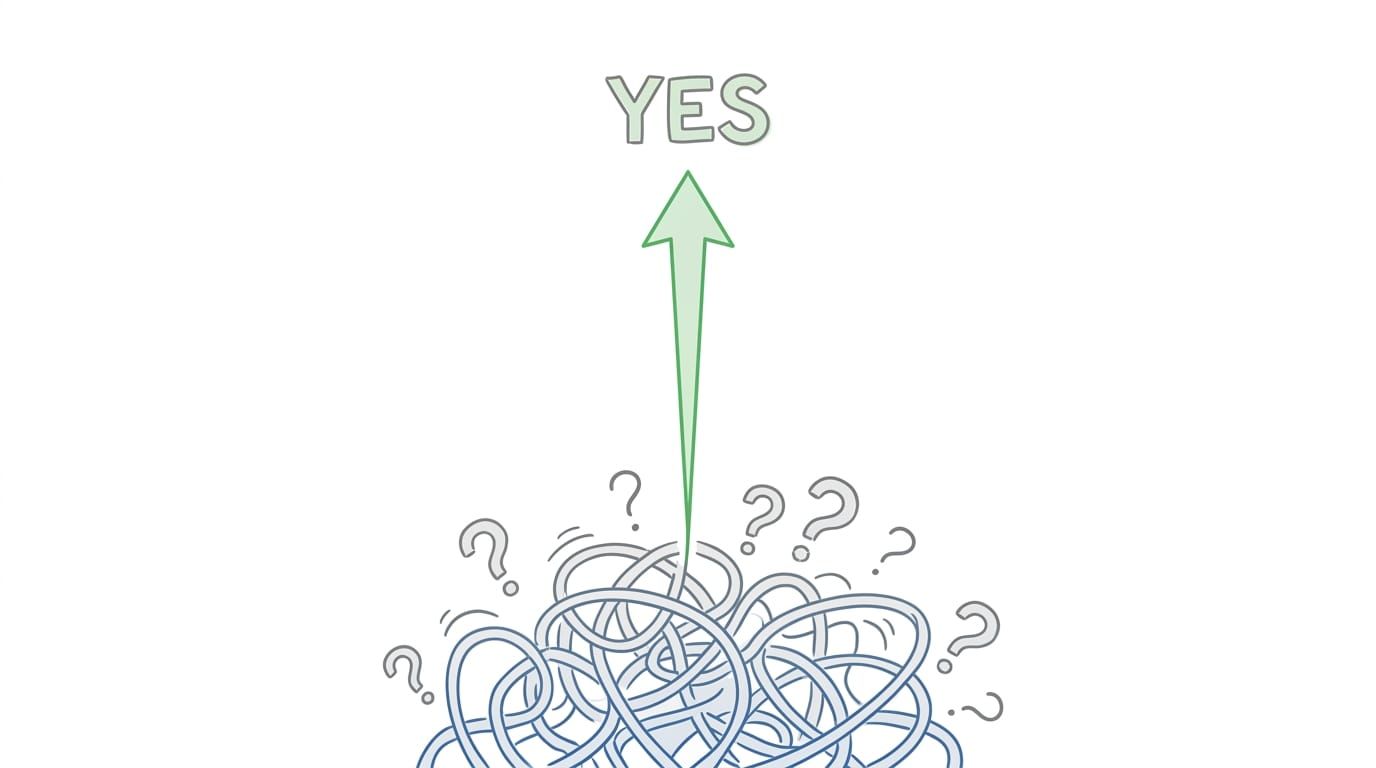
When most of us “make a decision,” we don’t really decide.
We tell stories. We build long pros/cons lists. We talk in circles. Time passes, nothing changes, and we pretend the situation is “complex” rather than admitting we’re avoiding a call.
Robert Fritz offers a different approach he calls digital decision making.
This post is my summary of how I understand and use his process, why I think it’s valuable, and how it fits particularly well with EO Forum presentations that hinge on a binary decision. All credit for the underlying ideas goes to Robert Fritz. Any mistakes or distortions here are mine, and if this resonates, I strongly recommend you go straight to his original material and courses. I did and those materials and time with him in his courses had one of the most significant impacts on my life.
Digital vs analog thinking
Fritz draws a distinction between analog and digital thinking.
Analog thinking is what we default to. There are shades of grey, nuance, backstory, emotion, context, politics. It’s rich, but it’s also slippery. Almost any argument can be made to sound reasonable if you tell the story well enough.
Digital thinking, in Fritz’s sense, forces discrete states.
You collapse the fuzziness into simple positions like:
- Yes or No (for the decision)
- Adequate or Inadequate (for conditions)
- Getting better, Staying the same, or Getting worse (for trends)
Once you force yourself into those simple states, the underlying structure of the situation becomes visible. You see what really drives the choice, rather than what makes the best narrative.
The core idea: a binary decision, driven by structure, not story
At the centre of Fritz’s digital decision making is a simple rule:
You define the decision as a binary yes/no question, then work backward from that outcome rather than forward from your story.
You are not deciding which of several possible stories is most persuasive. You are deciding whether you are going to do something or not.
Examples:
“Do we open a US office in the next 12 months?”
“Do I fire my COO?”
“Do I commit to this new product for 2 years?”
From there, you identify the handful of factors that actually matter for that decision and make them digital too.
Digital Decision Making
Get a structured yes/no decision with clear reasoning you can defend to your team. 10-20 min.
Step 1: Define the decision as a clean yes/no
This is the first discipline.
The “decision” is not:
“Should we explore possibilities around expanding into the US while also keeping other options open?”
The decision is:
“Do we open a US office in the next 12 months? Yes or no?”
A lot of what we call “complex” decisions simply die right here, because once stated this way, you realize you already know the answer. You have just been unwilling to name it.
Step 2: List the factors that truly matter
Next, list the factors that are actually relevant to this specific decision.
Not an exhaustive brainstorm, just the ones that really move the needle for you.
For example, for “Do I commit 2 years to a new coaching product?” the factors might be:
- Financial upside
- Lifestyle fit
- Impact / purpose
- Complexity or drama risk
Another person might choose very different factors. That’s okay. The point is not to adopt someone else’s values, but to reveal your own structure.
Each factor will eventually be judged in simple terms: adequate or inadequate, and often also whether it is improving, flat, or deteriorating.
Step 3: Check if there is even a real decision
Fritz suggests two thought experiments:
If every factor were clearly positive and adequate, what would you do?
If every factor were clearly negative and inadequate, what would you do?
If your answer is “yes” in both scenarios, there is no real decision. You are going to do it.
If your answer is “no” in both scenarios, there is no real decision. You are not going to do it.
A surprising number of “agonizing” decisions vanish here.
You wanted to believe that getting more data or options would help, but once you strip away the story, the decision is already structurally determined.
Only if those 2 imaginary extremes lead to different choices do you truly have a decision to make.
Step 4: Reveal your value structure with combinations
Now you start to play with combinations of factors. This is where the process earns its keep.
You ask questions like:
“If the financial upside were high but the lifestyle fit were poor, what would I do?”
“If the lifestyle fit were great but the financial upside were modest, what would I do?”
“If the impact were very high but the drama risk were also high, what would I do?”
Each time, you force yourself to a digital answer: yes or no.
You are not just talking about the factors. You are using them to drive an actual decision in that hypothetical scenario.
Over a handful of combinations, patterns appear:
You might find that you will usually say no whenever lifestyle fit is poor, regardless of financial upside. That tells you that lifestyle is structurally dominant over money, whether you like that fact or not.
Or you might find that high drama risk almost always pushes you to no, even when the impact is attractive. That exposes how much you really want a calm business, even if your story is “impact above all.”
This part of the process doesn’t judge your values. It simply maps them.
In EO Forum terms, it shifts the conversation from “what should I value?” to “what do I actually value, based on my own choices?”
Step 5: Reality check the actual situation
Once you have a sense of which factor combinations drive a yes or a no, you come back to reality.
You ask, for each factor:
What is actually true right now?
Is the financial upside adequate or inadequate?
Is the lifestyle fit adequate or inadequate?
Is the drama risk low, medium, or already high and getting worse?
You then match the real-world pattern to one of the hypothetical patterns you explored earlier.
If the real pattern looks like “moderate financial upside, strong lifestyle fit, high impact, low drama risk” and you already decided that combination would be a yes in your thought experiments, the structure is telling you that the decision is yes.
At that point, the real question is not “What should I do?” but “Am I willing to act on what I have just seen?”
Step 6: Announce the decision and deal with friction honestly
The process ends with a clear statement:
“My decision is: Yes, I will do this.”
or
“My decision is: No, I will not do this.”
If you or others still resist the conclusion, that friction is useful data.
Often it means either:
A factor is missing. You left out something you care about, such as health, reputation, or a relationship.
A factor is misunderstood. You are kidding yourself about how adequate or inadequate something is.
In that case, you adjust the factor list or the reality ratings and run the structure again.
Digital Decision Making
Run the full six-step digital decision process with an AI facilitator guiding each stage. 10-20 min.
Why this works so well in EO Forums
EO Forums are designed for experience sharing around real, often emotional, issues. Many of those issues boil down to a binary decision:
“Do I stay in this partnership?”
“Do we shut this division down?”
“Do I move my family to another country?”
The normal Forum risk is that we spend most of the time in story:
History. Context. Personalities. Justification. Worst-case fantasies.
All of which matter, but can also obscure the decision.
Digital decision making helps in at least 3 ways.
First, it creates a clean anchor.
When a member frames their presentation as a clear yes/no decision at the start, the group has a focal point. Instead of wandering, the conversation orbits around a single binary call.
Second, it surfaces the presenter’s real values.
By walking through combinations of factors and forcing yes/no answers, the Forum sees what actually drives the member’s choices. This is far more powerful than debating what they “should” care about.
Third, it reduces politics and advice.
Forum best practice is “no advice, only experience.” Digital decision making fits that perfectly. Members can share experiences that illuminate how they weighed similar factors, without arguing for a specific outcome.
You can structure a Forum presentation around this:
Define the binary decision.
Share the factors that matter to you.
Walk through a few hypothetical combinations and your yes/no responses.
Then present your reality check and ask: “Based on this, what do you see that I might be missing?”
The goal is not for the group to decide for you, but to help you see your own structure clearly enough that the decision becomes obvious.
Strengths and limitations
Like any tool, this one has edges.
On the plus side, digital decision making:
Cuts through analysis paralysis and gives you a real yes or no.
Exposes the gap between your stated values and your actual decision patterns.
Avoids the endless pros/cons and story-telling that can dominate Forum time.
On the minus side:
It is only as good as the factors you include. If you omit a critical element, such as your health or your family, the structure will give you a clean but bad answer.
It can oversimplify when magnitude truly matters. Sometimes “adequate” vs “inadequate” hides huge differences in risk or reward that should be modeled more carefully.
It doesn’t fix bad values. If someone’s priorities are unhealthy, this process will still execute them faithfully. Clarity is not the same as wisdom.
Used with some humility, though, it is a powerful way to move from talk to truth.
Go to the source
To be clear, this post is only my interpretation of Robert Fritz’s work on digital decision making and structural dynamics. He goes much deeper into the theory and practice in his books and courses.
If this resonates with you, especially as an entrepreneur or an EO member, I strongly encourage you to:
Read his original material, such as “The Path of Least Resistance” and his other books on structural thinking.
Look into his workshops and courses on structural dynamics and digital decision making.
If you are presenting a binary decision in Forum, consider using this as your framework. Define the yes/no question, make your factors digital, explore the combinations, and then bring your real-world pattern to the group.
You may find that the “hard decision” you have been carrying for months has already been made. The only remaining question is whether you are ready to act on it.
Digital Decision Making
Get a structured yes/no decision with clear reasoning you can defend to your team. 10-20 min.