
The following is how I would sell a business with $1M+ EBITDA. There are many ways of going about this and I am not professing that my way is better than any other. These notes are based on what I did, somewhat organically and not nearly as strategic as listed here, combined with what I learned and would do differently next time.
I founded my company in 1992. I spent the next 25 years creating software and begrudgingly selling hardware when I had to. Throughout this period I would call it an “okay” company. Lots of ups and downs, fire fighting and pivots. Many wasted initiatives. By the end of the 25th year I stopped drinking my koolaid and started our transformation. The Entrepreneurs Organization was instrumental in helping me realize that I could make this change. Over the next 5 years I, with the help of many, figured it out and went from okay, to good, to great, and I sold the business in 2022.
My slow 25 year climb, with many oscillations was because;
- we were a great team but we had no accountability
- no core customer - serving over 100 industries in 110 countries (NUTS!)
- trying to do everything all at once (if there is more than 1 priority, there is no priority)
- lover of technology looking for a problem to solve (I was the problem)
We changed all of the above in our last 5 years. It was organic with continuous trials, learnings, and improvements. In hindsight, I realize now that with a systematic, not organic approach, this can be done in 3 or less years. It didn’t have to take 5. Let alone the first 25 years.
The Homework
Adopt an operating system - 3HAG, EOS, Scaling Up, etc. - I prefer 3HAG. Hire a business coach to implement it and guide you. You can’t do this yourself, you have too many blind spots and not enough authority. Be fanatical about implementing and maintaining it.
Hire a leadership coach for yourself and your executives. For the same reasons as hiring a business coach.
Define who your core customer is (singular, not plural). Write the StoryBrand Brandscript (K-12 in North America). Hire them to teach you how to do it. It is unbelievably worth it.
Create a Market Map; typically a one-page picture of your playing field that includes customers, channels, geographies, competitors, substitutes and influencers, and not typically done, but do it - add potential strategic acquirers. Who are the strategic acquirers in your industry that would value what you do? Strategics will pay more. Use the map to capture all of the opportunities and risks, and further think through any associated risks that could devalue your business; failing customer retention, too much customer concentration, supply chain disruption, technical debt, etc.
Define your core customer attributes and rank your ability to meet them against your competition, find the white space between you and them. Define the activity map to achieve the white space and plot one strategic initiative per quarter, over 12 quarters, that will deliver it.
Know how your industry is valued? Multiple of EBITDA, ARR, something else? And what supporting EBITDA margin, retention, annual growth, etc. is needed to get the higher end of the multiple range?
With these numbers in mind define what is the economic engine (company critical #) that will deliver the valuation multiple that you want.
Define the financial results that must be achieved month over month, for the next 3 years, to hit the exit target? In particular focus on cash and the EBITDA margins that must be maintained to generate enough liquidity to support your strategy.
Reconcile the strategic initiative that will be delivered each quarter, over the next 12 quarters, to confirm that they will support the financial results? Plan strategic announcements each quarter that win customers and attract acquirer attention.
What are the 3 to 5 values that you believe in, that when adhered to will deliver the results you want, and can be used by every employee to guide every decision they make? Values are an incredible tool for the creation of a self directed company. What is one story that exemplifies each value and what are 3 to 5 questions that could be asked by an employee to determine how they should act to adhere to the value? Each question has 3 example answers; strongly aligns (green), somewhat aligns (yellow), and does not align (red).
Make everyone accountable (Functional Accountability Chart). The company has a critical #, every team within your company has a supporting critical # that is within their control, every employee on a team either has the team critical # or a critical # of their own that supports the team # - once again, a # that is within their control.
All critical #’s have a green (stretch, but achievable goal), yellow (minimum acceptable result) and red (unacceptable) range.
All numbers are presented, and roll up, on one dashboard weekly, as of the previous business day, and by the close of the next business day any number in the red, or trending to the red, has a plan to correct it. The plan describes the situation, what caused it, the correction(s) to be made, by who, and by when, and what the follow-up date(s) are to evaluate the success of the corrections.
Meet with all teams leads together weekly to review the results and correction plans.
Every employee's performance is evaluated quarterly on their critical # and values adherence. If the critical # is red, or a value is red (with examples), they have 1 quarter to correct, extenuating circumstances aside. If everything is green, one area is identified for improvement and a plan made to execute on that improvement within the next quarter.
If the employee manages people, their Skip Level (Kim Scott, Radical Candor) review (or similar system) is done by their manager prior to their performance review and the results of that process are used as inputs to determine their situation and improvement plan.
Review the strategy and results every quarter, refine it, and carry it forward one more quarter in your 12 quarter plan.
Align Compensation With The Goals
Executives; 20% or more of OTE is tied to achieving rule of 40 targets (profit margin + growth, and put a floor on profit margin to make sure you have the cash) - have a green, yellow and red target, paid quarterly, and put aside a % (I used 10%) of the sale for them in the form of a retention bonus and meeting the earnout (if applicable)
Team Leads; 10% or more of OTE is tied to achieving their critical # - have a green, yellow and red target, paid quarterly
Small monthly rule of 40 compensation for all employees, not large, but it can be used as a focal point for everyone - review results at a monthly all hands meeting and set one thing that needs to be done in the next month to improve the number
Set aside another % (I used 5%) of sale for all employees - paid pro-rata based on their tenure
Pay a token amount for achieving the quarterly strategic objective, green, yellow and red target, gamify continuous improvement.
Investment Banker
One year before your targeted sale;
- Hire a CEO and become their mentor and coach, sounds simple, it isn’t, you will need training. Roy Group really helped me understand this.
- Hire an investment banker. I used IJW out of Montreal. Best thing I did.
Your job is now to sell your business. If you no longer have a critical role in the company your business won’t suffer as a result of the time needed for managing the sale. The sales process, negotiation and results will have your full focus. AND, it is very easy to say that you won’t go with the company (assuming you don’t want to) as you don’t have a job at the company.
My requirement for the investment banker for the deal was;
- Purchaser can’t be a consolidator, they must embrace our culture and be able to provide even greater opportunities for our employees
- At least 5X ARR - all cash
- No earnout
- I didn’t come with the deal
- I had a list of potential acquirers that I had been approached by and if one of them was the purchaser the fee was less
- I had control over who was approached and had full discretion on any offer
- Any trading after the fact, I walk
What actually happened was that I was approached by a strategic and rather than have a sole source negotiation I hired IJW to make it competitive and to act as the negotiator with the strategic and every other potential acquirer. IJW ended up with 73 prospects plus an additional pool of “20–30 US/Canada search funds,” so roughly 93–103 in total were entertained.
Operating System
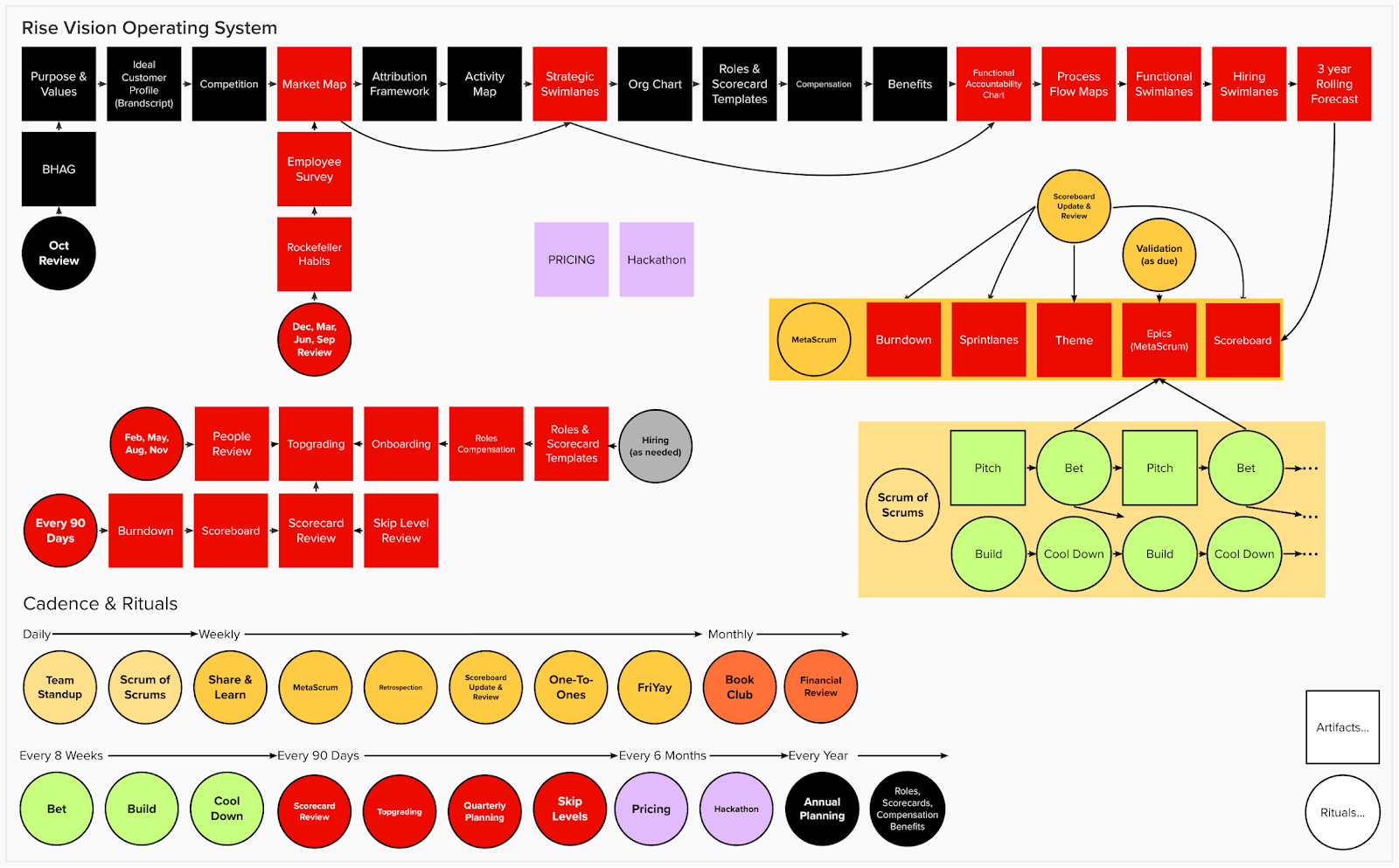
One of the reasons why we were successful in selling the company was the execution culture that we had developed and the operating system that drove it. This operating system defined the artifacts (the documents and other media repositories and tools) and the rituals (the processes and meeting cadences) to;
- always know the customer (brandscript),
- the external situation (market map) within which we serve them,
- our internal state and capabilities (key process flow map, function process flow map and accountability charts, and organization chart),
- to determine what to do, and more importantly - what not to do (attribution framework and activity fit map),
- to position the company (brandscript, brand promise, secret sauce, elevator pitch), and
- deliver the strategy over the next three years (swim lanes, thirty six month rolling forecast),
- quarter over quarter, week over week (sprint lanes, burndown and scoreboards) and
- hold each other accountable (scorecards) for making it happen.
How it all flowed looked like this;
Get new articles by email.
Subscribe