
Ask a founder about their competition and you get one of two answers. A shrug, because they are heads-down building. Or a list of thirty names, because everyone who has ever shown up in a Google search feels like a threat. Both answers stall the same way: when it is time to make a strategic choice, nobody in the room actually knows how the competition wins.
The problem
Competitor knowledge in most founder-led companies is gut feel wearing a suit. The sales team remembers the last deal they lost and treats that one rival as the whole market. The founder carries opinions formed two years ago. Nobody has written any of it down, so the opinions cannot be checked, and they do not age out when the market moves.
The cost shows up later, in the strategy work. Sooner or later every leadership team has to answer a comparison question: where do we honestly stand against the alternatives our customer weighs us against? In my experience coaching founders, the teams that stall on that question are almost always the ones that have not done the competitive homework. They can describe themselves. They cannot honestly describe anyone else. The comparison stops being strategy and becomes guessing with a straight face.
The fix is not more analysis. It is a small, durable discipline: decide who actually belongs on your list, decide what you need to know about each of them, rate how confident you are in what you think you know, and keep it alive. This article covers that discipline. It draws heavily on Michael Porter's work and on the modern competitive-intelligence practitioners who translated him; credit where it is due throughout.
Competitor File Builder
Builds one evidence-rated file per focus competitor: the grid, the four corners, the threat rating, and the watchlist. Works from your data or your answers.
Who belongs on the list
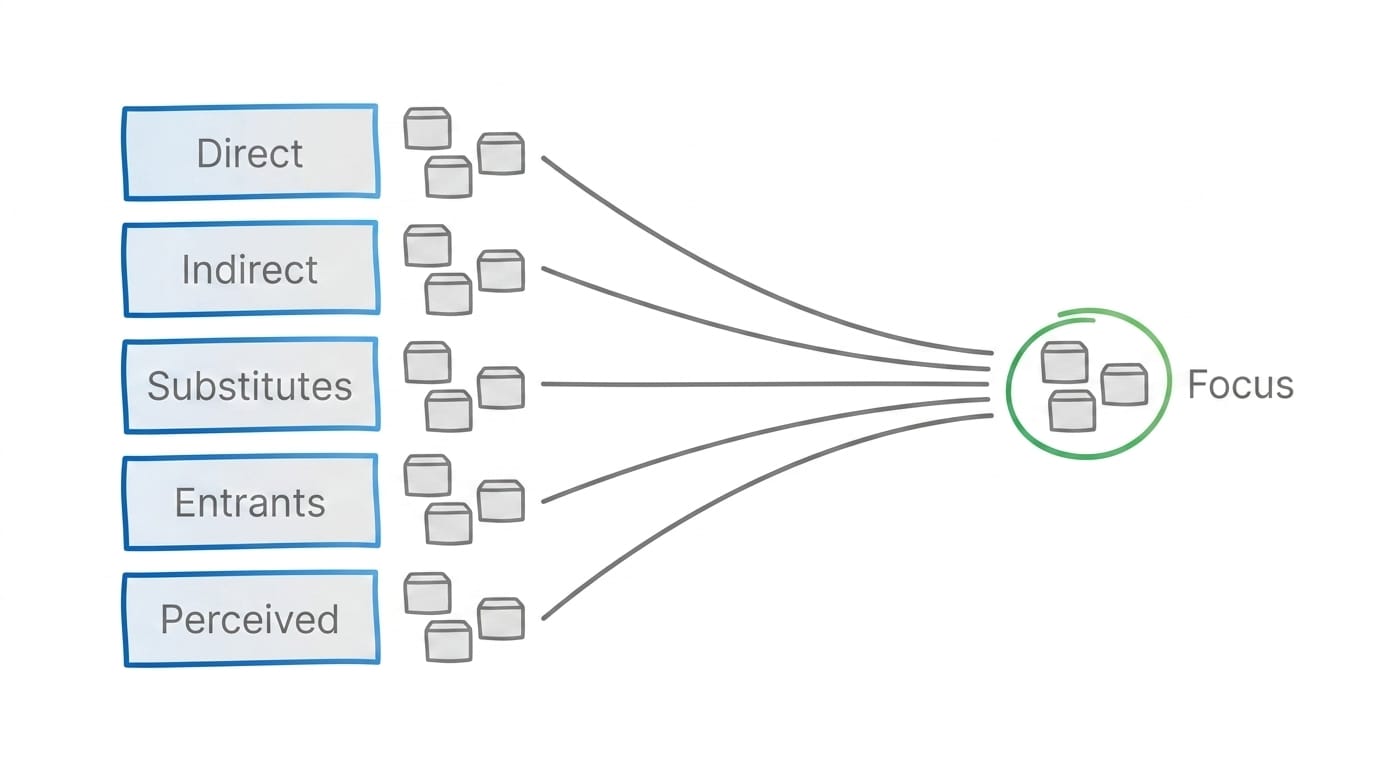
Most teams define competition too narrowly: companies that look like us. Porter's answer, from Competitive Strategy, is that competition is anyone competing for the same customer's money, and he made the categories concrete.
Direct competitors. Similar offering, same customers, comparable price. The ones you meet in deals.
Indirect competitors. A different offering that serves the same purpose for the same buyer.
Substitutes. A different way of meeting the underlying need entirely. Videoconferencing was the substitute for business travel. Include the two substitutes every team forgets: "do nothing" and "build it themselves." At Rise Vision, my previous company, which sold digital signage to K-12 schools, "do nothing" meant screens going dark, and it beat us more often than any vendor did.
Potential entrants. Porter's list here is worth keeping verbatim: firms that could cheaply jump the entry barriers, firms with an obvious synergy or extension motive, and your own customers or suppliers integrating toward you. The threat of entry shapes a market even before anyone enters.
Perceived competitors. This one comes from the team at Crayon, and it earns its place: companies you do not consider competition, but your prospects assume solve the same problem. If buyers compare you to them, they are on your field whether you agree or not. Ask your last five prospects who else they looked at. The answers will surprise you.
Narrow to the ones that matter
Everyone above goes on your list. Not everyone gets your attention. Here the experts agree on a principle and refuse to give a number: narrow by impact, not completeness. Track deeply the three to five competitors whose moves would actually change your decisions: the ones showing up in deals, the ones with the most overlap on your customers and channels, the ones with the resources to hurt you. Everyone else gets a light touch, a name on the list and an occasional glance, so a new move does not catch you blind.
If you have drawn your Market Map, you have already made this choice. The three to five competitors whose reach you mapped are your focus set. This article goes one level deeper on them.
What to know about each one
For each focus competitor, build one page. I call it the Competitor File, and it has two layers.
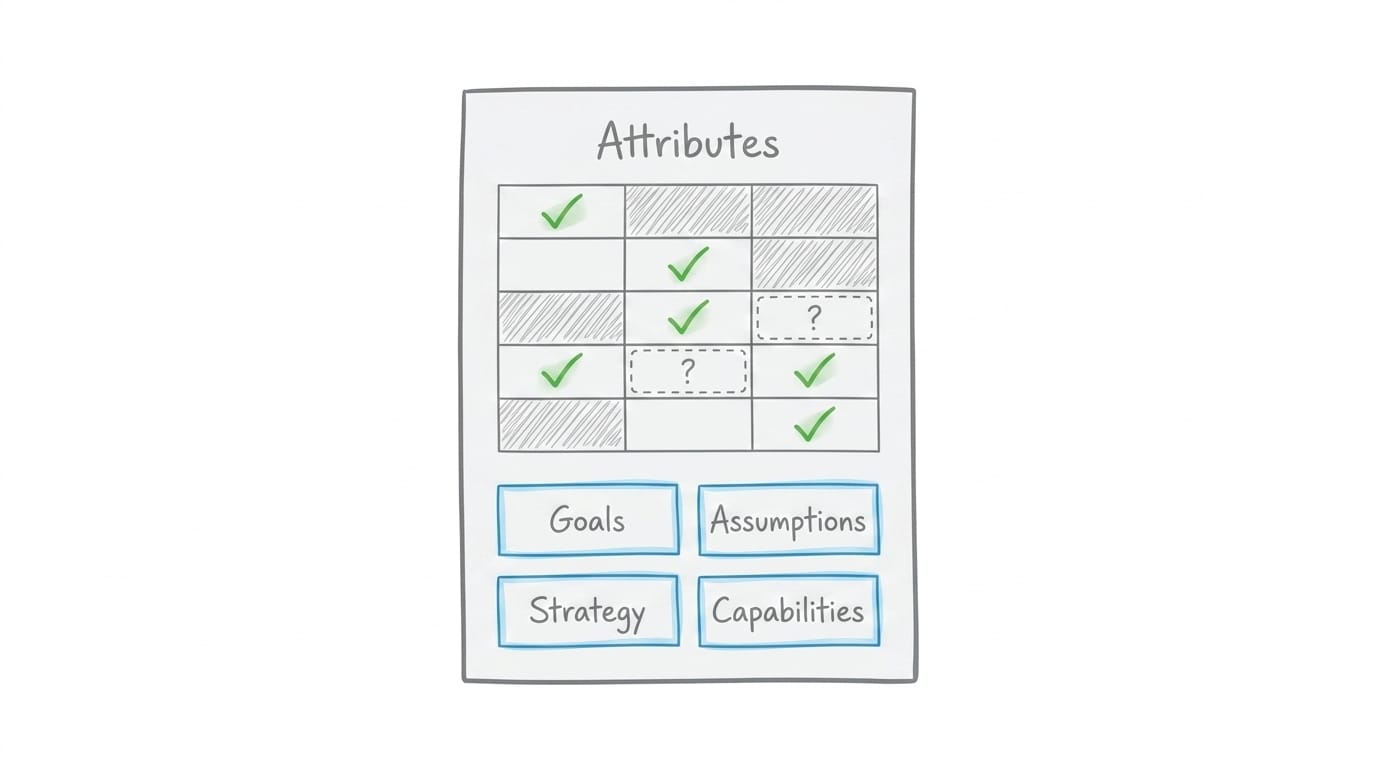
The attribute layer is the factual grid: what they sell, how they price, how they position themselves, which customer segments and channels they reach, and how they compare on the attributes your customer actually evaluates. Build the attribute rows from your customer's buying criteria, not from a feature checklist; a hundred-row feature matrix is effort disguised as insight.
The criteria are not a brainstorm. They are already written down in three places: your Core Customer's top needs, the reasons in your lost deals, and what reviewers in your category praise and complain about, in your buyers' own words. Pull the rows from there. And watch for features in disguise: "API access" is a feature; "works with the tools we already own" is a criterion.
The four corners come from Porter, and they answer the question the grid cannot: what will they do next? Four short paragraphs. Their goals: what is this competitor trying to become? Their assumptions: what do they believe about themselves and the market, and where are they wrong? Their strategy: how do they actually compete today? Their capabilities: what can they do well, and what can they not do without breaking their model?
Then the part that separates a working file from a wish: rate your confidence in every cell. Green means you have evidence: a lost deal, a customer quote, their published pricing. Yellow means informed inference. Red means folklore. The red cells are your research assignments. Nothing built on a red cell is strategy. But do not wait for an all-green file. Most cells will stay yellow, and yellow, honestly rated, is enough to decide with. Red is the only color you cannot build on. The practitioners are blunt about which evidence outranks the rest: win/loss data. What your closed-lost deals say about why customers chose them beats what anyone in your company believes.
Competitor File Builder
Walks the whole discipline above: focus set, buying criteria, the files, and the watchlists. Runs in build mode or quarterly update mode.
Keep it alive
Porter wrote something in 1980 that reads like it was written about this morning: competitor data comes in trickles. There is no annual report that tells you a rival just rebuilt their pricing page. The knowledge arrives in fragments, a job posting here, a new product page there, a lost deal with an unfamiliar name in it, and a team without a standing habit loses every fragment.
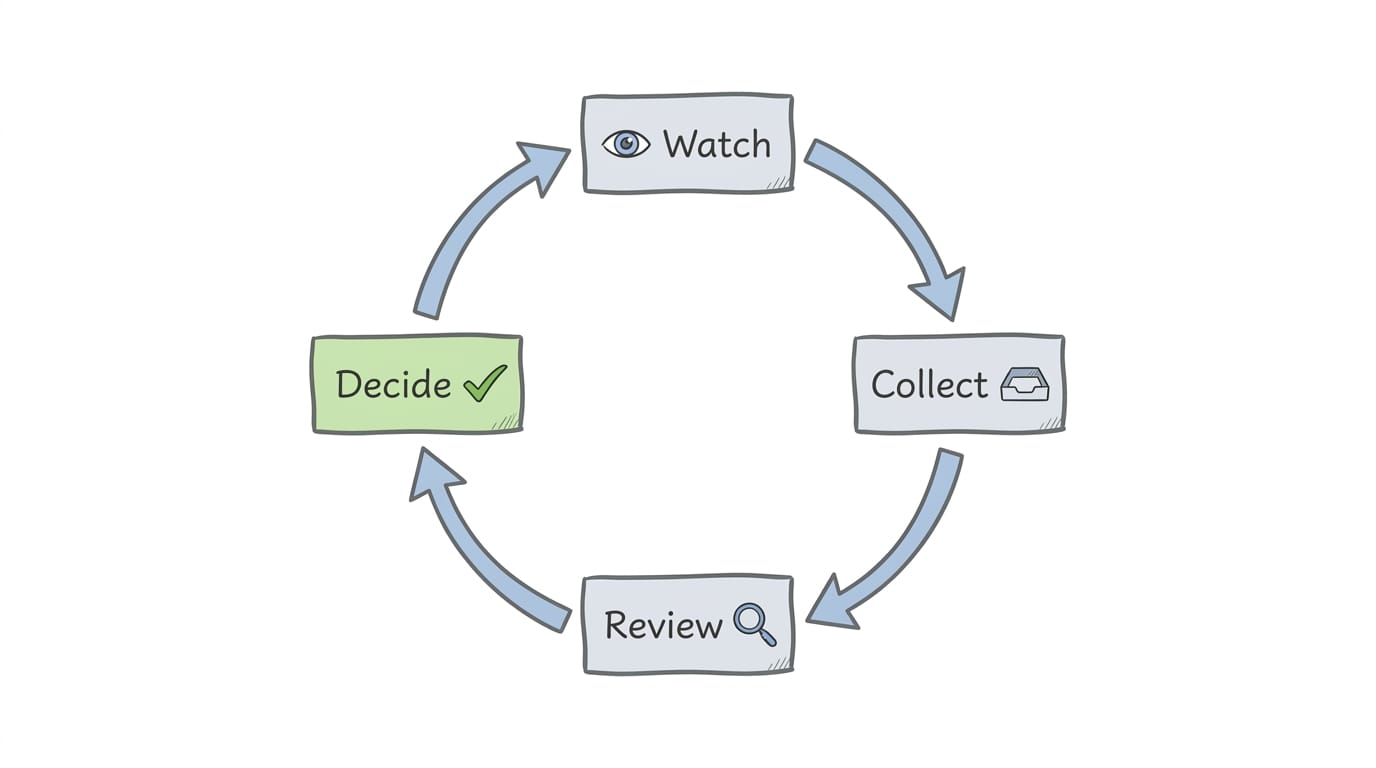
The habit does not need software or a budget. My practice: watch their websites for change, because companies announce their strategy in public whether they mean to or not. A new section on their website is a new bet. A rewritten pricing page is a repositioning. New job postings tell you what they are building next quarter. Customer reviews on the comparison sites tell you, in your buyers' own words, where they are loved and where they leak. Set the watches once, then check the trickle monthly and bring it to one place.
Then close the loop where it counts. At every quarterly planning session, alongside the Market Map review, walk each Competitor File and ask three questions. What changed since last quarter? What does it upgrade or downgrade in our confidence ratings? And what one decision does it force? That last question is the whole game. The competitive-intelligence field's own research says these efforts die two ways: the knowledge never reaches the people selling, or it informs the planning binder and never a single decision. A competitor review that does not end in a named decision, a pricing move, a positioning change, a roadmap call, or a deliberate "no change," is a hobby.
What comes next
The Competitor File feeds both of its neighbors. Backward, it refreshes your Market Map: reach lines get corrected, new entrants get boxes, and the overlap picture stays honest. Forward, it is the raw material for the next strategic picture in this series, where you will score yourself and your competitors on the attributes your customer cares about and go looking for the open space. That exercise is only as honest as the files behind it. Built on green cells it is a weapon. Built on red ones it is a mirror for your own wishful thinking.
Who are you really competing with? If your leadership team's answer is a shrug or a list of thirty, start the files. Three to five pages, honestly rated, reviewed every quarter. The first build is the real work. After that, each quarterly pass is a diff: what changed, what it moves in the ratings, what one decision it forces. That is the difference between strategy built on the field as it is and strategy built on the field as you remember it.
Competitor File Builder
Everything in this article as one guided exercise, with a quarterly update mode so the files stay alive and every review ends in a named decision.
The categories of competition, the four-corners framework, and the principle that competitor intelligence must be a standing mechanism rather than a one-time study are Michael Porter's, from Competitive Strategy (1980) and his Five Forces work in Harvard Business Review (1979). The "perceived competitors" category and the tier-your-attention practice come from the modern competitive-intelligence field, in particular the teams at Crayon and Kompyte, whose published frameworks translate Porter into working practice. The Market Map this discipline feeds is Shannon Susko's Strategic Picture from 3HAG WAY and Metronomics. The Competitor File format, the confidence-rating discipline, and the quarterly decision loop are my synthesis, informed by running competitive strategy at Rise Vision and coaching it in founder-led companies. All credit for the underlying ideas goes to the original authors. Any mistakes or distortions are mine. I strongly recommend reading the originals.
- Values - How Not To Chase Your Tail
- How to Discover Your Company's Values Using AI
- How Your Company Makes Money
- Scoreboard Day And The Weekly Leadership Review
- Compensation
- Severance
- Skip Level Reviews
- The Eight Meetings That Run Your Company
- Who On Your Team Is An A-Player?
- Where Are You Going?
- Who Is Your Most Valuable Customer?
- Competencies: The End of Personality Reviews
- Scorecards: The End of Directive Management
- Where Are You Playing?
- Who Are You Really Competing With?