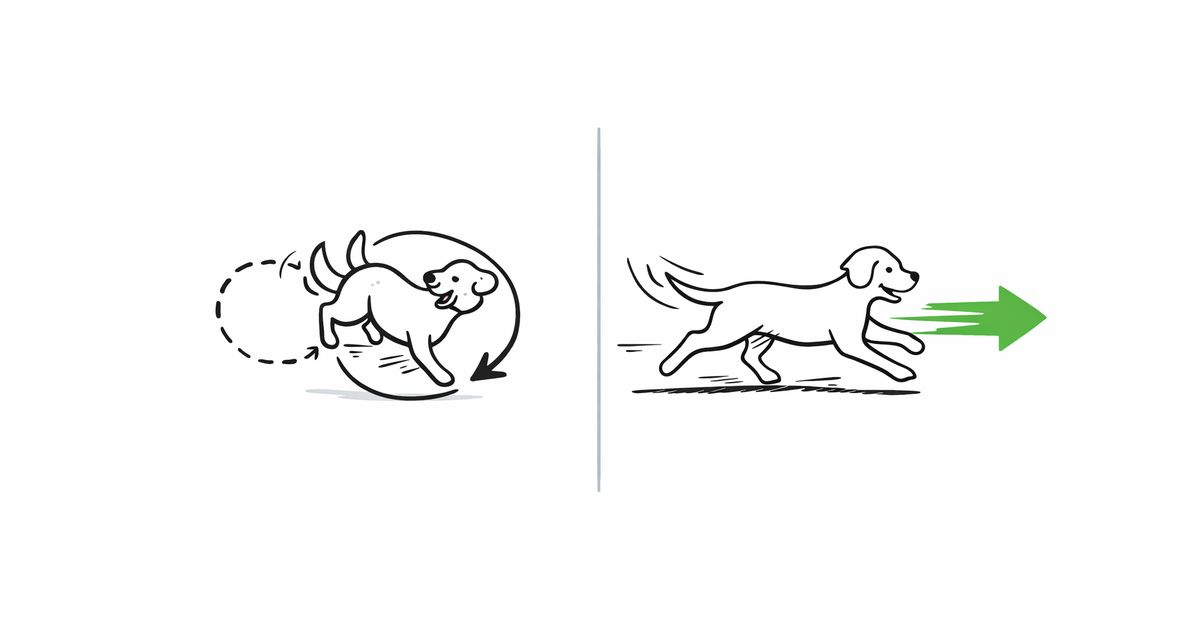
We were an amazing team. We laughed, cried, had incredible fun—and worked our asses off putting out fires together.
Sounds amazing. Yup, it was. It felt great. But we were going around in circles. The same fires kept happening. We would make some progress, then lose ground later. Everyone was tired. We were all working way too hard for too little reward. We were on a treadmill going nowhere.
Why?
No one was accountable. Everything was a priority. Our assessments were emotional and subjective. We would hire fast and take forever to fire. And I loved being the smartest person in the room, solving everyone's problems. It feels amazing to be a saviour.
If the same problems keep happening, fixing them repeatedly won’t remove the root cause. We were constantly addressing the effects and never the source of anything.
How did we fix it?
It took years of pain to learn, but the solution was surprisingly simple. I didn't figure this out alone—I borrowed and synthesized insights from brilliant thinkers who'd already solved these problems.
I'm forever grateful to Verne Harnish (Scaling Up), Shannon Susko (3HAG), Brad Smart (Topgrading), Geoff Smart (Who), Kim Scott (Radical Candor), Robert Fritz (Managerial Moment of Truth), Peter Drucker (Management by Objectives), and the coach who shone the light on all of my foibles, Sean Evans (Step Consulting). My interpretations, add-ons, and modifications of their work are just that—mine—and I am in no way affiliated with any of the above. I highly recommend that you read the works of the original authors to truly appreciate what they have put together.
To eliminate the chaos described above – or if you are smarter than I was, to never let it happen in the first place – put the following in place:
- Define company Values that give every employee clear guidelines to act independently.
- Map how cash moves through each function of your company from the customer to your bank account.
- Define each function's mission and the single critical number used to evaluate its performance.
- Name one accountable owner for each function (ideally no one owns more than 1).
- Create Scorecards for all functions.
- Publish a functional organization chart that makes accountability clear.
- Design compensation that attracts the right people and rewards success.
- Hold a weekly Scoreboard Day to identify issues and initiate correction plans.
- Run skip-level reviews every 90 days.
- Review everyone’s performance every 90 days. If a person’s critical number is off, they’re not demonstrating competence, or they’re out of alignment with the company's Values, give them 90 days to correct it.
- If they don't, unforeseen circumstances aside, move them out or into a role that better fits their skill set.
- Where Are You Going?
- Who Is Your Most Valuable Customer?
To make sure that you hire the right people in the first place, use Topgrading for all employee hires. Take the time to define exactly what you want and hire slowly. Follow every step of the Topgrading process to maximize the best chance that you have the right person. Be explicit about how you’ll know within the first 90 days that it’s working.
The hardest change was me.
I loved problem solving. I loved having all of the answers. And I loved my ideas. It felt incredible to be the person everyone turned to, the one who could solve anything. Being the saviour is addictive.
But every time I solved someone's problem, I was creating a bigger one. I was taking ownership of what they were supposed to do and placing it squarely on my shoulders. I was working 60+ hours a week and burning out, while my team wasn't growing.
I had to fundamentally change my approach. Instead of solving everyone's problems, I had to learn to ask questions that helped them discover their own solutions. I had to stop talking and telling, and start asking. Letting go of being the hero was one of the hardest things I've done.
I never achieved mastery, but I did get better. That incremental improvement had an oversized return on investment—my involvement dropped from 60+ hours a week to just 10. More importantly, my team became stronger, more capable, and truly accountable.
If someone's performance is lacking, and through coaching they can't find the answers and independently execute on them, and you end up telling them what to do, or worse, doing what they should be doing, you have the wrong person. Make changes fast. Don’t overthink. Just get it done.
This degree of accountability and transparency isn’t for everyone. We saw high turnover in the first year of employment; if they stayed past that point, they were there for the long run.
Lastly, and most importantly, you as the founder and leader have to sign up for this. You have to be vulnerable and transparent and live by the same rules you ask everyone else to follow. If you don't, spending time on all of this is for naught. No one will follow you or take this seriously if you don’t walk the talk.
These principles transformed our organization from a chaotic, reactive team into one that operates with clarity and purpose. The same fires stopped recurring. People knew what they owned and what was expected of them. We built a system that scales.
A-Player Team Assessment Prep
Get a structured assessment of your team's alignment with your values and accountability standards. 15-30 min.
Starting With Values
Values define how you and your team operate in your business. They create the behaviour framework that guides every decision and action within your organization. Well-defined Values empower your team to make decisions independently.
Why Values Matter
There's a considerable gap between what you want your business to be and the thousands of daily decisions and actions that ultimately determine what it becomes. Values bridge this gap by establishing clear principles for how decisions should be made.
Rules are complicated, typically long and boring, often legal in nature, and easily forgotten. Rules cause "this is the way we have always done it", "that's against the rules" - so people hide in mediocrity behind them. A few Values and guiding principles are hard to forget, inspire the good and creative in all of us, and don't come with the expense of having a lawyer review them. It comes down to what you want; limitations or inspirations; rules or Values?
This distinction captures the fundamental difference in approach. Rules create boundaries people work within (or find ways around). Values, when properly articulated and embedded, create a framework people work from. Rules tell people what they can't do; Values guide people in what they should do.
The most agile, innovative, and purpose-driven organizations don't eliminate rules entirely—some regulatory and legal requirements will always exist. However, they minimize rule-based management in favor of values-based guidance that inspires rather than limits. With well-defined Values:
- Decision-making becomes distributed yet consistent
- New team members integrate faster
- Customers experience a coherent brand
- Leadership can focus on strategy rather than operations
- Intentions become embedded in daily actions rather than remaining abstract
Effective Values share characteristics that make them operational rather than aspirational:
- They're actionable - guiding specific behaviours and decisions
- They're distinctive - real choices that differentiate you from others
- They're memorable - simple enough to recall in the moment of decision
- They include examples - clear illustrations of the Value in action
- They're limited in number - focus on 3-5 core Values (not 10+)
- They create tension - true Values involve trade-offs and difficult choices
- They're consistently applied - true across all situations
- They’re decision-driving - they guide your behaviour just as much as your team's
To determine if a Value is authentic rather than aspirational ask yourself:
- Would you maintain this Value even if it became a competitive disadvantage?
- Are you willing to hire and fire based on this Value?
- Do you demonstrate this Value consistently, even when difficult?
- Would your team identify this as a Value without being prompted?
Creating Your Values Framework
Values can be discovered rather than invented. They often already exist in your organization's behaviours, especially in:
- How you make difficult decisions
- What you celebrate and reward
- What behaviours frustrate you in others
- The traits of your most successful team members
- The principles you won't compromise on, even when costly
Once identified, make each of your 3 to 5 Values easy to understand and use by giving them:
- A clear, concise statement of the Value (1-3 words ideally)
- A single sentence explanation
- Three levels of behaviour examples showing:
- A person who exemplifies this Value
- A person who partially understands this Value
- A person who acts against this Value
- 3-5 guiding questions this Value would "ask" to help you and your team make decisions
An example of a well-defined Value is:
Own the Outcome - We take full responsibility for results rather than focusing on effort or intent.
- Exemplifies the Value: You see a project falling behind and proactively communicate with all stakeholders, reorganize priorities, and develop alternative solutions before anyone asks.
- Partially understands the Value: You complete your assigned tasks but stop there, not considering how your work impacts the overall project’s success.
- Acts against the Value: You blame delays on external factors and respond "I did my part" when a project fails.
Guiding questions this Value would ask:
- Am I taking responsibility for the end result, or just my part of the process?
- If this doesn't work as planned, what alternative solutions can I prepare now?
- Have I communicated potential issues early enough for us to address them?
- Am I measuring my success by customer outcomes or my activities?
- Have I considered secondary and indirect effects of my work and addressed them?
Values act as your constant presence when you're not in the room. Each Value is a distinct "voice" or "persona" with a specific perspective to contribute to any decision.
When team members face decisions, they can mentally consult this invisible board, asking what each Value-persona would advise. This transforms abstract principles into practical guidance, creating consistency without requiring your direct involvement.
This approach also reinforces that Values aren't optional or situational—they represent the collective wisdom that guides your company, including you as the owner. No single person, regardless of position, can override these Values without undermining the entire system.
A-Player Team Assessment Prep
Run the prompt to evaluate each team member against your values framework and identify coaching priorities. 15-30 min.
Implementing Values in Your Organization
To move Values from documented to operational, integrate them into every situation possible:
- Hiring processes - screen candidates for Values alignment
- Onboarding - teach new hires how Values guide decisions
- Recognition - celebrate team members who exemplify Values
- Review processes - evaluate performance against Values
- Meetings - reference Values in decision discussions
- Leadership modeling - demonstrate Values-based decisions visibly
As a leader, you must be the primary model of your Values in action. Beyond personal behaviour, deliberately incorporate Values into every discussion across all levels of meetings:
- Begin leadership team meetings by highlighting a recent example of a Value in action
- Frame strategic decisions explicitly in terms of how they align with specific Values
- Include a "Values moment" in your weekly team reviews where someone shares how a Value guided their work that week
- Analyze successes and failures through the lens of Values adherence during monthly reviews
- Require the same Values-centred approach from your entire leadership team
When leaders consistently reference Values as decision-making tools rather than abstract concepts, team members understand these principles are truly operational, not wall decorations or marketing material. This consistent reinforcement transforms Values from aspirational statements into your organization's operating system.
To ensure Values remain operational rather than aspirational, train your team to use a simple process for Values-based decisions:
- Identify the decision or action required
- Consider which Values apply to this situation
- Use the decision questions associated with those Values
- Make the decision and explain the Values-based reasoning
Include Values in your quarterly Scorecard reviews. Use them to evaluate how well team members embody each Value and when someone is out of alignment, identify the corrections required by the next Scorecard review. By connecting Values to performance evaluation, you send a clear message that "how" work gets done matters as much as "what" gets accomplished.
Values Evolution
Values should remain relatively stable but may evolve as your business matures. Signs of healthy Values evolution include:
- Refinement of language to increase clarity and actionability
- Better examples based on real experiences
- More nuanced understanding of how Values apply in different situations
- Occasional reprioritization of Values as your business context changes
Signs that you're wavering rather than evolving include:
- Frequently adding new Values
- Ignoring Values when they become inconvenient
- Different Values for different departments or situations
- Significant changes in core Values without corresponding changes in business direction
Review your Values annually to ensure they remain authentic and operational.
Your Values create the consistent behaviour framework that guides your leadership and empowers your team to make independent decisions without constant direction - a board of directors in your absence and an omnipresent guide for your employees - that brings wisdom to every situation you all face. When properly defined and consistently reinforced, Values become the invisible operating system that allows your business to scale while maintaining its essential character.
A-Player Team Assessment Prep
Walk away with a clear picture of who on your team is living the values and where to focus your leadership energy. 15-30 min.
In subsequent posts I will share the remaining tools and processes we used to transform our organization from no accountability and constant firefighting into one that operated with intention and could scale. These “how to not chase your tail” practices will include:
- Values
- How Your Company Makes Money
- Scoreboard Day
- Scorecards
- Skip-Level Reviews
- Scorecard Reviews
- Compensation
- Scorecards
Get new articles by email.
Subscribe