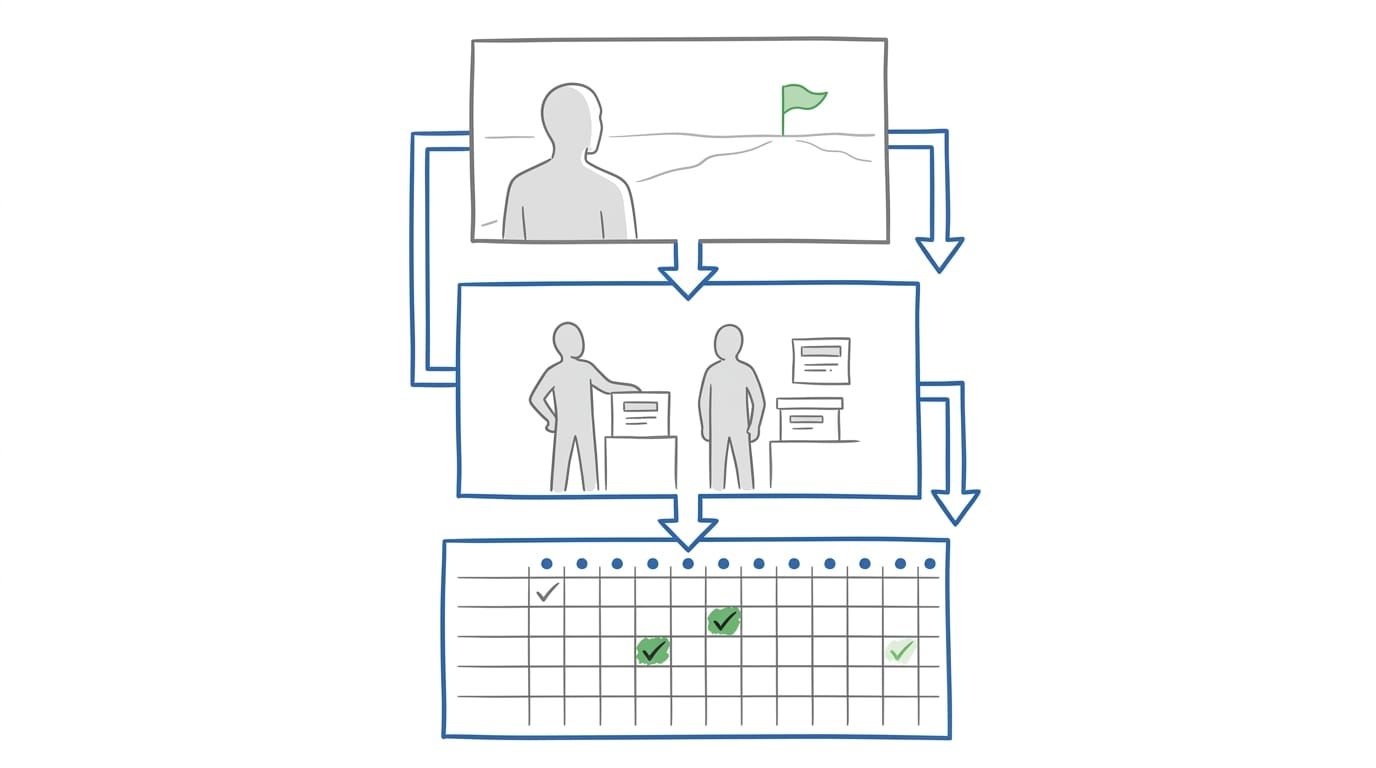
Most founders have a big vision and a to-do list. Nothing in between.
The vision says something like "build a $50M company" or "become the market leader in our space." The to-do list says "hire two salespeople" and "fix the onboarding process." Both are real, but neither connects to the other.
Strategy usually stalls in the gap between the ten-year ambition and Monday morning. Not because the founder lacks ambition or discipline. There is simply no structure connecting the two.
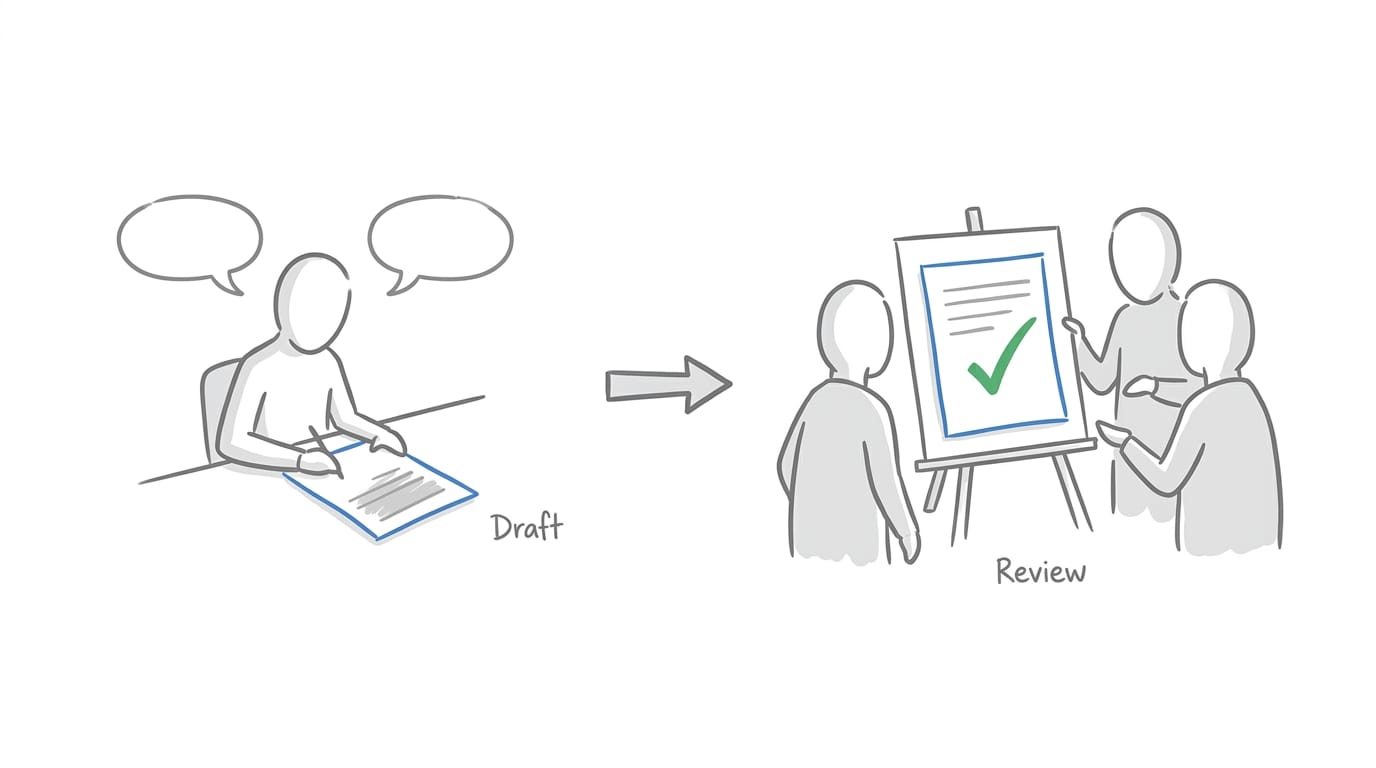
The planning cascade fills that gap with four connected plans at four time horizons. If you already understand the concept and want to start building, the Planning Cascade Builder can interview you question by question and produce a draft to bring to your team. What follows explains the principles behind it.
Planning Cascade Builder
A question-by-question interview that drafts a cascade you can bring to your team.
Definitions
A few terms recur throughout this article, and one underpins the rest: the widget. A widget is a non-financial operating measure the business can count. Some accumulate over a period, such as new customers, contracts signed, or projects delivered. Others are a point-in-time balance, such as active clients or headcount.
The Big Hairy Audacious Goal [BHAG] is a concept from Jim Collins and Jerry Porras in Built to Last. It is a 10-to-30-year goal with no numbers. Just a destination the whole company can believe in and align to. If you have not yet defined yours, Why Does Your Company Exist? walks through the process.
The 3 Year Highly Achievable Goal [3HAG] is Shannon Susko's framework. It describes where the company needs to be in three years to stay on track toward the BHAG. It includes fiscal targets, widget commitments, key capabilities, a statement of the company's future position, and what it wants to be known for.
The word "achievable" is deliberate. The BHAG is the moonshot. The 3HAG is the next leg, close enough for the team to see and believe in.
The 1 Year Highly Achievable Goal [1HAG] translates the first year of the 3HAG into fiscal targets, widget commitments, corporate priorities, measures of success, and owners.
The Quarterly Highly Achievable Goal [QHAG] breaks one quarter of the 1HAG into month-over-month targets and priorities. The 13-Week Sprint is the execution layer beneath it. It turns each quarterly priority into weekly deliverables, with one real deliverable per priority in every active week and no blanks between active weeks.
The four horizons
The four horizons form a cascade. Context flows down. The 3HAG frames the annual plan, the annual plan frames the quarter, and the quarter frames the sprint.
Validation flows up. Building each level tests the one above it. A three-year goal you cannot translate into this year's numbers is not a plan yet.
Where do you want to be in three years? Good. What has to be true this year to be on track? Good. What has to be true in the next 90 days? Good. What ships this week? That is the cascade.
The gap between where you are and where you said you want to be creates forward energy. Robert Fritz calls it structural tension. The cascade makes that gap visible at every zoom level.
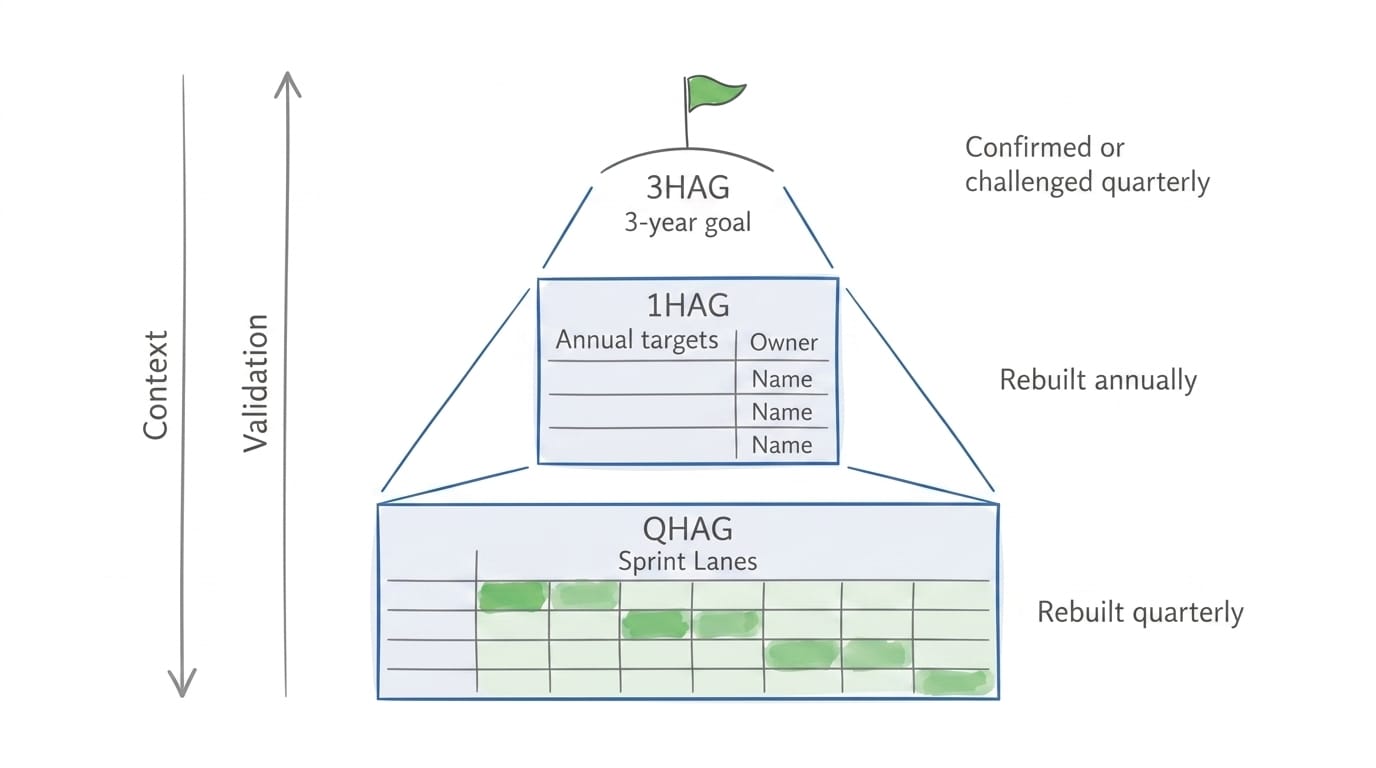
Remove a level and the ones below tend to lose direction. A quarterly plan without a 3HAG slides easily into a task list. Weekly deliverables without a quarterly plan become busywork. A 3HAG without a quarterly plan risks staying a poster on the wall.
Do the KFFM first
The cascade does not invent its own units. The Key Function Flow Map [KFFM] defines the widget vocabulary: the countable things moving through the functions of your business from lead to cash.
Profit/X is the one unit of measurement that best captures how the company makes money, such as profit per customer, transaction, or project. It picks its X from those flows.
The Functional Accountability Chart [FAC] gives each widget one accountable owner. All three are covered in the same article, along with the full KFFM process.
So the order matters. Do the KFFM first. This is a strong recommendation, not a hard requirement.
The KFFM gives you real widgets tied to the real functions of your business. You can draft a cascade without one, but every widget remains provisional until it reconciles to the KFFM. The cascade sets quantities and timing for those widgets. It does not invent new ones.
When the cascade and the KFFM diverge, flag the gap and resolve it deliberately. Sometimes the cascade is wrong. Sometimes the KFFM is wrong.
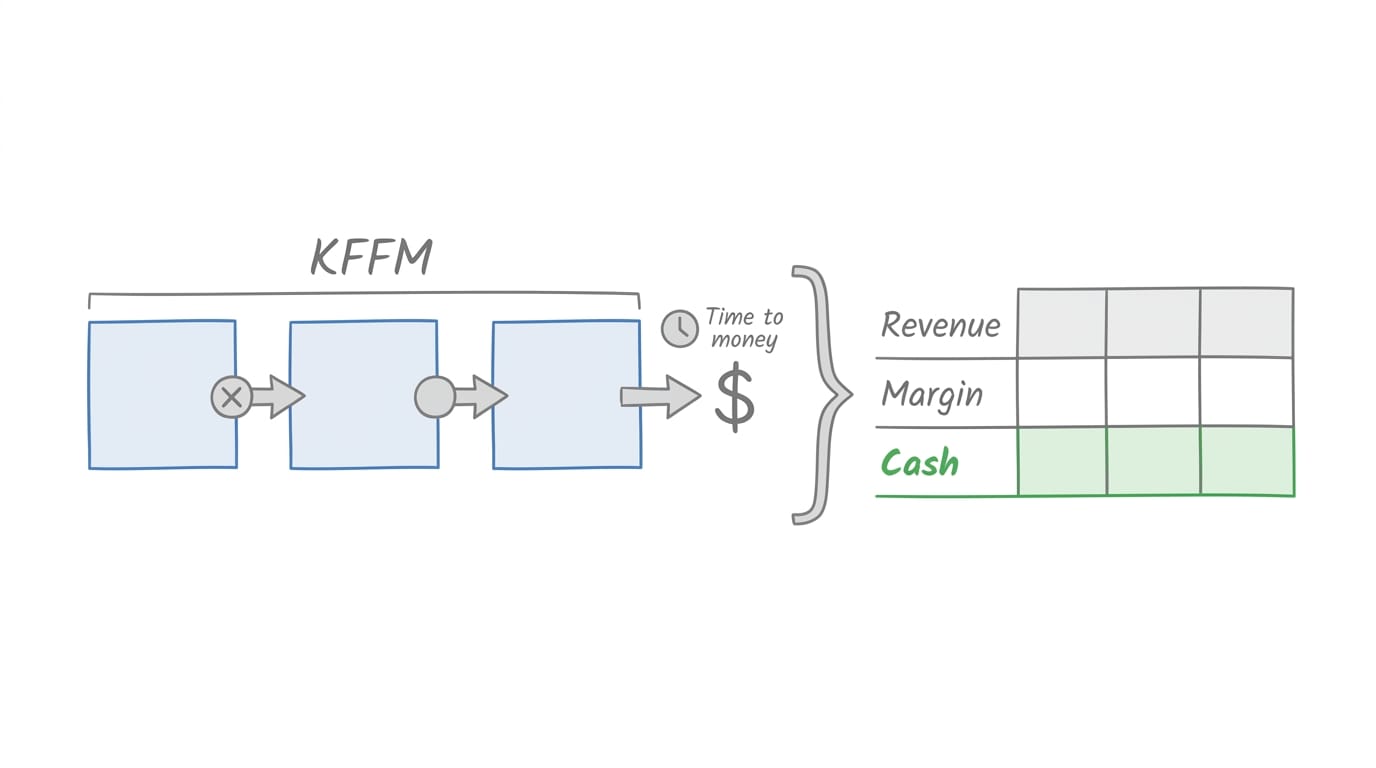
One company I coach had defined its X as the recurring client, but the recurring client was not tracked anywhere. The fix was not abandoning the X. It was adding the missing flow to the KFFM and giving it a target at every horizon.
Building the cascade
The leadership team builds the cascade by answering questions, one horizon at a time. Each leader answers alone before anyone shares. The first answer spoken, usually the CEO's, anchors the room. The disagreements that surface when everyone has written independently are the most useful part, because they expose the assumptions each person was making.
One company runs through the rest of this article to make each horizon concrete: Brightwater Filtration, a commercial water-filtration service business whose X is the active service account.
The 3HAG
Six questions.
- What is the fiscal year-end date, three years from now?
- How much cash do you want in the bank on that date, and what is your topline revenue for the year ending on it? And the third number, my addition: what profit margin will that revenue carry? At Paradata, the company Shannon Susko built and sold, the team agreed on $2M cash and $20M revenue; the original exercise stopped there, and the margin line is the one I add.
- What widgets are needed to achieve that cash and revenue? Same widgets as the KFFM, the X among them, each with the number it must hit.
- What will the company be in three years? One sentence, no numbers.
- What are the 3 to 5 key capabilities needed to deliver on all of the above? Your first answers here will be rough, and that is expected: later strategic work will sharpen them. The draft comes first; the tools revise it. Write them down and move on.
- What do you want to be known for in three years, in the customer's voice?
Questions 4 and 6 are judgment calls, not data problems. The tests for good answers come below.
Shannon's original 3HAG exercise stops at the numbers. I add one step before moving on: assign one owner to cash, revenue, margin, and each widget, including the X. Different widgets can have different owners. The owner rule starts here, not at the annual plan.
Her most persistent teaching point applies to the numbers: good enough, not perfect. If the team is debating whether revenue should be $18M or $22M, choose the target with a credible path and move on. Good enough means documented and backed by math, not unexamined.
The widgets provide that math. They reconcile the plan with the fiscal targets. Move that many widgets, at the revenue and cost each carries, and you should land on the fiscal numbers. If the widget quantities do not produce those numbers, one of them is wrong. Fix it now, not in year two.
The original exercise asks for two fiscal numbers. I add a third beside revenue and cash at every horizon: net profit margin, or profit after all costs as a share of revenue. Margin tests whether the company makes enough money to fund the growth it has committed to.
Cash reconciles to profit. Profit on paper does not fund growth. Cash in the bank does. The KFFM already measures the distance between the two as time to money.
Ask whether the plan realizes profit in the bank fast enough to fund the growth you want. A healthy margin collected slowly can starve a plan as surely as a thin one.
Then test what the numbers imply. Examine the required revenue growth, the sales and marketing investment needed to fund it, and what must change to hit the cash target. Compare the plan with your industry. A margin far outside the typical industry band needs a structural explanation. Then walk the path and define what year two must look like for year three to be credible.
Things to watch for on the 3HAG.
Capabilities are engines, not results. A capability is something the company must be able to do that it cannot fully do today. "Bring in new clients consistently" is a result. The engine behind it is a marketing and sales system that generates qualified leads every month without leaning on the founder's network.
A capability is something you build, not something you buy. It is an internal strength the company must develop, not a role you hire or a tool you purchase. If the list reads like outcomes, it is not a capability list yet.
The statement is a decision filter. It is not your Core Business. The one-sentence statement names the position you are growing into.
Two tests matter. First, it must help you hold up a real choice and get a clear yes or no. If you cannot use it to say no, it is not a filter yet.
Second, it must differ from your Core Business statement, which names what the company is today. Repeating the Core Business, sometimes with a revenue figure attached, gives you a description rather than a destination.
Known-for is the customer's voice. It is the sentence a happy client would say about you to a peer, in their words rather than yours. Shannon Susko's team at Paradata answered "Making payments EASY."
It is not a tagline or a claim you make about yourself. The statement is your decision filter. Known-for is the reputation that filter should earn. Test each decision by whether it earns that reputation.
The X is a tracked widget. If you have defined your Profit/X, the X must have a three-year target. An X the plan does not track is a strategy the plan cannot see.
For Brightwater, the three-year picture landed at $18M revenue, 14% margin, and $2.25M cash, on 1,200 active service accounts as the X. Marcus owns revenue, Priya margin, Tom cash, Elena the accounts. The statement: "The filtration partner facilities call first when clean water cannot fail." One capability behind it: a two-day install standard any certified crew can hit.
Brightwater's 3HAG
Three years ending December 31, 2028
| Area | Owner | Target |
|---|---|---|
| Revenue | Marcus Bell | $18,000,000 |
| Profit margin | Priya Nair | 14% |
| Cash | Tom Alvarez | $2,250,000 (about three months of base cost at the $18M run-rate) |
| Widgets (X) | ||
| Leads | Marcus Bell | 1,440 / year (120 / month) |
| Site surveys | Elena Cho | 600 / year (50 / month) |
| Signed contracts | Marcus Bell | 360 / year (30 / month) |
| Active service accountsthe X | Elena Cho | 1,200 active accounts at year-end |
3HAG statement
The filtration partner facilities call first when clean water cannot fail.
Key capabilities
| # | Capability we must build inside the company |
|---|---|
| 1 | A repeatable outbound and referral engine that fills the pipeline without the founder. |
| 2 | A two-day install standard any certified crew can hit. |
| 3 | A recurring-service platform that renews itself and flags at-risk accounts early. |
| 4 | A regional depot model that puts a technician within two hours of every account. |
Known for
| In the customer's words | |
|---|---|
| "They never let our water go down, and we barely have to think about it." | |
The 1HAG
Seven questions.
- What is your gross revenue for the upcoming fiscal year, and what profit margin will it carry?
- How much cash will be in the bank on the last day of the year?
- How many of what widgets make those numbers true?
- Who owns revenue, margin, cash, and each widget line, the X among them? One name beside each.
- What is the number one corporate priority that makes the greatest contribution to those numbers and moves the company a year closer to the 3HAG? Name the 3HAG capability it builds, copied word for word, and its measure of success. The capabilities are what deliver the numbers; the priorities are how the capabilities get built.
- What are the remaining priorities, up to two more (three total, maximum)? Each one names the capability it builds and its measure of success.
- Who owns each priority? One name per priority.
Then one closing question: what is the single biggest issue facing the business this year, and which priority addresses it? It carries real weight. If cash is the number one issue and none of the priorities is a cash or collections priority, the plan is ignoring its own diagnosis.
Measures of success on priorities are my addition, not Shannon's. A measure verifies the result rather than merely confirming completion. It defines the metric, target, and timing.
The priority is the work. Done means the work was checked off. The measure proves the work produced a result.
Ideally, the measure is a function's critical number from the KFFM. That lets the existing instrument verify the result instead of creating a new metric for the plan. If no function's number captures the intended result, either the measure is wrong or the machine is missing a gauge.
A completed priority with an unmoved measure produced activity, not a proven result. That gap deserves a hard look.
Aim for at most three priorities, including the number one. Three is the ceiling, not the target. Three priorities executed well beat five executed halfway.
Morten Hansen calls this "do less and obsess" in Great at Work. At Rise Vision, my previous company, moving from five or six priorities to three was one of the hardest disciplines to enforce and one of the most valuable.
The ideas that survived the cut got the team's full attention. The shelved ideas remained available at the next annual plan. If they still mattered, they made the cut.
Things to watch for on the 1HAG.
One name per line. Revenue, margin, cash, and each widget have exactly one owner at every horizon. The X carries an owner like every other widget. The unowned widget is the most common gap I see.
Priorities and capabilities must cover each other. A priority tied to no capability is either building something the 3HAG missed or drifting from the plan. Either way, name it.
Every priority must advance a capability. In the other direction, any capability not being built this year must be explicitly staged for a later year. Nothing falls through the cracks. Every capability is either built now or consciously deferred.
The numbers must reconcile, not just the names. Matching widget names across horizons is not enough. The quantities must agree.
I have seen an annual plan call for 25 qualified leads a month while the three-year and quarterly plans said 20. Nobody had decided which was right.
Brightwater's first year set $7.2M, 11% margin, and $850K in cash on 520 active accounts. The priority that carries our running example, Elena's, is to certify crews to the two-day install standard, the 3HAG capability of the same name, measured by two-day install completion moving from 60% to 90% across three crews by year-end.
Brightwater's 1HAG
One year ending December 31, 2026
| Area | Owner | Target |
|---|---|---|
| Revenue | Marcus Bell | $7,200,000 |
| Profit margin | Priya Nair | 11% |
| Cash | Tom Alvarez | $850,000 |
| Widgets (X) | ||
| Leads | Marcus Bell | 720 / year (60 / month) |
| Site surveys | Elena Cho | 300 / year (25 / month) |
| Signed contracts | Marcus Bell | 216 / year (18 / month) |
| Active service accountsthe X | Elena Cho | 520 active accounts at year-end |
Annual company priorities
| # | Priority | Owner | Measure of success | Connection to 3HAG |
|---|---|---|---|---|
| 1 | Stand up the outbound and referral engine | Marcus Bell | Improve qualified leads from 30 to 60 a month (half from referral) by December 31, 2026 | A repeatable outbound and referral engine that fills the pipeline without the founder. |
| 2 | Certify crews to the two-day install standard | Elena Cho | Improve two-day install completion from 60% to 90% across three crews by December 31, 2026 | A two-day install standard any certified crew can hit. |
| 3 | Launch the recurring-service platform | Priya Nair | Improve accounts on auto-renew from 40% to 95% (churn under 5%) by December 31, 2026 | A recurring-service platform that renews itself and flags at-risk accounts early. |
The QHAG and 13-Week Sprint
The QHAG applies the 1HAG structure month by month within the quarter. It tracks the same fiscal measures and widgets, with clear ownership. It also narrows the annual priorities into quarterly priorities with their own owners and measures of success.
Each quarterly priority must advance a 1HAG priority. In the other direction, every annual priority must either move forward this quarter or be explicitly staged for a later quarter. This keeps deferral conscious rather than silent.
Each quarterly priority gets a 13-week Sprint Lane. The lane turns the priority into one concrete deliverable for every week it remains active. Its owner stays with it from the QHAG.
"Homepage wireframe approved" is a deliverable. "Continue working on the new website" is not. At Rise Vision, we called this "rocks only, no sand." If the work would happen anyway without a lane, it does not belong.
A deliverable does not have to be a shipped artifact. A decision made, test run, result verified, dependency cleared, or checkpoint can all count. It only has to be real and checkable.
Avoid blank weeks while the priority is active. A priority that finishes before week 13 can be marked complete. A live priority that cannot name real weekly work is either too vague or too small to warrant a lane.
The Sprint also carries a weekly target for the X across all 13 weeks. The owner is the same person who owns the X on the QHAG.
Things to watch for on the QHAG.
Cash appears monthly, not only at quarter end. A single quarter-end figure hides two thirds of the quarter. Cash is almost always the first row to go missing.
The measures reconcile according to what they represent. Revenue accumulates across the three months. Cash is the ending balance rather than a sum. Profit margin is blended according to revenue rather than treated as a plain average. Widgets follow the same flow-or-stock distinction.
No lanes means no early warning. Each quarterly priority has its own measure of success, as it does in the annual plan. Sprint Lanes are not that measure. They show the weekly work required to achieve it.
A QHAG without Sprint Lanes has no weekly path. You may not know it is off track until the quarter is over. The lanes tell you early.
Done and worked are different questions. At quarter end, ask whether the work was completed and whether the measure of success moved. The Sprint Lanes answer the first question week by week.
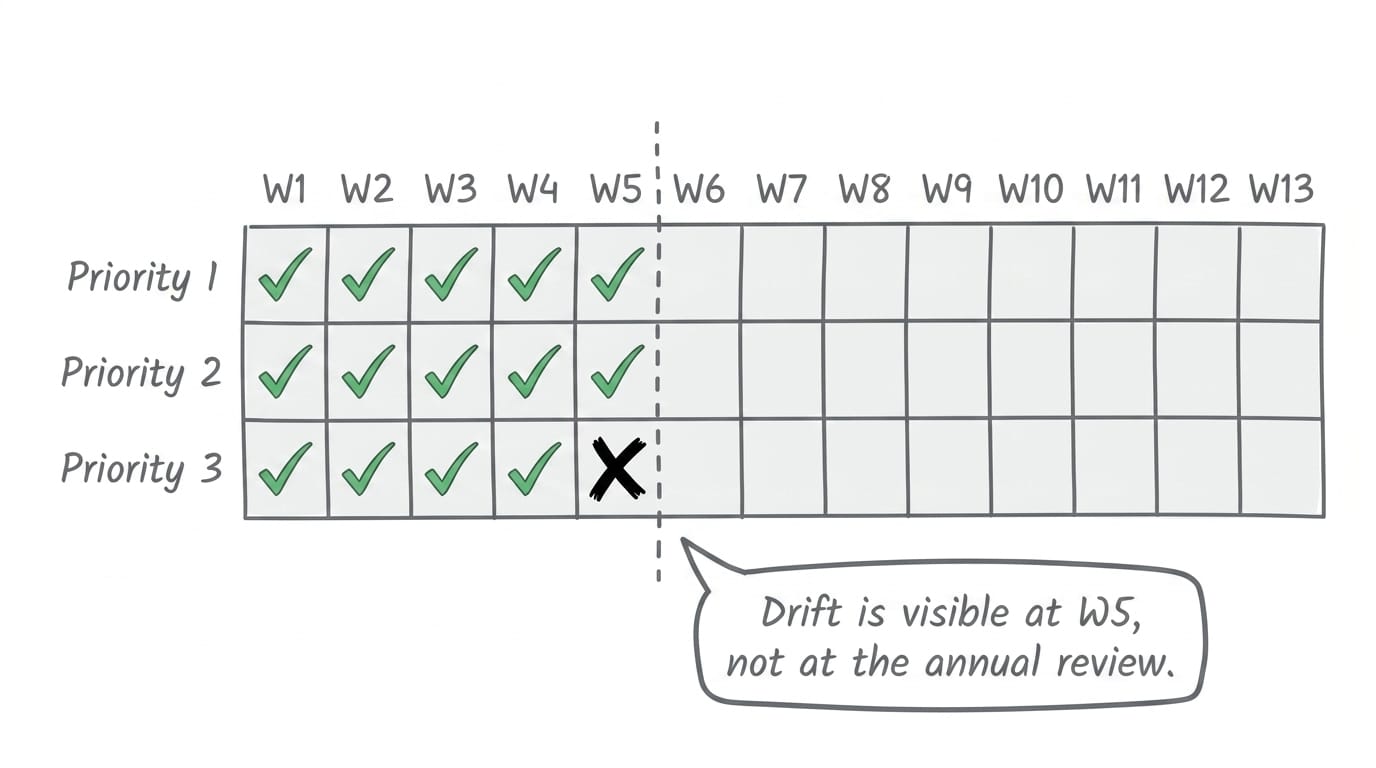
All-green lanes with an unmoved measure signal a need to review the work, the measure, the timing assumption, or the causal model behind it. They do not call the effort into question. Completing the work and closing the gap are different things. Check both.
In Brightwater's third quarter, revenue ran $520K, $560K, $600K and active accounts climbed 415, 445, 480. Elena's lane, certify crews 2 and 3 to the two-day standard, ran from "two-day standard doc finalized" in week 1 through "Crew 2 trained on the standard" in week 2 to "September install audit signed off" in week 13, with her weekly active-account target rising underneath it the whole way.
Brightwater's QHAG
Quarter ending September 30, 2026
| Area | Owner | Month 1 · Jul | Month 2 · Aug | Month 3 · Sep | Quarter total |
|---|---|---|---|---|---|
| Revenue | Marcus Bell | $520,000 | $560,000 | $600,000 | $1,680,000 |
| Profit margin | Priya Nair | 9% | 10% | 11% | 10% (blended) |
| Cash | Tom Alvarez | $610,000 | $640,000 | $700,000 | $700,000 (end of quarter) |
| Widgets (X) | |||||
| Leads | Marcus Bell | 45 | 50 | 55 | 150 |
| Site surveys | Elena Cho | 22 | 25 | 28 | 75 |
| Signed contracts | Marcus Bell | 20 | 22 | 24 | 66 |
| Active service accountsthe X | Elena Cho | 415 | 445 | 480 | 480 (end of quarter) |
Quarterly company priorities
| # | Priority | Owner | Measure of success | Connection to 1HAG |
|---|---|---|---|---|
| 1 | Ship the outbound sequences and book referral partners | Marcus Bell | Improve qualified leads from 35 to 55 a month (20 from referral) by September 30, 2026 | Stand up the outbound and referral engine. |
| 2 | Certify crews 2 and 3 to the two-day standard | Elena Cho | Improve two-day install completion from 70% to 90% by September 30, 2026 (crews 2 and 3 pass the two-day audit) | Certify crews to the two-day install standard. |
| 3 | Go live with auto-renew on the service platform | Priya Nair | Improve accounts on auto-renew from 180 to 300 by September 30, 2026 | Launch the recurring-service platform. |
Brightwater's 13-Week Sprint Lanes
Quarter ending September 30, 2026. One binary deliverable per priority per week, no gaps.
| Week | Widget metric: active accountsowner: Elena Cho | P1 · Outbound & referral engineowner: Marcus Bell | P2 · Two-day install standardowner: Elena Cho | P3 · Auto-renew service platformowner: Priya Nair |
|---|---|---|---|---|
| W1 · Jul 6 | 417 | Sequence copy drafted | Two-day standard doc finalized | Platform vendor confirmed |
| W2 · Jul 13 | 420 | CRM sequences built | Crew 2 trained on the standard | Account data migrated to platform |
| W3 · Jul 20 | 424 | First 200 prospects loaded | Crew 2 shadow install done | Auto-renew flow configured |
| W4 · Jul 27 | 428 | Sequences live to segment A | Crew 2 first solo two-day install | 25-account auto-renew pilot live |
| W5 · Aug 3 | 432 | Referral partner list built | Crew 2 audit passed | Pilot billing verified |
| W6 · Aug 10 | 437 | 5 referral partners pitched | Crew 3 training scheduled | At-risk flag rule built |
| W7 · Aug 17 | 442 | 3 partner agreements signed | Crew 3 trained on the standard | 100 accounts migrated |
| W8 · Aug 24 | 448 | Segment B loaded and live | Crew 3 shadow install done | Renewal emails automated |
| W9 · Aug 31 | 454 | Booking rate reviewed, copy v2 live | Crew 3 first solo two-day install | 200 accounts migrated |
| W10 · Sep 7 | 460 | 40 qualified leads hit for the month | Install-time tracker live | Churn dashboard live |
| W11 · Sep 14 | 467 | Referral intake form live | Crew 3 audit passed | At-risk outreach tested |
| W12 · Sep 21 | 473 | 50 qualified leads hit for the month | 90% two-day rate measured | 275 accounts migrated |
| W13 · Sep 28 | 480 | 55 leads, 20 from referral, confirmed | September install audit signed off | 300 accounts on auto-renew |
Planning Cascade Builder
Interviews you one question at a time and produces your 3HAG, 1HAG, QHAG, and 13-Week Sprint as four readable tables with glossaries, checking the connections between levels as it goes. 30 to 40 minutes.
How they connect
Here is what good alignment looks like. Brightwater's chain runs the whole way down: the 3HAG capability "a two-day install standard any certified crew can hit" becomes this year's priority to certify crews to that standard, owned by Elena; the quarter's version, certify crews 2 and 3; and week 2's deliverable, "Crew 2 trained on the standard." Anyone working that lane can trace their week straight back to the three-year goal. The same chain works at any size: a clinic's 3HAG to open a second location becomes this year's priority to hire its lead therapist, and week 3's deliverable to post the role.
Drift is a quarter spent on work tied to no three-year goal. That work is not necessarily wrong. It might be a prerequisite the 3HAG missed. The cascade makes the gap visible before four quarters pass.
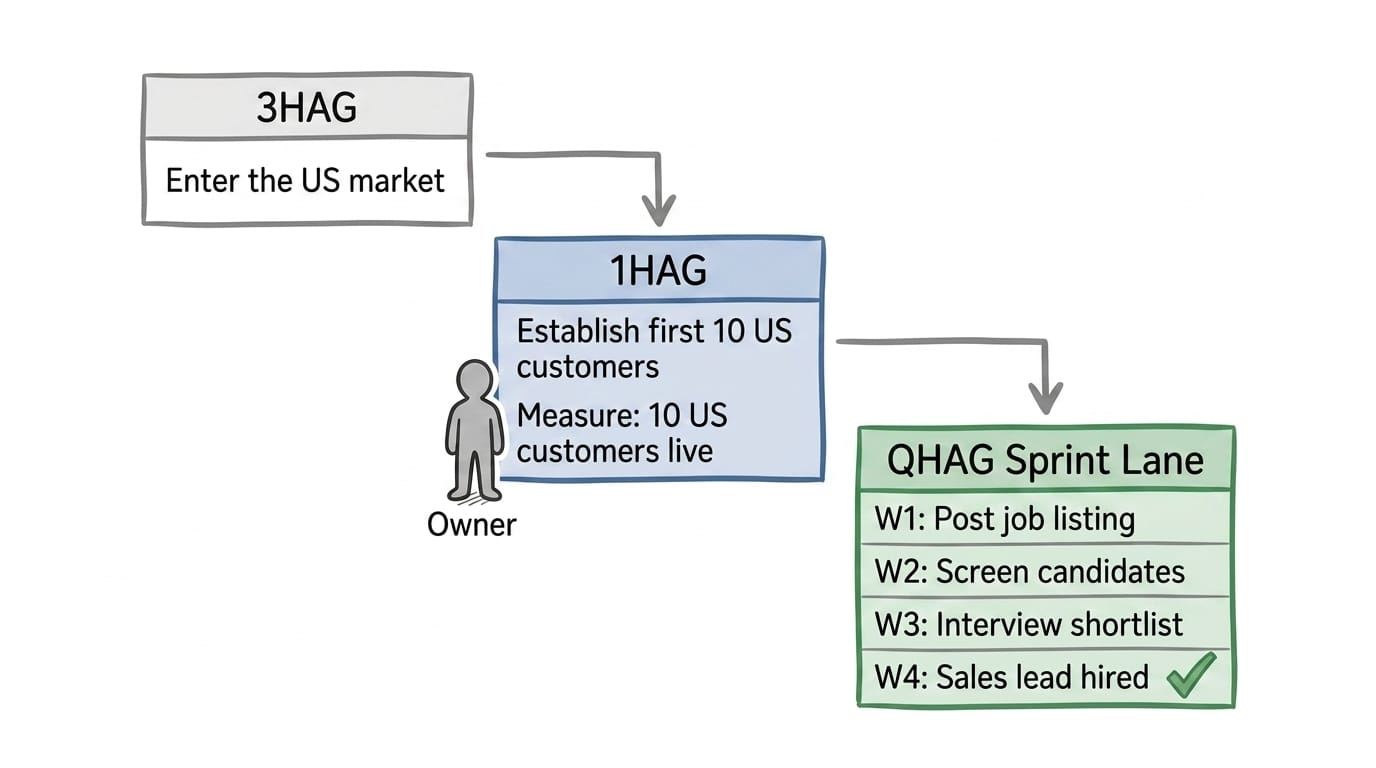
Forced alignment is worse. The team rewrites the logic of the 3HAG to justify what it already wanted to do this quarter. If quarterly priorities do not connect to the 3HAG, either the priorities are wrong or the 3HAG needs updating. Both are legitimate. Pretending they align is the problem. The team knows.
Keeping it alive
The cascade is not a document you build once.
Weekly, review Sprint Lane status in the leadership team meeting. If a deliverable is red, the owner has already posted what they are doing about it. The discussion focuses on removing blockers, not assigning blame.
Measures of success do not wait for quarter end. When they are function critical numbers, they are already on the wall every week at Scoreboard Day. That is the weekly meeting where each function's key numbers go up in front of the team.
Monthly, review the QHAG. Compare month-over-month targets with what actually happened. Address any fiscal measure drifting from plan before the quarter is spent.
Quarterly, close each ending priority on both questions: done and worked. Apply the lessons from any gap to the next quarter's priorities before rebuilding anything.
Then rebuild the QHAG and Sprint Lanes. Review the 1HAG for alignment. Confirm or challenge the 3HAG.
Annually, rebuild the whole forward plan rather than rolling it forward. Begin with current evidence and reconsider every assumption. Do not carry last year's numbers, priorities, and owners forward on autopilot.
Keep the actuals, lessons, and prior versions. Rebuild the plan ahead, not the record behind it. Start from a blank sheet, backed by what the year taught you rather than a light edit of last year's answers.
The Open Playing Field is the always-visible board Shannon's method runs on. It should show the current state of all four horizons at all times. When someone asks, "what are we doing and why?" the answer is on the wall.
The board can be physical or virtual. It is visible to the whole leadership team. Update it before every meeting, not during it.
What comes next
The 3HAG you draft at this stage is a stake in the ground. It becomes operationally coherent when the numbers reconcile, but it is not yet strategically validated. Those are different tests.
Reconciliation proves that the plan hangs together across widgets, fiscal targets, owners, and horizons. It does not prove the market wants what you are selling, that your pricing holds, or that you chose the right capabilities.
The capabilities and known-for came from gut feel. Later strategic work will sharpen both. For now, draft the cascade and reconcile its widgets with the KFFM and FAC. Confirm one accountable owner and a throughput target for each widget.
That gives you a plan you can explain. It shows who owns each piece, what must be true each quarter, and which market and capability assumptions still need testing.
Sources. The 3HAG, 1HAG, and QHAG are Shannon Susko's, from 3HAG WAY and Metronomics. The BHAG is Jim Collins and Jerry Porras's, from Built to Last. Structural tension is Robert Fritz's, from The Path of Least Resistance. The Sprint Lane adapts Verne Harnish's 13-week race from Mastering the Rockefeller Habits. "Do less and obsess" is Morten Hansen's, from Great at Work.
My additions are called out where they appear: the margin line beside revenue and cash, an owner on every line at every horizon, and a measure of success on each priority. Everything else here is how I run these tools with the companies I coach, informed by a decade of running them at Rise Vision. Go read the originals in full. Your thinking will be sharper for it.
Planning Cascade Builder
Turn your planning session into four tables you can put in front of the leadership team.
- Values: How Not To Chase Your Tail
- How to Discover Your Company's Values Using AI
- Key Function Flow Map
- Scoreboard Day
- Compensation
- Severance
- Skip Level Reviews
- The Eight Meetings That Run Your Company
- Who On Your Team Is An A-Player?
- Where Are You Going?
- Who Is Your Most Valuable Customer?
- Where Are You Playing?
- Who Are You Really Competing With?