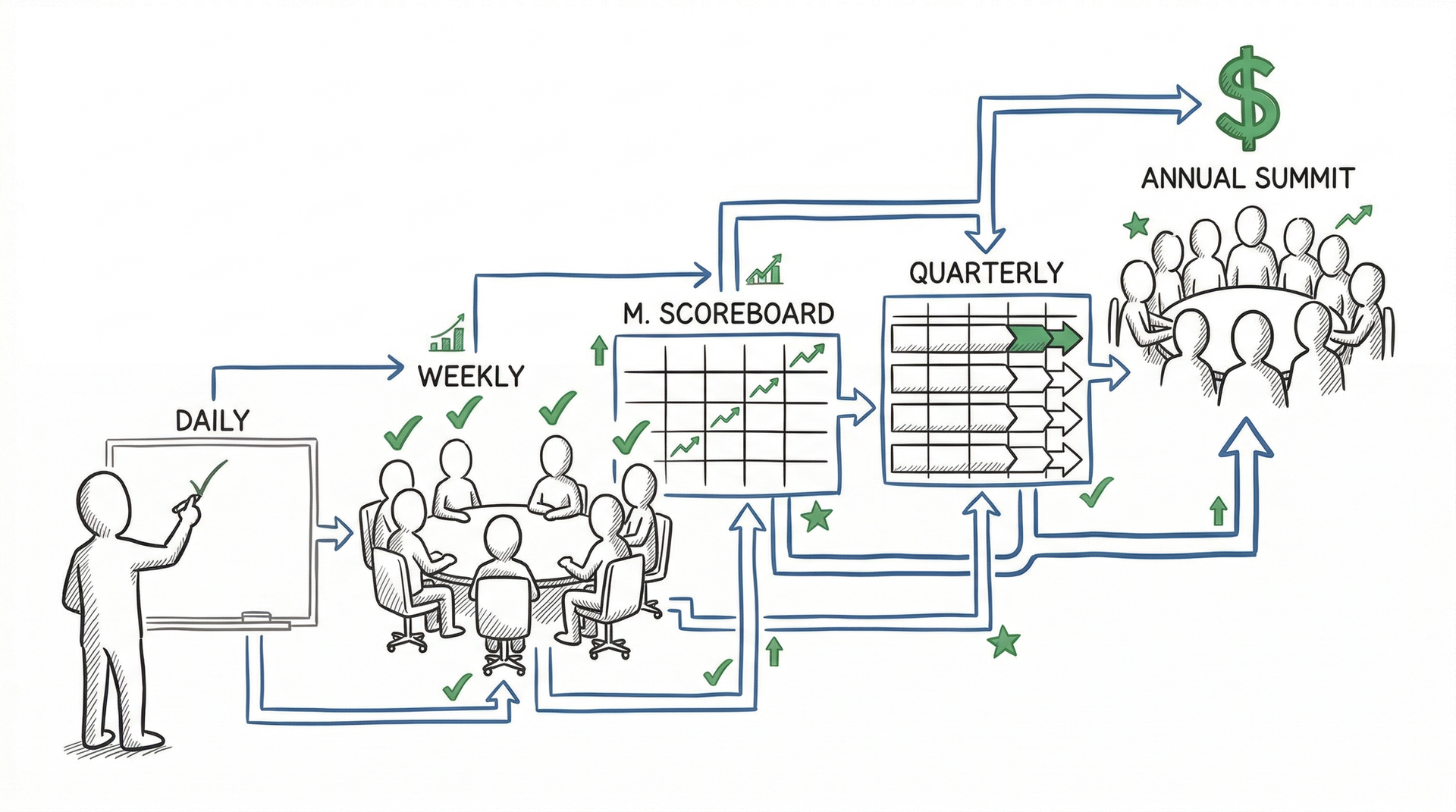
Most companies have meetings. Few have a cadence. Fewer still have the discipline to keep it.
A cadence is not just a calendar of recurring events. It is a ritual. When meetings happen on the same day, at the same time, with the same standing agenda, something changes in the team. People prepare. They show up ready. They know what to expect and what is expected of them. The meetings become productive because the structure removes the guesswork. Decisions get made. Problems get surfaced before they compound. Progress becomes visible.
Over time, the cadence builds momentum. People can count on these meetings happening. They can count on them being useful. They can count on the team showing up, doing the work, and leaving with clear next steps. That reliability is what turns a group of people into a team that moves together. The daily huddle keeps everyone aligned to today. The weekly meeting keeps the leadership team aligned to the quarter. The monthly meeting keeps cash aligned to the forecast. The quarterly meeting keeps the 90-day plan aligned to the three-year strategy. Each frequency reinforces the one above it and the one below it. Miss a level and the alignment breaks.
Shannon Susko, in Metronomics, adapted the meeting rhythm from Verne Harnish's Mastering the Rockefeller Habits and refined it over years of coaching hundreds of companies. What follows is what Shannon recommends, with adaptations I have made based on what I learned running these systems at Rise Vision for over a decade. The system uses eight meetings at five frequencies. Daily, weekly, monthly, quarterly, and annually. Each meeting advances the same six systems: Cohesive, Cultural, Human, Strategy, Execution, and Cash. The higher-frequency meetings carry the execution and cultural pulse. The lower-frequency meetings carry the strategic and structural work. Good News opens every meeting. Values recognition runs through almost all of them.
At Rise Vision I ran twenty rituals across eight frequencies, including a product development cycle, weekly all-hands, retrospectives, hackathons, and skip-level reviews. What follows here is the starting point. Master this first. Once these eight meetings are running and the team has internalized the rhythm, add to it where your business needs it. What I built at Rise Vision is one example of how the base system can be extended and adapted over time.
If you only do one thing from this article: run the five-minute Daily Huddle for thirty days. Everything else builds from there. Come back when you have it.
One principle before we begin. Each meeting has one purpose, and there is only one meeting per purpose. Two halves to that rule. First, do not mix status meetings with decide meetings. The huddle and the weekly leadership team meeting are status meetings. They surface what is on track and what is not. If a problem needs a longer discussion, assign an owner and take it to a separate meeting. Status and problem-solving do not mix well. When you try to do both, neither gets done properly.
Second, do not run two meetings for the same purpose. If your team already runs an existing meeting that overlaps with one of the eight (a Weekly Business Review for the Weekly Leadership Team Meeting, an All Hands for the Monthly Town Hall, a stand-up for the Daily Huddle), do not add the canonical meeting alongside the existing one. Rename the existing meeting and update its agenda to match the canonical. To make this concrete: if your team already runs a meeting called "Monday Sync," rename it to the Weekly Leadership Team Meeting and replace its agenda with the standing agenda above. Do not add a second meeting alongside Monday Sync. Running parallel meetings splits attention and signals the canonical system as the extra thing rather than how the company operates.
One more principle. Each meeting has one owner. The owner is one named person who runs the agenda, including Good News and Values Recognition. If the owner cannot attend, they delegate to a second in charge who runs the meeting in their place. The owner is not the leadership team or whoever happens to attend. It is one person whose name belongs on the meeting.
Meeting Cadence Assessment
Get a custom scorecard showing which of the eight meetings your company has in place and what to add next. 30 min.
Daily Huddle
Purpose: Keep the team connected to the plan every day.
Duration: 5 to 7 minutes.
Who: Each team, aligned to function.
Owner: Function lead.
Standing agenda:
- Good news and values recognition. One person, 30 seconds. Name someone. Name the value. Name what they did.
- Are you on track? Yes or no.
- Stuck and need help? Yes or no.
- What is your number one thing for today?
No discussion. No problem solving. If someone is stuck, note it and take it offline. The huddle is a pulse check, not a working session.
The huddle is the most important meeting in the system. Everything else builds on it. If your team is not connecting every day to review where they stand against the plan, the weekly meeting becomes a catch-up session. The monthly becomes a surprise. The quarterly becomes a reset instead of a step forward.
Weekly Leadership Team Meeting
Purpose: Review the scoreboard, check progress against the plan, and surface issues that need attention.
Duration: 60 minutes.
Who: The leadership team.
Owner: CEO.
Standing agenda:
- Good news
- Values recognition
- Scoreboard review
- Quarterly Highly Achievable Goal [QHAG] status
- Priority and Sprint Lane status
- Dynamic (stucks, ask for help, offer help)
- What Do You Recommend? [WDYR]. Leaders share examples of how they used WDYR with their teams this week.
The scoreboard review is where the Key Function Flow Map [KFFM] metrics come to life. By the time this meeting starts, every critical number owner should have already updated their scoreboard. Any red number should already have a posted corrective action describing what is being done, by whom, and by when. If people arrive at this meeting with stale numbers, you lose the first 30 minutes to status updates instead of decisions.
The Dynamic section is where team members raise stucks, ask for help, or offer help. This is not an open floor. It is a structured practice for developing cohesiveness. When someone asks for help in front of their peers, and someone else offers it, the team gets stronger.
WDYR is a coaching habit. When a leader brings a problem, the response is not to solve it for them. The response is to ask what they recommend. Over time, this develops decision-making capacity across the leadership team. The weekly meeting is where leaders share how they used WDYR with their own teams. Concrete examples reinforce the habit and help other leaders learn how to apply it.
I wrote about the scoreboard discipline and the weekly leadership review in detail in Scoreboard Day.
Weekly One-on-One
Purpose: Coach the individual. Not status. Not task management. Coaching.
Duration: 30 to 60 minutes.
Who: A leader and each of their direct reports, individually.
Owner: The leader.
Standing agenda:
- Good news
- Values discussion. Which value showed up or was tested this week?
- What is on your mind? The person being coached sets the direction.
- Question Funnel as needed. Explore, then converge on action.
- Improvement check-in. What is the one thing from your last scorecard review? How is it going? How can I help?
- WDYR
- Commitments and next steps
The one-on-one is the person's meeting, not yours. They choose what to talk about. Your job is to listen, ask questions, and help them find their own answers. If you come with a detailed agenda of things you need to know, you will get defensive accountability instead of growth.
The improvement check-in is the thread that connects this meeting to the quarterly scorecard review. At the scorecard review, one improvement is identified. In the weekly one-on-one, you check in on it. At the next scorecard review, you assess whether it changed anything. That cycle is what turns good intentions into structural learning.
The coaching framework I use draws on training from the Roy Group, Michael Bungay Stanier's The Coaching Habit, and Robert Fritz's Path of Least Resistance. I wrote about it in The Art of Mentorship.
Monthly Meeting
Purpose: Review the 36-month rolling forecast against actual performance. Compare what the team said it would deliver to what it has actually delivered. Then identify anything strategic that has changed and is now affecting the trajectory.
Duration: 60 minutes maximum.
Who: The leadership team and the person who owns the financial model.
Owner: CEO, with the financial model owner co-running the cash review.
Standing agenda:
- Good news
- Performance against the 36-month rolling forecast. What did we say we would do, and what have we actually done?
- Strategic check-in. What has changed in the market, the Swimlanes, or the assumptions behind the forecast that is affecting performance? Surface what needs attention at the next quarterly.
This meeting is where cash becomes visible. The leaders review their actual results compared to the rolling forecast and the approved forecast for the year. The approved forecast stays static. The rolling forecast adjusts as reality unfolds. The leaders identify where they are tracking, where they are off, and what adjustments are required.
The 36-month rolling forecast provides long-term context for short-term decisions. When you can see the fiscal impact of this month's results projected out three years, you make different choices than when you are only looking at the current quarter.
The discipline of this meeting is that the leaders own their functional area forecasts. The finance team builds the model and inputs the numbers. The leaders own the assumptions based on the widgets in their functional area. This shifts ownership from the finance function to the people who actually control what flows through the business.
Monthly Town Hall
Purpose: Keep the whole company connected to the plan, the numbers, and the culture.
Duration: 30 to 45 minutes.
Who: Everyone.
Owner: CEO.
Standing agenda:
- Good news
- Values recognition. Name someone in front of the whole company. Name the value. Name what they did.
- Theme progress. What is the one thing for this quarter? Where are we? Why does it matter? What is the one thing we can all do to help achieve it?
- Financial transparency. What is working and what is not.
- One thing we can do as a company to improve our financial health.
This is the only meeting where the whole company hears the same information at the same time from the leadership team. The theme progress keeps everyone oriented to the quarterly goal and gives them something concrete to contribute to. The financial transparency builds the financial literacy of the entire team. When people understand how money flows through the business and what they can do to improve it, they make better decisions every day.
Quarterly Meeting
Purpose: Review all six systems. Create the plan for the next 90 days.
Duration: One full day.
Who: The leadership team.
Owner: CEO.
Preparation: Every leader's scoreboard is current. Every leader's Sprint Lanes from the past quarter are up to date. Every leader is ready to recommend what the next quarter needs to advance the company toward its 3 Year Highly Achievable Goal [3HAG].
Standing agenda:
Cohesive System
- Good news
- Cohesive question or icebreaker
Cultural System
- Core Purpose review
- Core Values review
- Big Hairy Audacious Goal [BHAG] review
- Profit/X review
Human System
- KFFM review (structural). Are the functions right? Are the widgets connected? Do we need the next level?
- Functional Organization Chart
- A-Player Team Assessment
- WDYR check-in. How is it going with your teams? Examples from the last 90 days.
Strategy System
- 3 Year Highly Achievable Goal [3HAG] review and validation
- Market Map review
- Core Customer analysis
- Attribution Framework
- Swimlanes review and update
- Brand Promise and Guarantee
Execution System
- Scoreboard review
- 1HAG status
- QHAG status
- Priority and Sprint Lane status
- New QHAG and 13-Week Sprint Lanes
Cash System
- Widget forecast versus actual
- 36-month rolling forecast
Closing
- Meeting effectiveness review. Is the cadence working? What should we adjust?
- Three Cascading Messages. The leadership team agrees on three key messages to share with the rest of the organization in tomorrow's huddle. Same messages, same time, from every leader. This practice comes from Pat Lencioni's The Four Obsessions of an Extraordinary Executive.
- One-Phrase Close. Each leader gives five words or less on how they feel right now.
This is the meeting where every system gets touched. That is why preparation matters. If anyone arrives without their status updated, the first hours are wasted on catching up instead of planning.
A note: this full agenda is what you build toward over several quarters. You do not start here on day one. In your first quarterly, run only the Cohesive, Execution, and Cash sections. Add the Cultural sections in Q2. The Human and Strategy sections come online in Q3 and Q4 as the team builds the artifacts they reference. Shannon's quarter-by-quarter progression adds items to this agenda as the team matures. What you see above is the destination. The path to get there is one quarter at a time.
Annual Meeting
Purpose: Validate strategy. Create the new 3HAG. Build the annual plan.
Duration: Two full days.
Who: The leadership team.
Owner: CEO.
Day 1 is strategy. The agenda follows the same flow as the quarterly meeting through the Cohesive, Cultural, Human, and Strategy systems, with greater depth. The Five Dysfunctions of a Team Assessment is completed. The KFFM is reviewed at Level 1 and Level 2. Market Map and Core Customer are refreshed. Attribution Map, Activity Fit Map (Differentiators), Swimlanes, and the 3HAG are rebuilt from scratch to force fresh thinking. The agenda follows the same flow as the quarterly meeting through the Cohesive, Cultural, Human, and Strategy systems. The difference is depth. The Five Dysfunctions of a Team Assessment is completed. The KFFM is reviewed at Level 1 and Level 2. The Swimlanes are reviewed and extended. A new 3HAG is built or the existing one is validated.
Day 2 is execution. Status review of the current 1HAG and QHAG. New 1HAG and QHAG with 13-Week Sprint Lanes, rebuilt to align with the new 3HAG. Full Cash System review including the 36-month rolling forecast extended by one year. Metronomics Survey review. Three Cascading Messages. One-Phrase Close.
The annual meeting is the quarterly meeting with more time and more strategic depth. If the quarterly meetings have been running well, the annual is not a reset. It is an extension. The team arrives with current data, validated strategy, and the habit of working through the systems together. They leave with a new year's plan built in the context of the next three years.
Quarterly Scorecard Review
Purpose: Evaluate performance and develop the individual.
Duration: 60 to 90 minutes.
Who: A leader and each of their direct reports, individually.
Owner: The leader.
Frequency: Every 90 days. Once established, this replaces annual reviews entirely.
Standing agenda:
- Scorecard review. Cover mission, critical number, supporting metrics, competencies, and values together.
- Skip-level review findings, where applicable. Input from the manager's manager about the team's experience of the manager.
- Continuous Improvement Plan [CIP]. The most important output of the meeting. Agree on one improvement focus for the next 90 days.
The scorecard review evaluates mission, critical number, supporting metrics, competencies, and values together. Not separately. A person who delivers results but consistently falls short on values is not a high performer. The scorecard makes this visible.
The skip-level review happens one month before this meeting. It surfaces how the person leads their team, not just whether they hit their numbers. The findings feed directly into this conversation. This gives both of you data that would otherwise take years to surface through normal observation.
The most important output is one improvement. Not three. Not a list. One thing to work on for the next 90 days. That improvement gets checked in on weekly in the one-on-one. It gets assessed at the next skip-level review. It gets evaluated at the next scorecard review. The cycle closes.
I wrote about the skip-level process and the Fritz situation-cause-correction-follow-up framework in Skip Level Reviews.
The Pattern
If you look across all eight meetings, a pattern emerges. The following table shows every standing agenda item and where it appears. The repetition is the design.
| Agenda item | Daily huddle | Weekly LT mtg | Weekly 1-on-1 | Monthly mtg | Monthly town hall | Quarterly (1 day) | Annual (2 days) | Quarterly scorecard review |
|---|---|---|---|---|---|---|---|---|
| Cohesive system | ||||||||
| Good news | ||||||||
| Cohesive question / icebreaker | ||||||||
| Five Dysfunctions assessment | ||||||||
| Left/right: stop, continue, start | ||||||||
| Cultural system | ||||||||
| Values recognition / discussion | ||||||||
| Core Purpose review | ||||||||
| Core Values review | ||||||||
| BHAG review | ||||||||
| Profit/X review | ||||||||
| Human system | ||||||||
| KFFM review (structural) | ||||||||
| Scoreboard review | ||||||||
| Functional Organization Chart | ||||||||
| A-Player Team Assessment | ||||||||
| Scorecard review | ||||||||
| WDYR | ||||||||
| Skip-level review | ||||||||
| Strategy system | ||||||||
| Strategic check-in | ||||||||
| 3HAG review / validation | ||||||||
| Market Map review | ||||||||
| Core Customer analysis | ||||||||
| Attribution Framework | ||||||||
| Swimlanes review / update | ||||||||
| Brand Promise / Guarantee | ||||||||
| Execution system | ||||||||
| Priority / Sprint Lane status | ||||||||
| Dynamic (stucks / help) | ||||||||
| 1HAG status | ||||||||
| QHAG status / theme progress | ||||||||
| New QHAG + Sprint Lanes | ||||||||
| New 1HAG | ||||||||
| Cash system | ||||||||
| Widget forecast vs actual | ||||||||
| 36-month rolling forecast | ||||||||
| Financial transparency + improvement | ||||||||
| Closing rituals | ||||||||
| Meeting effectiveness review | ||||||||
| 3 Cascading Messages | ||||||||
| One-Phrase Close | ||||||||
Good News runs all the way across. It never gets a day off. Values recognition covers six of the eight meetings. Those two rows are the Cultural and Cohesive systems getting reinforced at every frequency.
The Execution system lives in the daily huddle and the weekly leadership team meeting. Priorities, stucks, scoreboard, sprint lanes. These are the meetings where the plan gets executed.
The Strategy and Cash systems live in the monthly, quarterly, and annual meetings. These are the meetings where the plan gets built, validated, and funded.
The Human system shows up everywhere people are coached or assessed. WDYR runs through the weekly leadership meeting and the weekly one-on-one. The scorecard review anchors the quarterly scorecard review. These are the meetings where people get developed.
The quarterly and annual meetings are where everything converges. All six systems in one room. That is why they take a full day or two. And that is why preparation is not optional.
If you want to assess where your company stands against this cadence, there is a Meeting Cadence Assessment prompt on the Tools page. It will walk you through each meeting, identify your gaps, and recommend where to start.
Meeting Cadence Assessment
Run through a guided assessment of your meeting cadence against all eight meetings. 30 min.
Where to Start
Start with the daily huddle. Five minutes a day. If your team cannot commit to five minutes, no amount of quarterly planning will help. The huddle creates the rhythm. The rhythm creates the discipline. The discipline creates the momentum.
If your team already meets but uses different names for these meetings (Weekly Business Review, All Hands, OKR Check-ins, Bet Reviews, L10), these are not separate meetings to add the canonical eight on top of. They are local names for the same eight. Rename each existing meeting to its canonical name and update its agenda to match. Otherwise the team ends up with two meetings for the same purpose, the new one gets read as the extra thing, and the cadence never lands.
If you are under ten people, you still run all eight. Some of them collapse: the Weekly Leadership Team Meeting and the Monthly Town Hall might be the same meeting for now, and the financial model owner might be you with a bookkeeper feeding numbers. The cadence still applies. The size scales.
Once the huddle is running, add the weekly leadership team meeting. Then the weekly one-on-ones. Then the monthly. Layer them on one at a time as each becomes a habit.
The cadence is what runs the system when you are not thinking about strategy. It is the difference between a plan that lives and a plan that sits in a binder on a shelf.
Meeting Cadence Assessment
Get your meeting cadence scorecard with a prioritized sequence for building the full system. 30 min.
This article draws on Shannon Susko's Metronomics and Verne Harnish's Mastering the Rockefeller Habits for the meeting cadence framework, with adaptations based on my experience at Rise Vision.
Related articles:
- Scoreboard Day and the Weekly Leadership Review the weekly meeting in detail, and what happens when a number goes red
- Where Are You Going? the 3HAG the quarterly and annual meetings are built to hit
- How Your Company Makes Money the KFFM and FAC that give every meeting its numbers
- Cash! Who Owns the Forecast? the forecast the monthly meeting exists to re-price