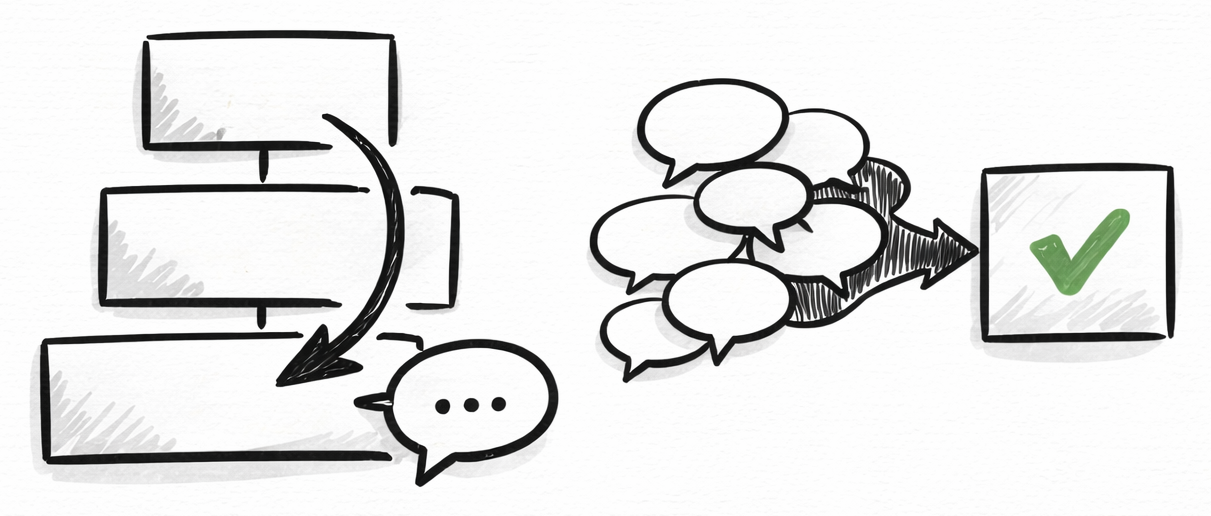
Most founders I work with are missing the information they need to coach their managers well. They have one-to-ones, they review results, they observe what they can — but they are only seeing the manager's perspective. The view from inside the team is invisible to them.
The managers themselves have the same problem. They rarely get candid feedback from their own teams. People soften things, avoid conflict, or assume the manager already knows. The blind spots stay blind.
That gap matters. A manager might be struggling with something that would take years to surface through normal observation, but that their team could articulate in ten minutes. Or they might be doing something exceptionally well that the entire company could benefit from — but no one tells them, the practice never spreads, and the opportunity is lost.
Skip level reviews close that gap for both of you. They give you direct insight into how a manager is experienced by their team — not to monitor or second-guess, but to coach. And because everything is documented in a shared document visible to the manager, they get that same information. They finally see what their team needs from them and can start improving immediately.
With that transparency, a manager can improve exponentially faster than if you were both working from your own limited observations.
The Framework Behind This
The information gap exists because people do not naturally give candid feedback — especially upward. Kim Scott explains why in Radical Candor. She argues that most people default to what she calls Ruinous Empathy: they see problems but stay silent, thinking they are being kind, when they are actually letting the other person fail in slow motion. Withholding honest feedback to spare someone's feelings is not kindness. It is a form of cruelty.
This is why the view from inside the team stays invisible. Team members notice things about their manager every day — what works, what does not, what is frustrating, what is excellent — but they rarely say it directly. The feedback that could accelerate a manager's growth sits locked in people's heads, filtered by politeness and the instinct to avoid conflict.
Scott's solution is the skip level review: a structured meeting between a leader and the people who report to their direct reports, designed to surface the feedback that would otherwise stay hidden. The process I describe here is hers. What I have added is the integration into a quarterly scorecard rhythm — timing the skip level review to land at least one month before the manager's own scorecard review, so you have real data about how they are leading their team before you sit down to evaluate their overall performance.
How the Skip Level Review Works
Every person in the company has a scorecard that is reviewed every 90 days. These reviews give timely, constructive feedback on performance and development. For people who manage others, a skip level review is added to the rhythm: it happens one month before the manager's next scorecard review.
One week before the skip level review, the manager's direct reports are asked to think about five questions:
- What should the manager keep doing? What works well?
- What should the manager stop doing? What doesn't work so well?
- What should the manager start doing? What isn't happening that should be?
- What is your team struggling with, and how can the company help?
- If you were the team leader, what would you do differently?
Each person prepares their answers privately. These are not shared with colleagues in advance.
At the skip level review itself, you meet with the manager's direct reports as a group, without the manager present. The manager knows this meeting is happening — there is nothing covert about it — but they are not invited. This creates space for honest conversation that would be difficult with the manager in the room.
Each question is discussed openly, and everything said is documented in real time in a shared document that the team, their manager, and you can all see.
The feedback is attributed to the group, not to individuals. This is deliberate. Anonymous feedback can devolve into complaint sessions where people say things they would never own. Attribution to the group creates accountability — the team stands behind what they say — while still providing some psychological safety for raising difficult issues.
This applies to everyone who has people reporting to them — including the founder and CEO. In fact, it is most important for the founder and CEO. They are the furthest removed from the front lines and the least likely to receive candid feedback through normal channels. The power dynamics make it even harder for people to speak honestly. For the CEO, the skip level review should ideally be conducted by an outside party — a coach or advisor — who can create the same safe space for honest conversation that the CEO creates for everyone else's teams.
If you want to reduce the documentation burden, an AI meeting notetaker can transcribe the conversation in real time, generate summaries, and extract action items automatically. Because skip level feedback is attributed to the group rather than individuals, you can share summaries directly. If you use raw transcripts, review them first — AI captures everything, including context that may need editing before it goes in the shared document. For teams that want an additional layer of input before or after the live session, there are 360 feedback platforms designed specifically for anonymous collection, with AI that aggregates responses and filters out unconstructive comments. Either approach can work alongside this process; the key is that the documentation remains visible to everyone involved.
This Is Not a Fishing Expedition
I want to be clear about what this process is for. Skip level reviews exist to help a manager become a better leader. They are not complaint sessions. They are not opportunities to collect ammunition. They are not fishing expeditions.
That responsibility falls on you, the person conducting the review. You must not bring your own biases into the conversation. If you have a pet peeve about the manager — something that bothers you personally — you do not insert it into the discussion. You can test whether the team experiences the same issue by asking a neutral question. If the answer is no, then it is no. You accept that and move on. You do not fish for the answer you wanted to hear.
The same discipline applies to managing the conversation itself. If a team member starts turning the session into a venting exercise or a litany of complaints, you redirect. The goal is constructive feedback that helps the manager improve, not a catalogue of grievances. Keep the conversation focused on what would make this manager more effective, not on what annoys people.
If something surfaces that involves ethics, harassment, discrimination, or personal medical details, stop. Take it offline and move to resolve whatever surfaced quickly.
If the manager is doing an excellent job and there is genuinely nothing to improve, then you note that in the document and move on. This should be the exception rather than the rule — we all have room to grow — but the possibility must exist, or the process becomes a ritual of mandatory criticism that helps no one.
At the end of the meeting, the group identifies one specific improvement they would like the manager to make. One. Not three, not five, not a prioritized list. A single focus for the next 90 days. If the conversation surfaced multiple issues, the group must choose. Giving someone a list of things to fix is not feedback, it is an ambush. One thing, done well, creates more change than a scattered list of improvements that never get real attention.
The Debrief With the Manager
Following the skip level review, you meet with the manager in your next one-to-one. This is where you apply the same Situation, Cause, Correction, Follow-up structure I described in my article on Scoreboard Day, drawing on Robert Fritz's work in The Managerial Moment of Truth. The goal is to turn feedback into structural learning, not blame.
Your role is to coach the manager through the four parts — not to hand them the answers. You share what the team observed. They do the thinking. The conclusions are documented in the same shared document the team can see.
Situation. What is actually happening, in plain factual terms? The manager describes the gap between what the team needs and what they are experiencing. No interpretation, no judgment — just the observable reality. "The team reports that priorities change mid-sprint without explanation, and they often learn about deadline changes after the fact."
Cause. What is the root cause of this situation? This is where you coach the manager past surface explanations. "I need to communicate better" is not a cause; it is a restatement of the problem. You are helping them find structural causes: missing processes, unclear expectations, competing priorities, gaps in skill or capacity, broken feedback loops. "There is no mechanism for me to signal priority changes to the team before acting on them. I receive requests directly from the CEO and treat them as urgent without a triage step."
Correction. What structural change will make this situation less likely to recur? The manager proposes the fix. The test is simple: if they ran the same situation again with this correction in place, would they expect a different outcome? "All priority changes go through a 15-minute team standup before work is redirected. CEO requests go into a queue that I review with the team daily, rather than acting on them immediately."
Follow-up. When and how will they test whether the correction worked? The manager answers three questions:
- What will be measured? The specific observable behavior or outcome that indicates the correction worked.
- What does success look like? The threshold or condition that means "fixed."
- When will it be measured? The specific date — typically the next skip level review.
The test is simple: ask the team if the situation has changed. If yes, close it. If no, the correction didn't work — revisit the cause. The follow-up is what closes the loop and turns good intentions into actual learning.
This is where Radical Candor matters most. You are delivering feedback that might be uncomfortable. Do it directly, with care. Help the manager understand what was observed and why it matters. Work together on the structural cause — they often know things about the situation that the team does not see. But do not soften the message into meaninglessness, and do not let the conversation drift into vague promises to "do better."
After the debrief, the manager shares the Situation, Cause, Correction, and Follow-up with the team. This is not optional. The team needs to confirm that the manager understood the situation correctly — if they didn't, you fix it now, not 90 days later. More importantly, it shows the team that their contribution mattered. They raised an issue, and it is being acted upon. That visibility is what makes people willing to give honest feedback the next time.
The Follow-Up Review
At the next skip level review — 90 days later — the meeting follows a simple agenda:
Review progress on the previous correction. The team already knows what the manager committed to — they confirmed it after the last debrief. Now they assess whether it achieved the desired change. There are only two outcomes. Either the situation has improved and you note the result and move on. Or the situation persists, which means the correction did not work as expected. That is not a failure — it is information. You now know something you did not know before: the manager's understanding of the cause was incomplete, or the correction was insufficient. That insight becomes the basis for a new Situation Report with a new cause, a new correction, and a new follow-up date.
Conduct the current period's skip level review. Work through the same five questions, document the discussion in real time, and keep the conversation focused on constructive feedback.
Identify one improvement for the next 90 days. The group selects a single focus for the manager to work on before the next skip level review.
This avoids the common pattern where feedback is given, acknowledged, and then quietly forgotten. The follow-up creates accountability. The shared document creates visibility. The structure creates learning.
Where This Fits in the System
The skip level review is part of a broader system designed to create an environment of continuous improvement. The underlying premise is simple: none of us are perfect, and we all have room to grow. When everyone in the company — from the front line to the founder — accepts that premise and parks their ego, you create a culture where feedback is not a threat but a tool. One quarter at a time, people get better.
The skip level review is one part of the quarterly rhythm for evaluating managers. It happens at least one month before the manager's scorecard review, which gives you time to incorporate what you learn into your evaluation of their overall performance.
Think of it this way: the scorecard tells you whether the manager is hitting their numbers. The skip level review tells you how they are leading. Both matter. A manager who delivers results is good. A manager who delivers results while developing their team and earning their trust is exceptional. The skip level review gives you — and them — the information to make that leap.
The Goal
The goal of all this is not to catch managers doing things wrong. It is to create an environment where feedback flows, where growth is continuous, and where managers have the information they need to improve.
Kim Scott writes that the ultimate measure of Radical Candor is whether people trust you enough to give you feedback in return. A well-run skip level process builds that trust by demonstrating that feedback leads to action, that the process is fair, and that the point is growth, not punishment.
When it works, your managers get better. Your teams get healthier. And everyone has the information they need to keep improving.
Related articles:
- Who On Your Team Is An A-Player? the grid a skip-level often ends up changing
- Scorecards the numbers a manager and their report should already agree on
- Values the behaviour half of what a skip-level is listening for
- Scoreboard Day and the Weekly Leadership Review the weekly rhythm that surfaces problems before a skip-level has to