The A-Player Team Assessment
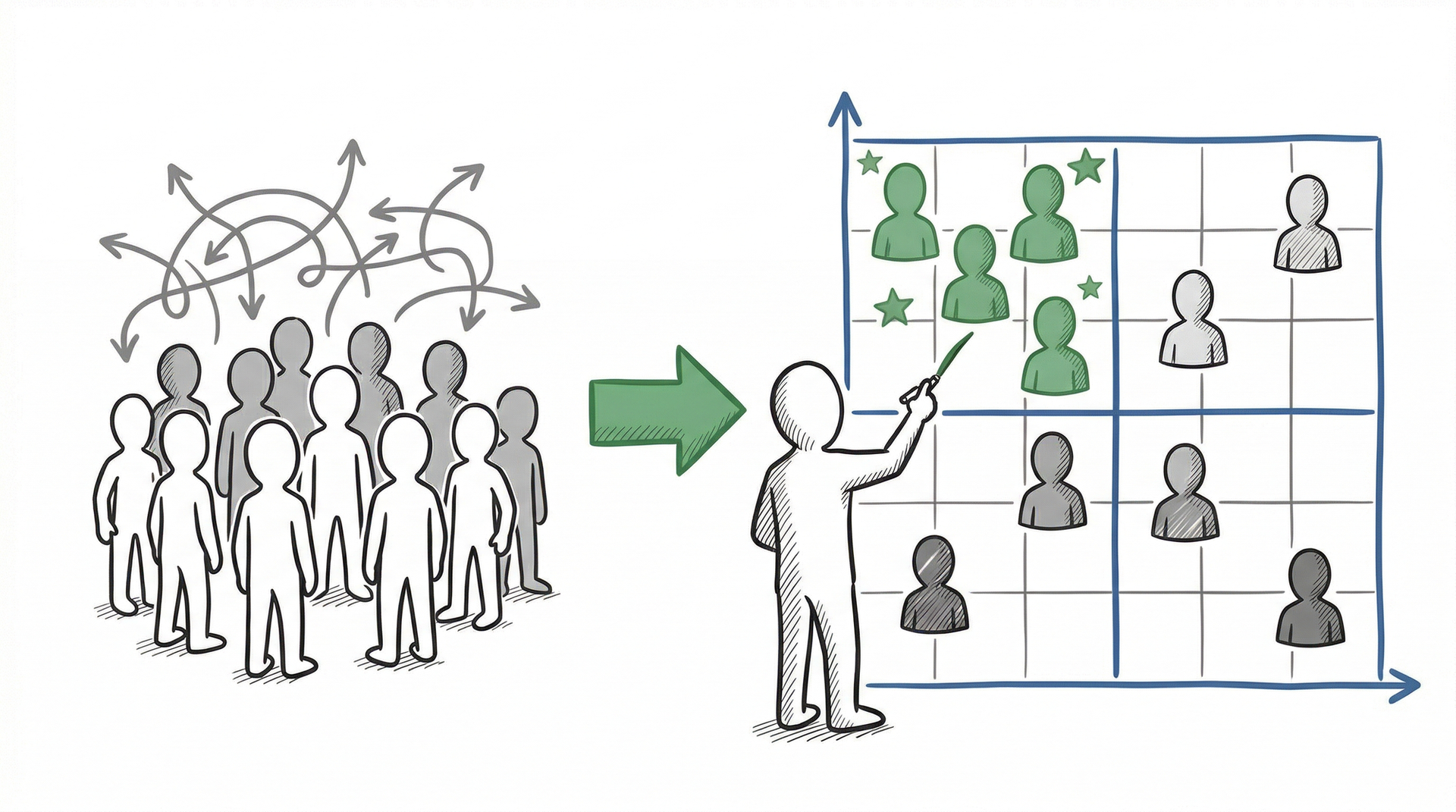
Most founders can tell you who their best people are. Ask them to be specific about why, and it gets harder. Ask them to assess every person on their team against two clear dimensions and defend that assessment to their leadership peers, and it becomes a different conversation entirely.
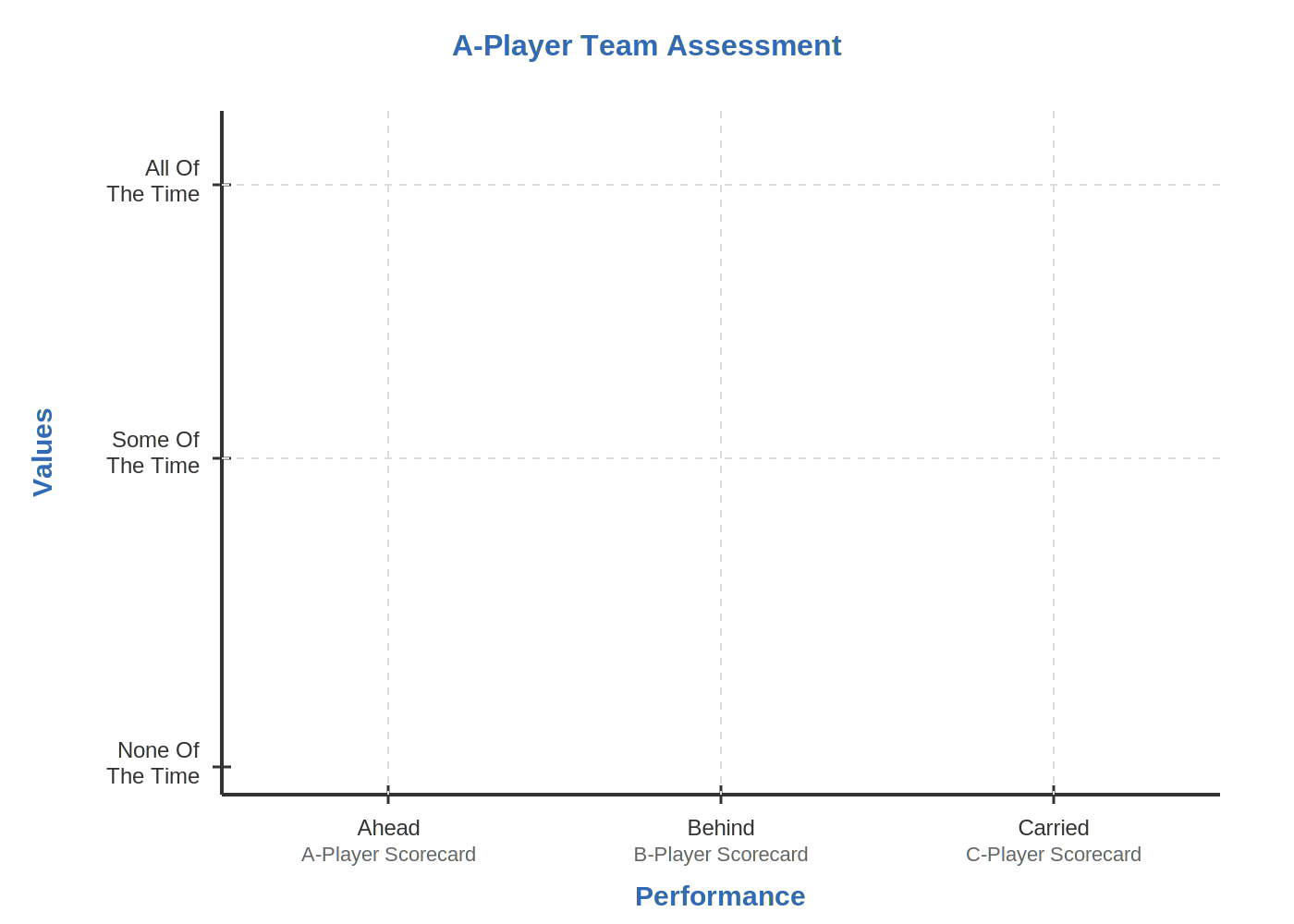
The A-Player Team Assessment is a simple tool that forces that conversation. It is a scatter plot with two axes. The Y-axis measures Values: how consistently a team member behaves in accordance with the company's Core Values. The X-axis measures Performance: how a team member is tracking against their scorecard.
The Values axis uses frequency language. All Of The Time. Some Of The Time. None Of The Time. This is observable behavior, not a subjective judgment of "cultural fit." You are asking a specific question: does this person demonstrate each Core Value consistently, sometimes, or not at all?
The Performance axis uses scorecard language. Ahead. Behind. Carried. Ahead means the team member is meeting or exceeding the targets on their scorecard. Behind means they are meeting most but not all. Carried means the team is carrying this person. They are not pulling their weight.
Team members are placed individually on the graph. There are no boxes or cells. It is a continuous field. A person can land anywhere on either axis, and their position relative to everyone else tells the story of the whole team at a glance. You can do this on a physical board with sticky notes, in a virtual tool like Mural, or using the AI prep prompt described at the end of this article to prepare your placements before the team discussion.
Shannon Susko created this tool as part of the Human System in Metronomics. The evolved language (Ahead, Behind, Carried) was introduced in November 2025. Brad Smart's Topgrading methodology provides the underlying definition of an A-Player: the top 10% of available talent for a given role at a given salary. What follows is my interpretation. I recommend reading both original sources.
A-Player Team Assessment Prep
Prepare your A-Player Team Assessment with an AI-guided walkthrough of every team member. 15-30 min.
Why this matters
The goal is 90% or more A-Players on your team. You cannot get there if you do not know where you are.
Most leadership teams have never discussed their people at this level of specificity with each other. They have opinions. They have frustrations. They sometimes have data. But they have rarely put names on a graph in front of their peers and said "here is where I think each of my people stands, and here is why."
That conversation is the point. Not the graph itself. The graph is a tool to make the conversation happen. When a leader places someone in the middle of the field and another leader says "I would have put them lower on values," now you have something to work with. Peer feedback on people assessments is rare in most companies. This process makes it routine.
The other reason it matters is speed. Without a regular team assessment, people problems surface slowly. A manager senses something is off, waits to be sure, gives it another period, hopes it improves, and eventually acts. By then, the rest of the team has been carrying the weight for months. The assessment compresses that timeline. It forces every leader to evaluate every person on two dimensions at a regular cadence and commit to action on anyone who falls below the standard.
How to read the graph
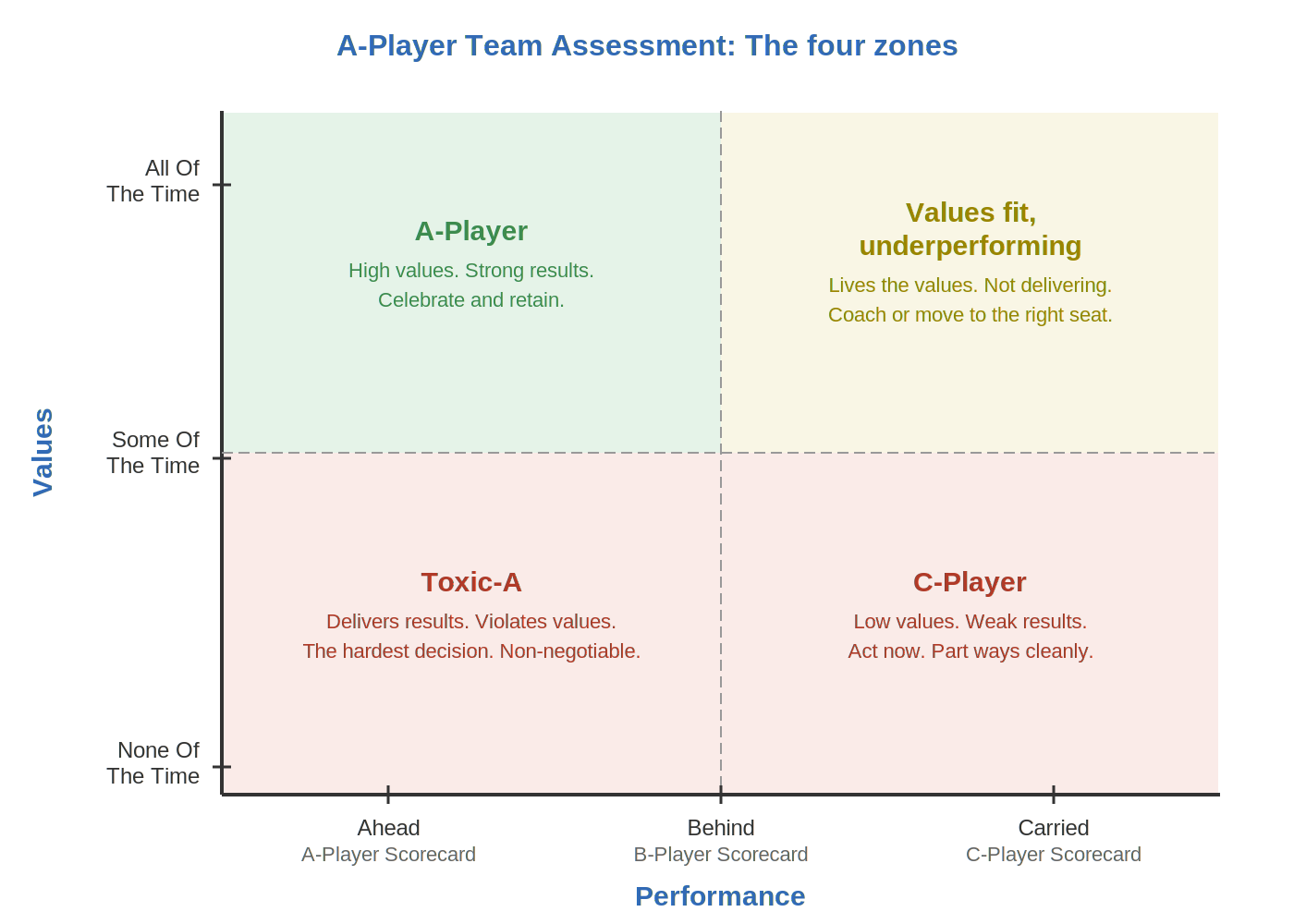
The graph divides into four zones. Zone labels appear subtly on the chart as orientation — A-Player, Values Fit/Underperforming, Toxic-A, C-Player — and each dot is color coded by zone: green for A-Players, yellow for B-Players, and red for C-Players and Toxic-As.
Top left: A-Player. High values, strong performance. This person demonstrates the Core Values all or nearly all of the time and is ahead on their scorecard. They are delivering results and behaving in a way the team expects of each other. Celebrate this. Make sure they know it.
Top right: Values fit, underperforming. High values, weak performance. This person lives the values but is not delivering results. They are a good human in the wrong seat, or they need coaching to close a skill gap. The values alignment gives you something to work with. Dig into whether they are in the right role, whether their scorecard expectations are clear, and whether there is a capability gap that coaching or training can close.
Bottom left: Toxic-A. Low values, strong performance. This person delivers results but violates Core Values. They might be your best salesperson. They might be your most productive engineer. They hit their numbers. But they undermine the culture doing it. Other people work around them. Other people leave because of them.
This is the hardest decision on the graph. The business perceives it cannot afford to lose their results. That perception is almost always wrong. The cost of a Toxic-A is not visible on any scorecard. It shows up in the people who leave, the people who disengage, and the people who stop raising problems because this person makes it unsafe to do so. Values alignment is not optional regardless of results.
Bottom right: C-Player. Low values, weak performance. This person is not delivering and is not behaving consistently with the team's values. Action is required. In most cases, the right answer is to part ways so they can find a better fit elsewhere. Generous severance, a clean exit, and no ambiguity. Keeping a C-Player costs the team far more than the discomfort of the conversation.
Four stages of maturity
The A-Player Team Assessment does not arrive fully formed. It starts rough and sharpens as the instruments behind it come into focus. Each stage changes what a leader is actually doing when they place someone on the graph.
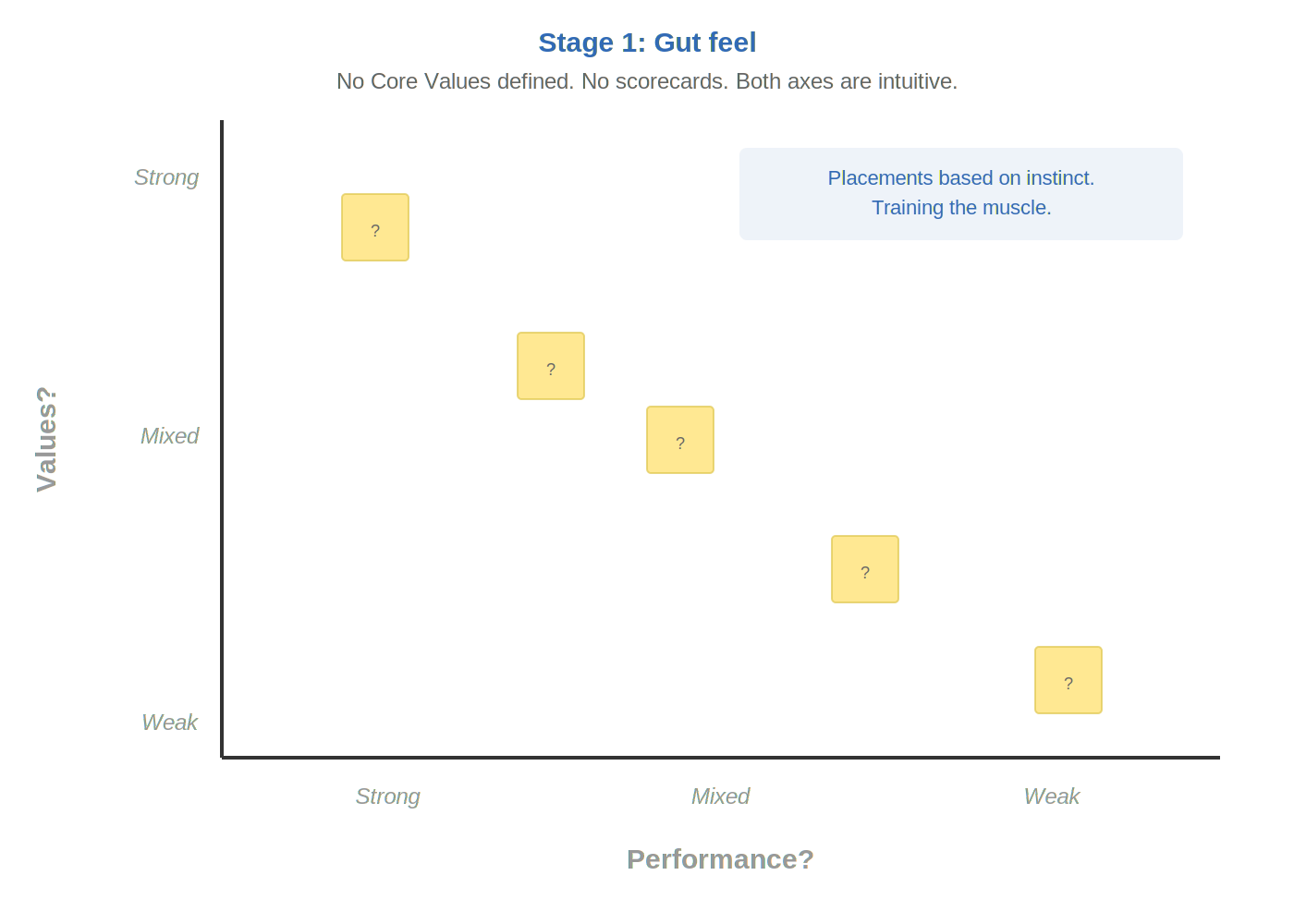
Stage 1: Gut feel. No Core Values defined. No scorecards. No critical numbers. The leader is working from instinct and anecdotal evidence. Both axes are intuitive.
The value at this stage is not accuracy. It is the act of thinking about every person on two dimensions and being willing to say it out loud. You are training the muscle. You are introducing the habit of evaluating people against values and performance simultaneously, even before you have the language to do it precisely. If someone is an obvious C-Player, you already know it. The assessment just forced you to name it.
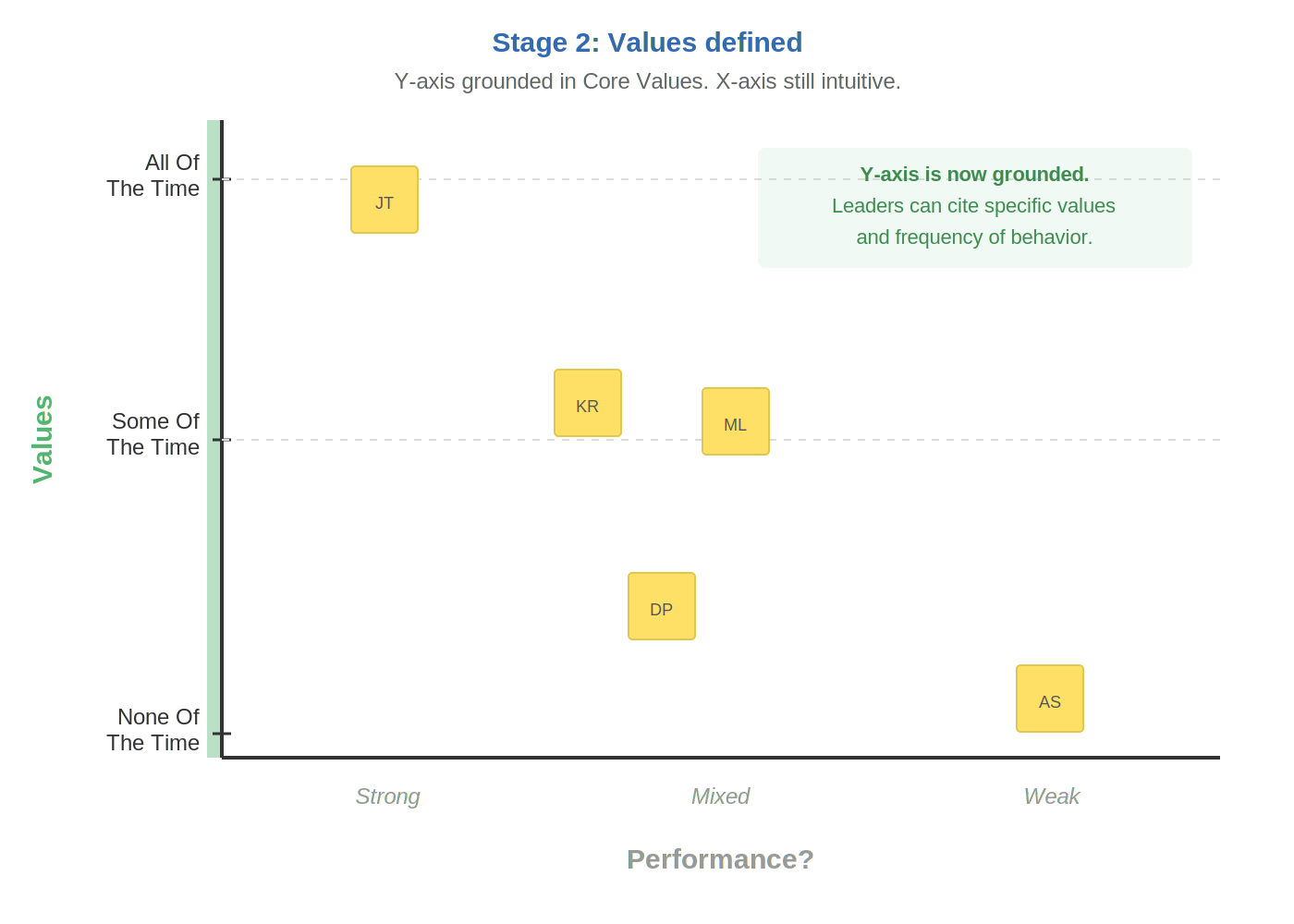
Stage 2: Values defined. The Y-axis is now grounded. Core Values have been articulated and the team has agreed on what they mean. A leader can cite a specific value and say "this person demonstrates Transparency all of the time" or "this person demonstrates Own It some of the time." The frequency language (all, some, none) becomes meaningful because there is a shared definition behind it.
The X-axis is still intuitive. You are assessing performance based on a general sense of contribution because there are no scorecard targets to measure against.
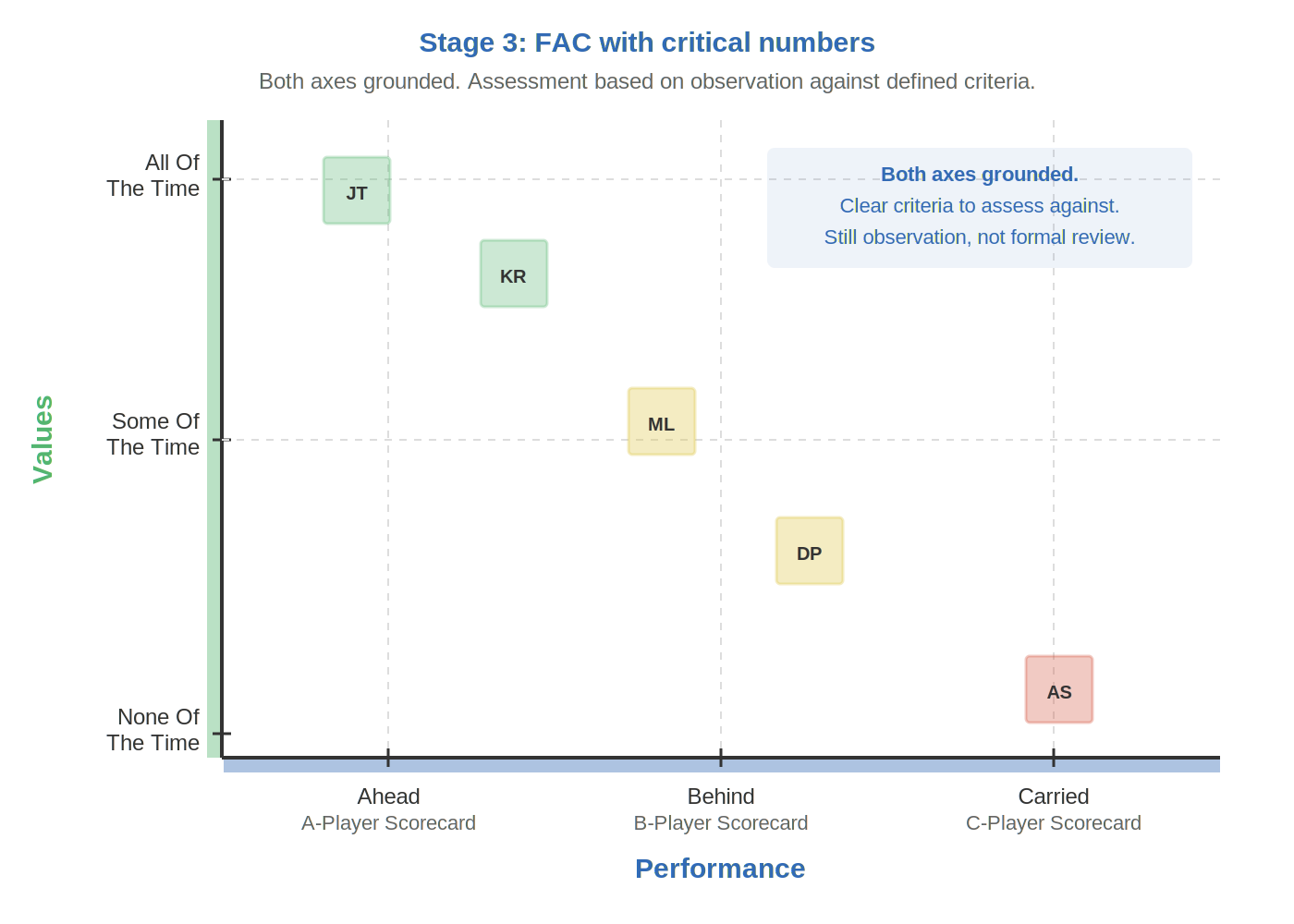
Stage 3: Functional Accountability Chart defined. The Functional Accountability Chart now exists with roles, owners, and critical numbers. Both axes have a definition behind them. The leader knows what the role is supposed to deliver and what good looks like on the values dimension. The leader has clear criteria to assess against but is still making the call from observation, not from a formal review process.
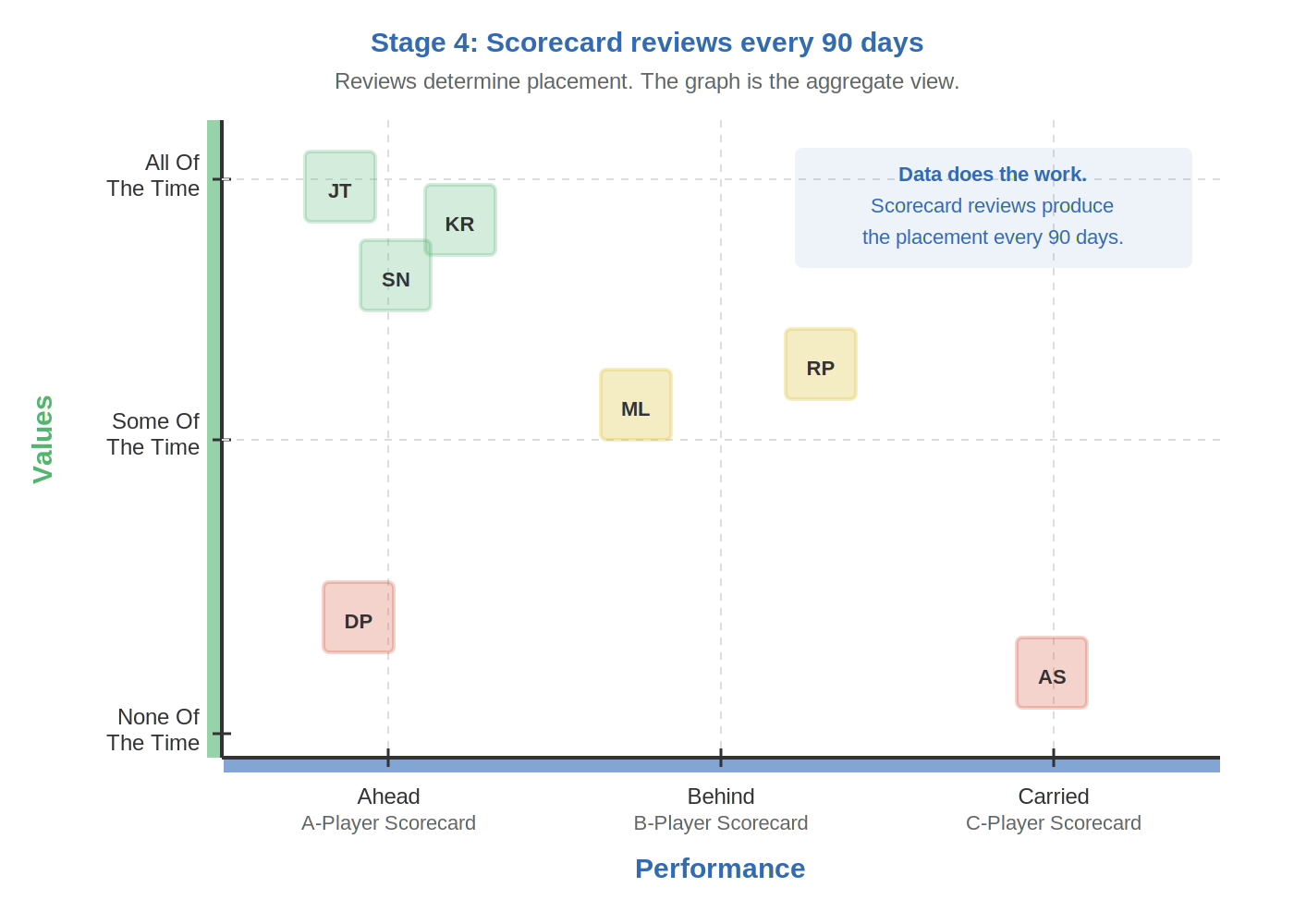
Stage 4: Scorecard reviews every 90 days. The scorecard review produces a rating on both axes. The values assessment and the performance assessment are documented outcomes of a structured process that happens every 90 days. The placement on the graph is no longer a judgment call. It is the output of the data.
At this stage, the A-Player Team Assessment graph is the aggregate view. Each individual scorecard review determines where that person sits. The graph plots all of those reviews together so the leadership team can see the whole team at once, spot patterns, and decide where to act. The graph never goes away. The process that feeds it changes.
What to do with the results
The assessment is only useful if it leads to action. At every stage, not just Stage 4.
The principle is simple: the rigor of the action matches the rigor of the evidence available. What changes as the tool matures is confidence, not willingness to act.
At Stage 1, the action is awareness and honest conversation. You now know what you believe your team is made up of. If someone is clearly a C-Player, you start the conversation. You may not have the data to point to a specific metric or a specific value violation, but you have enough to say "I do not think this person belongs on the team" and have your peers either confirm or challenge that.
At Stages 2 and 3, the action gets sharper because you can name what is wrong. You can point to a specific value being violated. You can point to a specific critical number being missed. The conversation moves from "I don't think this is working" to "here is specifically what needs to change, and here is what success looks like."
At Stage 4, the scorecard review produces the evidence. The action plan follows from the data. The scorecard review documents the gap, the correction, and the follow-up. For anyone below A-Player, the review itself generates the plan.
For C-Players and Toxic-As, act at every stage. Do not wait for perfect data. The cost of keeping a C-Player or a Toxic-A compounds every day. Other team members see it. They know who is being carried and who is violating values. When leadership does not act, the best people on the team start wondering whether the values are real.
For B-Players, the question is: what is the gap, and is it closeable? If the gap is values (bottom half of the graph), that is harder to close. You can coach skills. Coaching someone into a different set of values is a much longer road with a lower success rate. If the gap is performance (right half of the graph), ask whether they are in the right role, whether expectations are clear, and whether there is a capability gap that development can address. A person who lives the values but is underperforming may be a great team member in a different seat.
For the action planning framework I use when something needs to change, see Scoreboard Day and the Weekly Leadership Review, which describes the Fritz SCCF structure: Situation, Cause, Correction, Follow-up.
A-Player Team Assessment Prep
Run the full assessment prep described above with an AI assistant that adapts to your stage of maturity. 15-30 min.
How it connects to everything else
The A-Player Team Assessment does not stand alone. It is the team-level picture that sits on top of several other tools, each of which feeds one or both axes.
Values discovery feeds the Y-axis. Until values are articulated and agreed upon, the Y-axis is intuitive. Once values are locked, every assessment on the Y-axis can be grounded in specific, observable behavior against specific, named values. For the full values discovery process, see Values: How Not To Chase Your Tail.
The Functional Accountability Chart feeds the X-axis. The FAC defines the roles, the owners, and the critical numbers. Without it, the X-axis is a general sense of "are they doing a good job?" With it, the X-axis is tied to a specific metric with a defined target. For how the FAC works, see How Your Company Makes Money.
Scorecards formalize both axes. A scorecard includes a values assessment and a performance assessment. When scorecard reviews are in place, the data from those reviews is what places a person on the graph. The individual review is the mechanism. The graph is the aggregate view.
The scorecard review is the process that makes the assessment data-driven. It happens every 90 days. It produces the evidence. It documents the conversation. It generates the action plan for anyone below A-Player. At that point, the A-Player determination is an output of the scorecard review process. The graph is just the team-level summary.
Skip level reviews provide a second input. The scorecard review tells you whether the person is hitting their numbers. The skip level review tells you how they are experienced by their team. For managers, both inputs inform where they sit on the graph. See Skip Level Reviews.
Preparing for the assessment
The assessment itself happens in the room with peers. That is where the value is. The conversation, the disagreement, the peer feedback on whether someone else's read of a team member matches yours. That cannot be replaced.
What can be improved is preparation. A leader who walks into the room having thought carefully about each person with cited evidence on both axes will have a more honest and productive conversation than a leader who places sticky notes based on the feeling they had this morning.
I have built an AI-guided prep prompt that walks a leader through each team member before the assessment. It adapts to the stage you are at. If you have defined Core Values, it asks you to assess against each one. If you have a Functional Accountability Chart with critical numbers, it asks you to assess against those. If you have neither, it asks reflective questions that surface your intuition with more rigor than a blank graph would.
The output is your prepared position for each person on both axes, with the reasoning documented. You bring that into the room. Your peers do the same. Then you have the real conversation.
The prep prompt is available at darlison.com/tools.
A-Player Team Assessment Prep
Get your team placement, zone assignments, and action plans for every team member in one session. 15-30 min.
Related articles:
- Scorecards turns the assessment into a number each person can move quarter by quarter
- Skip-Level Reviews how to hear what the grid cannot tell you
- How Your Company Makes Money the KFFM and FAC, where functions and owners come from
- Compensation paying people in a way that matches where they sit on the grid