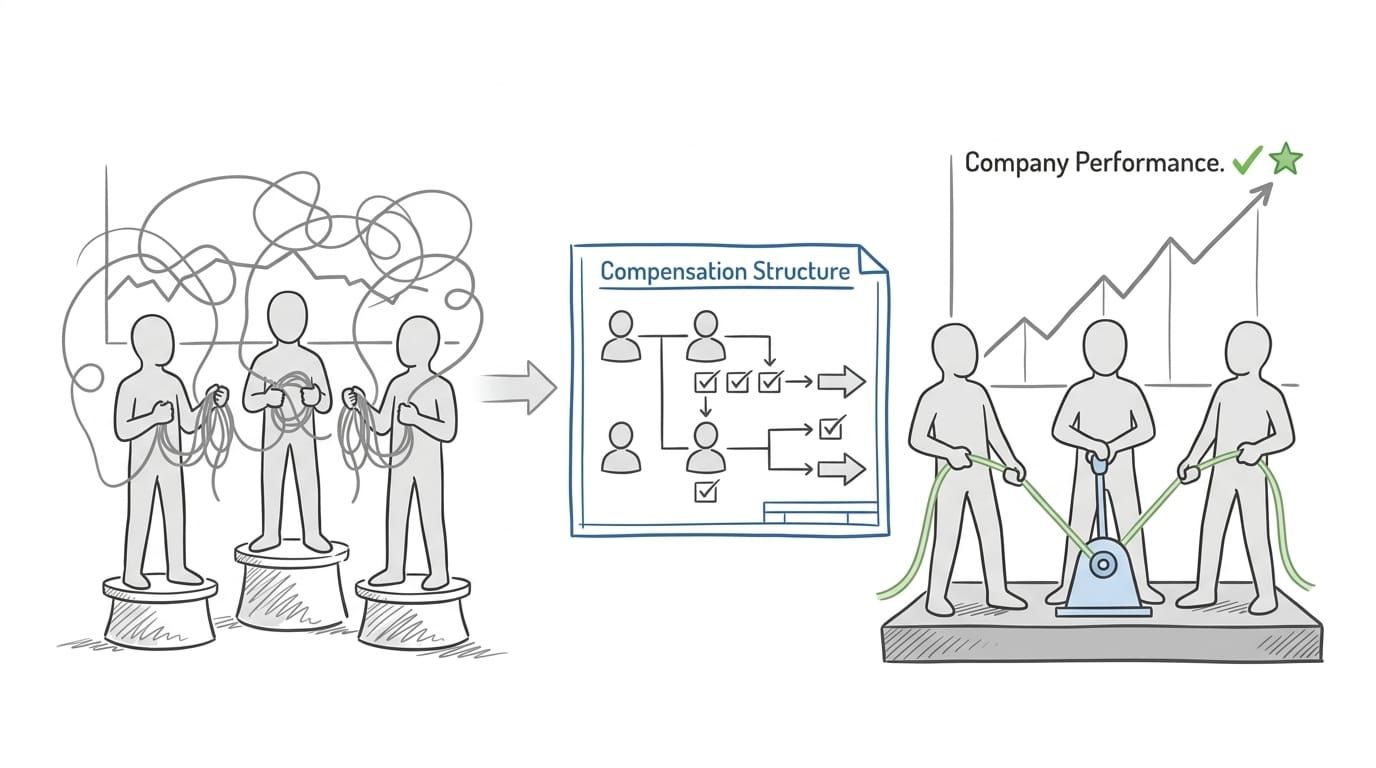
I believe employee compensation is the highest-leverage tool a company owner has to build a culture of accountability, empowerment, and execution. When structured properly, compensation can: attract and retain top talent within your target ranges; reward continuous improvement and excellence in role; connect every employee to the company’s financial performance and what will improve it; and reward employees for advancing the founder’s long-term goals.
This piece assumes you already have scorecards operating and critical numbers that have earned trust over at least two quarters. If you are earlier in that journey, start with Scorecards: The End of Directive Management, which covers the rollout sequence and why you should not wire pay to a critical number before the metric has been validated.
Attract and Retain
To attract and retain top talent, you need market-competitive pay for your roles. Start by defining your labour market (geography), your comparison set (industry and company size), and your target percentile. Then price every role in your Functional Accountability Chart against that benchmark using a service like PayScale, or a compensation consultant.
In my company, we benchmarked Toronto (Canada) and Lenexa (Kansas) in SaaS, against ~1,000-person firms. Our target was the 60th percentile, with an acceptable band of ±20% around that target.
For each role, we set an on-target earnings (OTE) range using that band: the low end was the 60th percentile minus 20%, and the high end was the 60th percentile plus 20%. We also captured typical variable-pay mix and benefits benchmarks from the same data source.
People new to a role started at the low end of the range. A consistently exceptional performer (‘A-player’), demonstrated through at least 2 consecutive quarters of scorecard reviews, was paid at the top end. Variable pay was tied to the role’s critical numbers (with green/yellow/red targets) and paid monthly when possible (quarterly at most), so pay followed performance closely. A-player status also requires consistent living of the company values. One C on a value drops the overall classification regardless of critical number performance. See Scorecards for how the values gate works in the quarterly review.
The tier of the seat on the Function Organization Chart tells you which market comparison set to use. Individual contributor seats benchmark against individual contributor seats in your market. People manager seats benchmark against people managers. Department head and executive seats each benchmark against their level. The tier is the sort key; the benchmarking service fills in the band. This keeps the ranges anchored to what the seat actually requires rather than to the person currently in it.
Proactively Review On Target Earnings
The target ranges for all roles are reviewed annually. If a role is undergoing rapid changes in demand for its skills, I recommend reviewing it semi-annually. At the completion of a review, if compensation for a role has increased above what is currently paid, compensation is increased automatically for employees in that role.
I don’t use cost-of-living increases as a default. Over time, they can push pay above market for a role even when performance and scope haven’t grown. I’m fine with someone choosing to stay in the same role long-term; I’m not fine paying materially above market for that role, or having a weaker performer paid meaningfully more than a stronger performer in the same seat.
Compensation increases are driven by the ability to perform the function that the employee holds. If an employee has two consecutive quarters of A player level Scorecard Reviews their compensation is increased to the highest level of the target range for the role in question.
On target earnings for all roles were published and shared with all employees. Everyone knew what roles paid what. We did not share where employees fell within a role's target range. That information was private to the employee in question.
Variable Compensation
Regarding bonuses. I prefer to stay away from subjective, personality driven bonuses and instead tie variable compensation to the achievement of the critical number targets for the function in question (as determined by your Functional Accountability Chart).
Depending upon the role and the structure of the team the role performs within, the critical number could be shared across the team, belong to the individual, or be a combination of the team’s critical number and the role’s individual critical number.
Critical numbers have green (on target or better), yellow (below target but somewhat acceptable) and red (unacceptable) results. It is up to you as to what percentage of the target variable compensation for the role is paid out for the green, yellow and red results and if that compensation is capped. Further, depending on the nature of the critical number you may choose to smooth out the results and use some form of moving average, or not.
Ideally this variable compensation is paid monthly and at most quarterly. Having the variable compensation paid as close to the results of the work that influences it is ideal.
Executive Team Variable Compensation
For executives, variable pay should align to the founder’s purpose. If the goal is profitable growth, a version of the ‘Rule of 40’ can work well. Example: the quarterly target is 20% growth plus 25% profitability (total target 45), with a profitability floor of 15%. If results are 22% growth and 19% profitability, the payout is 41/45 of target. If growth is 30% but profitability is 10%, the profitability floor applies and the payout is 0.
My preference is for the executive team to have both a Rule of 40 target and their individual critical number target determine their total variable compensation. Their teamwork achieves the Rule of 40 and their individual expertise (their roles critical number) ensures that their focus area is optimized to support the work of the group.
Profit Sharing
On top of OTE, we paid monthly profit sharing to everyone. We explicitly told employees not to rely on it, because profit can change due to investment decisions and external factors. The real purpose was education: profit sharing created a reason to review financial performance monthly, explain what drove it, and identify 1 concrete action the team could take in the next month to improve it.
We calculated the pool as 25% of the average monthly profit over the prior 6 months, paid at month-end and allocated pro-rata by full-time equivalency (FTE).
Employee Buyout Bonus
On a change-of-control sale, we allocated 5% of net sale proceeds (after transaction costs, debt adjustments, and any agreed deductions) to an employee buyout bonus pool . Only employees employed at closing participated, and allocation was proportional to tenure.
Executive Buyout Bonus
The executive team of your company needs to be aligned with your Purpose for why you started this business in the first place. Whatever that may be. Typically this end goal is an exit of some kind at some point down the road.
Using this example, I prefer to not allocate equity to executive employees, either in the form of options, or shares. As the company grows an executive may leave to pursue other interests, or they may no longer have the skills required to get the company to the next level and may no longer be employed by the company. In these situations, it is very difficult to deal with whatever form of equity they may have been given, and if you can’t buy it back, you will end up increasing the share of the company available to executives (past and current) so that whoever replaces them has the same level of incentive to achieve your purpose for the company.
I prefer phantom shares for executives in a sale-only context. A phantom plan is simply a contractual right to a defined percentage of sale proceeds, paid at close (or on the buyer’s payment schedule), without issuing real equity. This avoids the complexity of repurchasing equity when executives leave or when the company outgrows someone’s skill set. If retention through transition matters to the buyer, tie payouts to the buyer’s payment schedule and any performance or employment conditions that apply to those payments.
See also: Scorecards: The End of Directive Management for the operating system that produces the quarterly classifications this compensation framework relies on.