When values are right, your team makes decisions you’d make yourself, without you in the room. Hiring gets faster. Firing gets clearer. The arguments you keep having go away because the standard is explicit. When values are wrong, or vague, or borrowed from a poster, none of that happens. You get alignment theater. People nod in the meeting and do whatever they want afterwards.
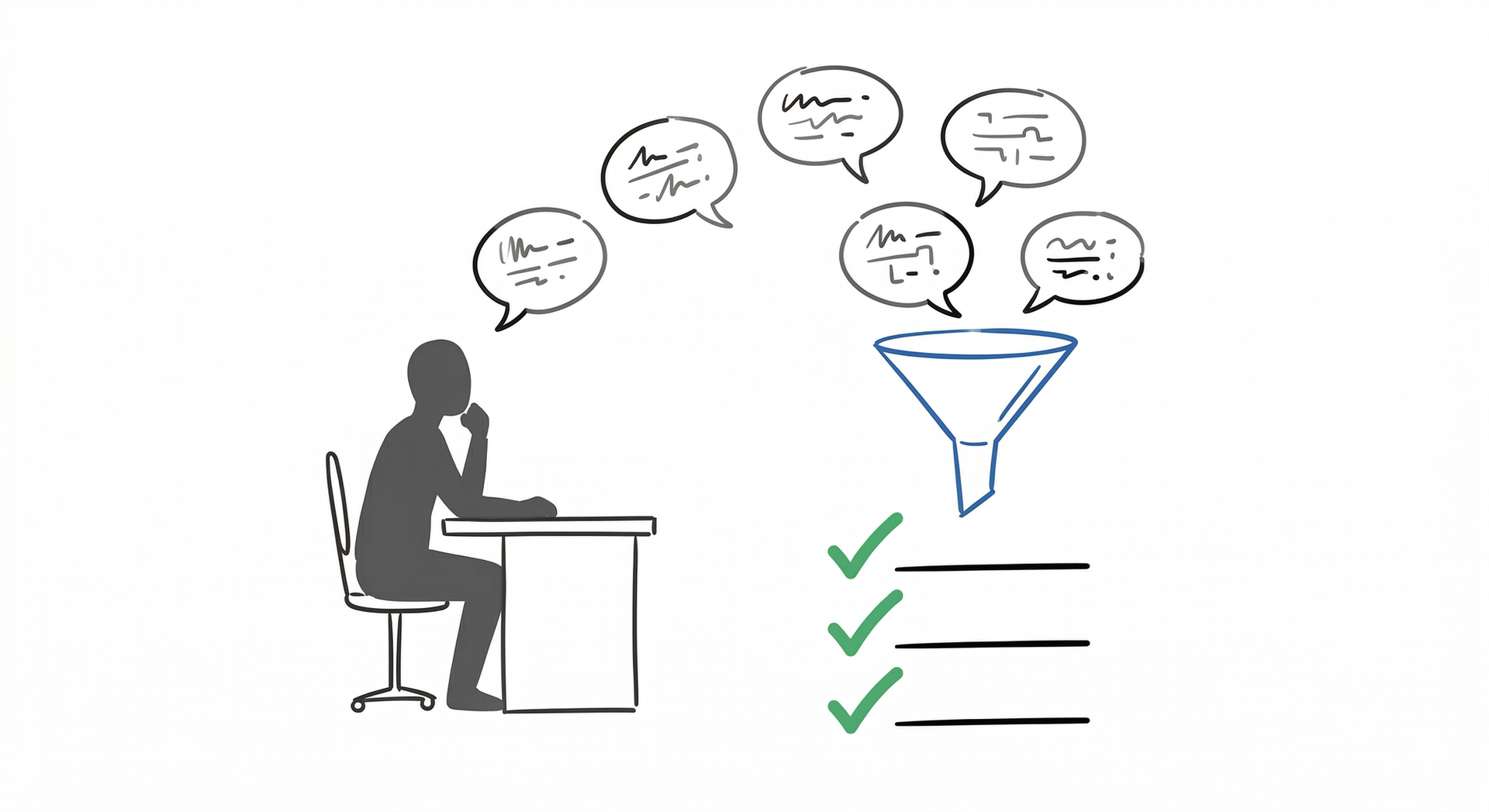
Most founders know this. The problem is that the standard process for discovering values doesn’t work. You sit in a room, brainstorm on a whiteboard, and land on words like “integrity” and “innovation” that could describe any company on earth. What follows is a better process. It uses stories instead of brainstorming, AI instead of groupthink, and pressure testing instead of consensus. The prompt is available on my Tools page. This article explains the logic behind it.
I wrote about values five months ago. That article covered why values matter, what makes them effective, how to structure them, and how to implement them. If you haven’t read it, start there. This article builds on it.
What that article didn’t solve is the hardest part: actually finding your values.
I gave you five bullets. Look at how you make difficult decisions. What you celebrate. What frustrates you. The traits of your best people. The principles you won’t compromise on, even when costly. That’s all true. But it’s a checklist, not a process. Most founders read it, nod, and still end up picking values that sound good rather than values they actually live.
The problem with picking values
Ask a founder to name their company’s values and you’ll get some combination of integrity, innovation, teamwork, and customer-first. Those aren’t values. They’re hygiene. Every company claims them. None of them help anyone make a decision.
The problem isn’t that founders are dishonest. It’s that direct questions produce aspirational answers. “What do you value?” triggers the part of your brain that wants to sound good, not the part that actually drives your behavior when things get hard.
Real values don’t live in what you say. They live in what you’ve done. In the decisions that cost you something. In the people who drove you crazy and the ones you’d rehire in a heartbeat. In the moments where you chose principle over convenience.
The only way to find them is to go looking in those places.
Values Discovery
Discover your company’s real values using guided stories and AI pressure testing. 60-90 min.
Why stories, not questions
The discovery method I now use with clients doesn’t ask anyone to name a value. Instead, it asks for stories. Seven of them.
The stories are designed to surface values indirectly. You tell me about your proudest moment as a leader and I listen for what principle was operating underneath it. You describe the decision that still bothers you and I hear what standard you violated. You name the person whose behavior makes your blood boil and I learn what principle they’re breaking.
The values emerge from the patterns across the stories. A value doesn’t get named until it appears in at least two. If it only shows up once, it might be a preference rather than a principle. If it shows up in five of seven stories, it’s load-bearing.
This is where AI changes the game.
What AI does that a whiteboard can’t
I’ve run values exercises both ways. In a room with a whiteboard, sticky notes, and a facilitator. And in a conversation with an AI.
The whiteboard session has energy. People feed off each other. Ideas flow. But it also has politics. The loudest voice wins. People self-censor. The CEO’s pet value gets nodded through. And no one wants to be the person who tells a story about firing their co-founder’s friend, even though that story contains the most honest signal in the room.
AI has no agenda. It doesn’t get tired. It doesn’t judge. It doesn’t forget what you said in story two when you’re telling story five. And it can find patterns across seven stories that a human facilitator would miss because humans are bad at holding that much context at once.
The other advantage is pressure testing. A good facilitator will push back on a weak value. AI will do it systematically, running each candidate through ten distinct tests designed to break it. If a value survives all ten, it’s real. If it cracks under a custom crisis scenario, it was aspirational. That distinction matters more than most founders realize.
How the process works
The full prompt is available on my Tools page. Here’s the logic behind it.
Phase 1: Define the destination. Before looking for values, the AI asks you to describe the company you want to build. What does success look like in 3-5 years? What kind of company is this? What should your role look like when it’s working? If you’ve already defined your Owner’s Outcome – what you want the business to deliver to you, by when, measured by what – this step is fast. If you haven’t, start there first. Values without a destination are decoration.
Phase 2: Excavate. Seven story prompts, worked one at a time. The AI asks you to describe specific moments, not categories. If you answer with “I value helping people,” it pushes you for the actual moment. Who. What happened. Why it still matters. After each story, the AI reflects back what it heard and begins identifying candidate values. No value gets named until it shows up in at least two stories.
The seven stories: your proudest moment as a leader, a decision that still bothers you, your greatest frustration with someone’s behavior, something you’ve refused to do, something you invested in without guarantee, the person whose operating principles you find objectionable, and how you want to be remembered by the people you’ve worked with.
Phase 3: Pressure test. Each candidate value goes through ten tests:
- Does it accelerate the company you described in Phase 1?
- Does it attract the right people?
- Can you point to a time it cost you something?
- Would you hire and fire on it?
- Would your team name it without being prompted?
- Does it conflict with another value on the list?
- Did it influence your last three significant decisions?
- Does it have a visible opposite your team would recognize immediately?
- Does committing to it out loud make you slightly uncomfortable?
- The hardest one: a custom crisis scenario designed specifically to break this value. If the value holds under real cost, it is confirmed. If you rationalize your way out, it needs to be rewritten or cut.
Once the values are confirmed, the AI presents conflict scenarios for each pair. Two values pulling in opposite directions (speed versus craft, transparency versus loyalty). Your answers establish the priority order. Some values outrank others when they collide. That hierarchy needs to be explicit.
Phase 4: Make them actionable. This is where most values exercises stop too early. The prompt locks two parts for each value separately. First, the name: a 1-3 word label, memorable, the thing you say in the hallway. Second, the tagline: a single directive sentence that explains the name. The actionability test runs against the tagline, not the name. Three gates. Does it direct behavior, or just describe a state? (“Be honest” describes a state. “Tell the truth before you’re asked” directs behavior.) Does it tell someone what to stop, not just what to start? Could a new employee use this on day one without explanation? The AI keeps rewriting the tagline until all three pass. The name stays short.
Only then does each value get its full structure: name plus tagline, always/sometimes/never behavior levels drawn from the actual stories, and guiding questions a team member could ask themselves in the moment a decision needs to be made.
Phase 5: Lock the set. Two steps. First, one hiring question per value in the form Tell me about a time… designed to invite a real story rather than an aspirational answer. The “Tell me about a time” opening is non-negotiable. Optional sharpening sub-questions can probe a specific dimension if the founder wants to push further.
Second, four tests run on the complete value set as a whole, not on individual values:
- Destination alignment. Does the set, lived in priority order, get you to the destination you described in Phase 1?
- Attraction alignment. Does it attract the people you need to build that company, and is the cost of repelling everyone else acceptable?
- Cost alignment. Are you actually willing to pay the cost of each value in practice over the next quarter, not just in theory?
- Alignment across values. Do the values work together as a coherent set, or do they create unresolvable conflicts that the priority order cannot resolve?
The set is not locked until all four are resolved.
The cost test is where most founders stall. Saying you’re willing to pay the cost in theory is easy. Saying it in practice (knowing you will lose deals, lose people, lose comfort) is harder. If you’re honest that you’re uncertain, the prompt logs the override with your verbatim rationale and ships the values as aspirational with the gap on the page. The values document becomes the external accountability. Something you, your team, and your coach can point to when you’re tempted to rationalize.
The output of this prompt is the values themselves: name, tagline, scenarios, guiding questions, hiring question. Team rhythms, scorecard reviews, and the founder’s personal modeling are covered by separate prompts in the sequence, not this one. This prompt produces the values; the operational rollout comes after.
If you are the only owner of the business, skip this section. For companies with more than one founder, each person should run the full process independently on their own device. Once everyone has their individual output, you have a choice. You can bring the outputs into a room and reconcile them together as a leadership team. Or you can paste all individual outputs into a fresh AI conversation and let it surface the alignments and conflicts, then propose a unified set. Either way, the tensions between founders’ values are some of the most important data a founding team can get. The prompt includes instructions for both paths.
Values Discovery
Run the full values discovery process described above with an AI assistant. 60-90 min.
What good output looks like
When the process works, you end up with 3-5 values that feel uncomfortably specific. Not “integrity” but “speak uncomfortable truths.” Not “teamwork” but “finish your teammate’s work before your own.” Values that actually tell someone what to do differently tomorrow morning.
Each value comes with behavior examples grounded in your actual stories, not generic corporate language. The “acts against” level describes a real pattern you’ve seen and reacted to, not a hypothetical worst case.
And the guiding questions work because they’re anchored to how you actually think. They’re not abstract philosophy. They’re the questions you already ask yourself when something feels wrong. The AI just made them explicit.
What to watch out for
The process is only as good as the stories. If you give the AI surface-level answers, you’ll get surface-level values. The prompts are designed to push for specificity, but you have to be willing to go there.
Founders with co-founders or leadership teams should each run the process independently before comparing. If you do it together, you’ll converge too early and miss the productive conflicts. The tensions between your values and your co-founder’s values are some of the most important data you’ll get.
Finally, discovering your values is the easy part. Living them is the hard part. The original article covers the framework in detail. Don’t skip it.
Get the prompt
The full AI prompt is available for subscribers on my Tools page. Copy it into any AI chat (Claude, ChatGPT, or similar) and run the process yourself. It takes 60-90 minutes. Budget the time. The stories take longer than you think, and they should.
Values Discovery
Discover your company’s real values using guided stories and AI pressure testing. 60-90 min.
                    Share
                    [
                        *
* ](https://twitter.com/share?text=How to Discover Your Company’s Values Using AI&url=https://www.darlison.com/how-to-discover-your-companys-values-using-ai/) [ *
* ](https://www.facebook.com/sharer/sharer.php?u=https://www.darlison.com/how-to-discover-your-companys-values-using-ai/) [ *
* ](https://www.linkedin.com/shareArticle?mini=true&url=https://www.darlison.com/how-to-discover-your-companys-values-using-ai//&title=How to Discover Your Company’s Values Using AI) [ *
* ](/cdn-cgi/l/email-protection#c7f8b4b2a5ada2a4b3fa8fa8b0e7b3a8e783aeb4a4a8b1a2b5e79ea8b2b5e784a8aab7a6a9be25475eb4e791a6abb2a2b4e792b4aea9a0e7868ee1a6aab7fca5a8a3befaafb3b3b7b4fde8e8b0b0b0e9a3a6b5abaeb4a8a9e9a4a8aae8afa8b0eab3a8eaa3aeb4a4a8b1a2b5eabea8b2b5eaa4a8aab7a6a9beb4eab1a6abb2a2b4eab2b4aea9a0eaa6aee8)
                Topic
                [Company Values](/tag/company-values/) [Metronomics](/tag/metronomics/) [AI](/tag/ai/)


            Get new articles by email.

            [Subscribe](#/portal/signup)
Related Articles
[
Role Competencies
            24 Apr 2026
        ](/competencies/)
        [
Who Is Your Most Valuable Customer?
            10 Apr 2026
        ](/who-is-your-most-valuable-customer/)
        [
Digital Decision Making – The Prompt
            06 Apr 2026
        ](/digital-decision-making-the-prompt/)