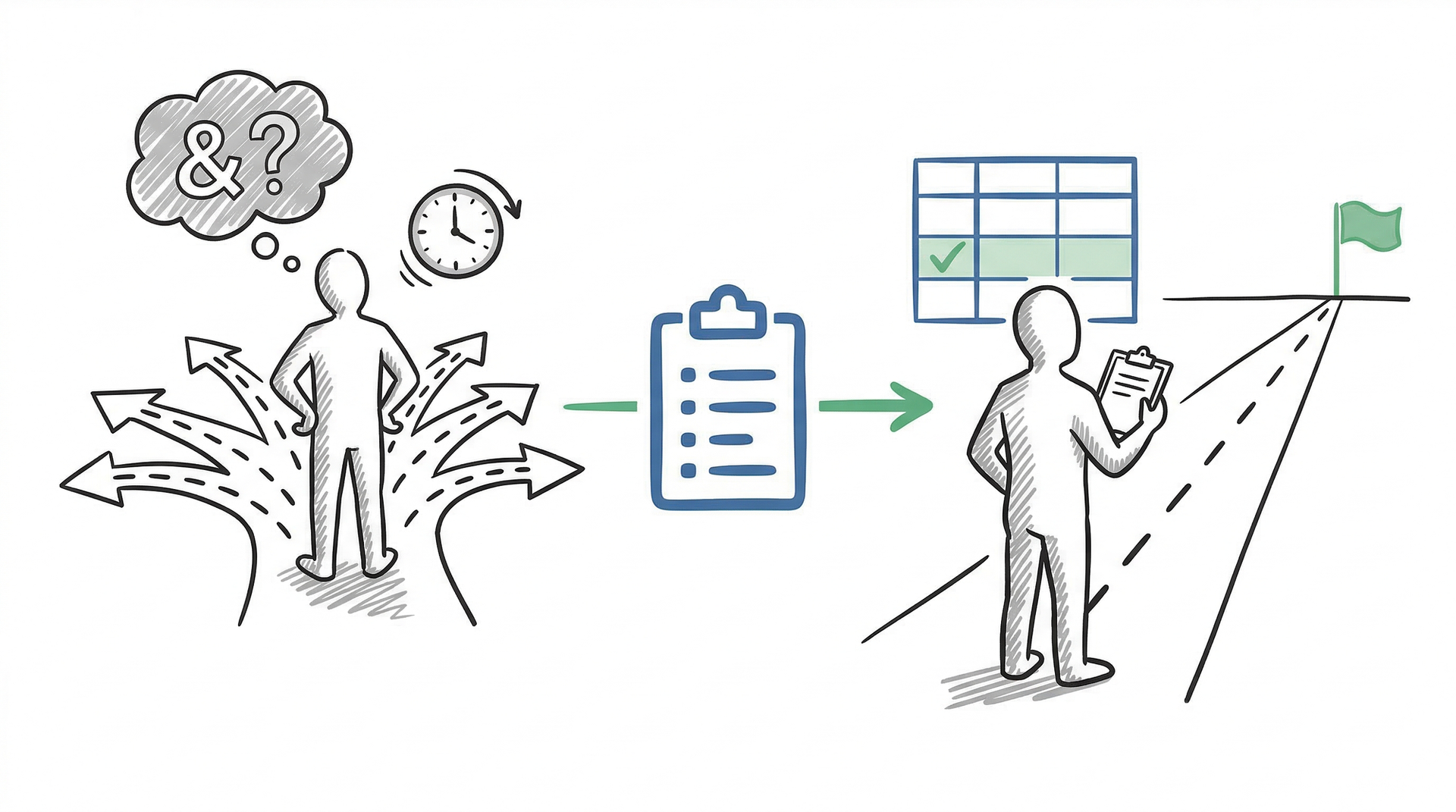
I wrote previously about defining your Owner's Outcome - the personal reason you are in business. What you want the business to deliver to you, by when, measured by what.
That article made the case for why this matters. This one covers the how. How to define the Owner's Outcome properly, how to review it on a regular cadence, and how to use it as the single standard against which you evaluate everything the business does. Including, if you have one, whether your coaching engagement is worth the investment.
The Point of Having One
If you founded or own a business, every decision you make should be moving the business closer to delivering what you personally want from it. That sounds obvious. It almost never happens.
What happens instead is that decisions get made for business reasons. You read an article about a new go-to-market strategy and reorganize around it. A competitor launches something and you chase it. An advisor suggests scaling and you start hiring. Each decision might be sound business thinking. But none of them are connected to a defined personal outcome. You are designing the business to achieve business goals that may have nothing to do with what you actually want from it.
The Owner's Outcome changes that. It gives you a fixed standard against which every decision gets evaluated. Should I take this client? Does it move me closer to my Owner's Outcome or further away? Should I hire this person? Should I invest in this system? Should I enter this market? The answer is always the same question: does this serve what I said I want, or does it serve something else?
Without that standard, you end up building whatever the loudest input of the day tells you to build. With it, your decisions compound in one direction.
This applies to founders. It applies to owner-operators. It applies to anyone who created the business and has the authority to shape it. It does not apply to hired executives running someone else's company. They have a mandate, not an Owner's Outcome. The distinction matters because the Owner's Outcome is personal. It is yours. It is the reason you took the risk in the first place.
At the end of this article I have included a prompt that you can paste into any AI assistant to have it guide you through the full process conversationally. You do not need a coach for the first draft. You need honesty and 45 minutes. If you already know you want it and do not need the explanation, skip to the prompt.
Owner's Outcome Assessment
Get a complete Owner's Outcome document with your personal definition of success and a gap scorecard. 30-60 min.
The Process
Defining the Owner's Outcome is not a vision boarding exercise. It is structured, sequential, and deliberately uncomfortable. The process has three parts: define what you want, map the gap between where you are and where you said you want to be, then commit to one specific action to close the most important gap.
Here is what each part covers and why it is ordered this way.
The three parts produce four elements you can hold and point at: a Statement (one sentence defining what you want, by when, measured how), the Guardrails (what failure looks like even if the numbers hit, your non-negotiables, your cash floor, whether home is aligned), a Gap Scorecard (where you are versus where you want to be across time, money, role, team, risk, and value or exit), and The One Thing (the single action you are committing to in the next 90 days). The Statement tells you where you are going. The Guardrails tell you what you will not trade to get there. The Gap Scorecard tells you what is in the way. The One Thing tells you what you are doing about it this quarter.
Part 1: Define What You Want
Most owners, when asked what they want, default to describing a better business. More revenue. Better team. Smoother operations. That is not the Owner's Outcome. Those are business goals. The Owner's Outcome is what the business delivers to the owner's life. The distinction matters because you can build an impressive business that delivers outcomes you never wanted.
The process starts with life, not business. What does your day look like if everything works? Not your org chart. Not your revenue. Your Tuesday.
From there it moves through a sequence designed to surface what actually matters to you, not what sounds good on paper.
The anti-outcome. What you refuse to tolerate. Most owners articulate what they do not want faster and more honestly than what they do want. "I never want to be checking my phone at my kid's game" is sharper than "work-life balance." This creates the hard boundaries your Owner's Outcome must respect.
Non-negotiables. The rules you will not break even if they cost you money or growth. Time constraints. Health constraints. Relationship constraints. The kind of work you will and will not do. These are different from the anti-outcome. The anti-outcome is the end state you refuse to accept. Non-negotiables are the rules you refuse to break along the way.
The people question. Who do you want to spend your working hours with? What do those relationships feel like? For some owners this is the most important question in the entire exercise. It shapes client selection, pricing, hiring, and capacity. For others it is less central. Either way, it reveals whether you have thought about the human dimension of the business you are building.
Home alignment. Does your spouse or partner know what you want from this business? Do they agree? This is upstream of everything. An owner can define a perfect Owner's Outcome, and if the person at home has a fundamentally different expectation of what the business should deliver to the family, the whole thing comes apart. Especially around income, time, and risk.
What kind of business are you building? A lifestyle business that funds the life you want without consuming it. A growth business you intend to scale and sell. A craft business you run because the work itself is the point. Something else entirely. Be specific about what you are willing to invest and what you are not. Capital, time, risk, complexity.
Risk tolerance and cash floor. How much risk are you comfortable carrying? How much cash do you need in the bank to weather a storm, take advantage of an opportunity in a downturn, or simply sleep at night? Your cash floor is the minimum amount of cash you need in the bank at all times. Below that number, you stop making new commitments until it recovers. It is the line between making decisions from confidence and making decisions from anxiety. Some owners want to bet aggressively on growth. Others want stability and predictability above all else. Your risk tolerance and your cash floor shape everything from hiring decisions to how you respond when things go wrong. Name your number.
Money. What annual income do you need the business to deliver to you personally? One number, not a range. Then the harder question: what does that number make possible that is not possible today? Money alone rarely sustains motivation. What the money enables is where the truth lives.
Time. How many hours per week do you want to spend on this business? Not someday. What is the target, and by when? What are you willing to invest to get there, and what are you not willing to invest? An owner who wants 20 hours but will not hire, outsource, or spend money on systems has a contradiction, not a plan.
Role. What are you doing during those working hours? What are you deliberately not doing? This surfaces whether you want to be the operator, the strategist, the chairman, or gone entirely. It also forces you to confront what you are willing to hand off.
The measurement lock. You will know you have achieved your Owner's Outcome when what is true? Name no more than three specific measures. Things you can count, observe, or answer with a yes or no. If you cannot state unambiguously when you have achieved it, you do not have an Owner's Outcome. You have a wish.
The statement. Everything above gets distilled into one sentence: I am in business because I want [what you personally want], and I will achieve it by [specific date], as measured by [your measures].
The integrity test. Four questions. Is this what you genuinely want, or what you think you should want? Would you hold to this even when it gets harder than expected? Can you say it to someone in 30 seconds without hedging? If you had a partner and they wrote a different statement, would that be a problem?
If you answer no to any of those, you are not done yet.
Part 2: Map the Gap
Once the Owner's Outcome is locked, you map the distance between where you are today and what you just said you want. Optimism here costs you clarity.
Six areas, compared side by side.
Time. How many hours are you currently working versus your target? Are those hours being spent doing what you actually want to be doing?
Money. What is your current income from the business versus your target? How much cash is in the bank versus your cash floor? Is the income gap a pricing problem, a volume problem, or a structural problem?
Role. What are you actually spending your time on versus the role you described in your Owner's Outcome? Are you doing work you should not be doing, or not yet doing the work you want to be doing?
Team. Do you have the people to support the target state? Are you working with the type of people you want to be working with? If you left for 30 days with no contact, what would happen? If the answer concerns you, name what would need to change. If you are comfortable with the answer, that tells you something useful too.
Risk. How much risk have you taken on? Are you comfortable with it? Is your current exposure within the tolerance you stated, or has it drifted? Do you have enough cash in the bank to feel comfortable making the decisions you need to make?
Value and exit readiness. This only applies if your Owner's Outcome involves selling the business or reaching a specific enterprise value. If it does, what is the current estimated value, what does the target require, and is the timeline realistic?
The output is a simple scorecard. Where you are. Where you want to be. The gap. No commentary. Just facts.
Part 3: Close the Gap
Close one gap at a time every 90 days. Not all at once. Not in parallel. One gap, one action, one quarter. The other gaps are still there, but they are explicitly deferred until the one thing is done.
The last step uses a framework from Robert Fritz's The Path of Least Resistance and The Managerial Moment of Truth: structural tension. The idea is simple. You define where you want to be. You define where you are. The discrepancy between the two creates tension, and that tension seeks resolution. Your job is to resolve it by changing reality, not by lowering the goal.
Pick one discrepancy. The single structural problem that, if resolved, would have the largest effect on moving you toward your Owner's Outcome. Not two. Not three. One. All of the other problems will still be there in 90 days. You do not want to split your attention between multiple priorities and get nothing done. Just pick the one that matters most.
For that one discrepancy, define the action that would eliminate it. Not a wish. Not a general intention. A specific action with a date by when it will be completed. The measure of success is that the discrepancy closes.
Name the other discrepancies. Write them down. They are real. But they are explicitly deferred until the one thing is done. They become the focus of future review cycles.
This is where the exercise earns its value. Most owners know they are not where they want to be. Fewer can name precisely why. Fewer still commit to one specific action with a deadline and protect it from everything else competing for their attention. The ones who do are the ones who move.
Do not take the output at face value. The prompt produces a first draft. If you have a coach, advisor, or mentor, bring the document to them. Use them as a sounding board. The action the AI defined may be the right one, or it may miss something that a person who knows your business would catch. Review the action, the priority, and the date with someone who can push back. If that conversation produces changes, update the document. Note what changed and why. Those refinements become part of the baseline for your next quarterly review, so the process gets sharper over time rather than restarting from scratch every 90 days.
Owner's Outcome Assessment
Walk through the full Owner's Outcome process with an AI guide that asks the right questions in sequence. 30-60 min.
The Review
Defining the Owner's Outcome is the first step. The review is what makes it useful.
Every 90 days you sit down with your Owner's Outcome document and work through a structured check. The first question is not "how do I feel about the quarter." The first question is: did I complete the one action I committed to in the last review?
If you committed to hiring an operations lead by March 15, did you do it? Start with the commitment. Yes or no.
From there, you measure the effect. For each dimension of your Owner's Outcome, state the goal, state the current reality, and name the discrepancy. If the action you took closed the gap, you can see it in the numbers. If it did not, that tells you the action was wrong, the execution was incomplete, or the problem was different than you thought. Each of those requires a different response.
Then you commit again. Look at the remaining discrepancies, including the ones you deferred last time. Pick the one that now has the largest effect. Define the action, the date, and the expected result. The cycle repeats every quarter. This is Fritz's structural tension at work: goal, reality, discrepancy, action, resolution. Over and over until the tension resolves because reality matches the goal.
As with the initial assessment, do not treat the review output as final. If you have a coach, review the updated document and the new action with them. Let them challenge the priority and the date. Note any refinements in the document so they carry forward.
Three additional questions complete the review.
Are the business decisions I made this quarter aligned with this outcome? Look at the actual decisions. Hires, investments, priorities, things you said no to. Did they move you toward your stated outcome, or did they serve something else?
Is the timeline still realistic? Your Owner's Outcome has a date on it. Given what you now know, is that date still achievable? If not, what changed?
What is the one thing that would have the largest effect in the next 90 days? Not a list. One thing.
How Often
Quarterly. Frequent enough to catch drift early. Infrequent enough to see real movement.
Put it on the calendar. Treat it like a board meeting with yourself.
What Changes
The review only matters if it changes something.
If you are on track, the review is short. Confirm the trajectory, note what is working, move on.
If you are off track, the review becomes a diagnostic. Where is the gap?
Strategy problem. The business model or growth plan is structurally incapable of delivering your Owner's Outcome. You need to change what the business does or how it does it.
Execution problem. The strategy could deliver the outcome, but you or your team are not executing. Priorities are scattered. Accountability is weak. The cadence is broken.
Clarity problem. Your Owner's Outcome itself is vague, contradictory, or no longer what you actually want. Go back and redefine it before anything else makes sense.
Most gaps are execution problems. The honest ones are clarity problems.
The Coaching Question
If you are working with a coach, the Owner's Outcome review is also the evaluation of that coaching engagement. Not in a vague "do I feel good about coaching" sense. In a measurable one.
Two questions.
Am I closer to my Owner's Outcome than I was 90 days ago? Measure it the same way you measure everything else. Numbers, not feelings.
Did the coaching relationship contribute to that progress? This is a separate question. Progress can happen despite coaching, not because of it. And coaching can be excellent while progress stalls because of factors the coach cannot control. Both of those situations require different responses. The first means the coaching is not working. The second means something else is in the way. Be honest about which one you are looking at.
A good coach will welcome this conversation. The Owner's Outcome is the scorecard for the relationship. If the engagement is not producing measurable progress toward your stated outcome, both of you need to know that.
This is also why "every quarter stands on its own" matters as a principle. If you cannot point to progress after a quarter of coaching, you should be able to walk away. No sunk cost reasoning. No guilt. The data decides.
Evaluating Against the Outcome, Not the Feeling
If you work with a coach, advisor, or peer group, you have probably been asked some version of "How is it going?" That question invites a feeling, not a measurement.
Compare these two answers.
"I feel like I'm getting a lot out of it. The conversations are really valuable."
"Six months ago I was working 55 hours a week, taking home $140K, with $45K in the bank. Today I am working 38 hours, taking home $160K, with $72K in the bank. My Owner's Outcome target is 20 hours and $200K by January 2028, with a cash floor of $80K. The gap is closing on all three dimensions. Time is moving the slowest. In the first quarter I committed to hiring an operations lead and I did it. My coach helped me refine the role definition and challenged my original timeline, which made the hire better. In the second quarter I committed to handing off client delivery to the new ops lead and a contract delivery resource. That is in progress. I have not yet addressed the income model question, which is deferred until the delivery handoff is complete."
The first answer tells you nothing. The second tells you exactly where you stand, what is working, what is not, whether you followed through on your commitments, and what the coaching contributed. That is the difference between evaluating a feeling and evaluating against a defined outcome.
Define Yours
I have built an AI prompt that will guide you through the full Owner's Outcome definition process. It starts with a few setup questions to configure your tools and preferences, then walks you through the assessment one question at a time. It covers everything described in this article: the definition sequence, the gap mapping, and the action commitment using Fritz's structural tension framework. It also includes the quarterly review prompt embedded in the output, scheduled to your fiscal quarters, so each quarter you open the document and the review begins.
You do not need a coach for the first draft. You need honesty and 45 minutes.
About the Prompts
The prompts are free to use and a work in progress. If you find problems, if a question does not land right, if the output misses something important, I would like to hear about it. And if you improve on them, I would appreciate it if you shared what you changed and why. You can reach me at [email protected].
The review framework within the prompts is based on Robert Fritz's concept of structural tension, described in The Path of Least Resistance and The Managerial Moment of Truth. The core idea is his: define the goal, define current reality, and let the discrepancy between the two drive specific action toward resolution. I have applied his framework to the Owner's Outcome review cycle, but the underlying structure belongs to Fritz. If this approach resonates with you, read his work directly.
Owner's Outcome Assessment
Get your Owner's Outcome document, gap scorecard, and 90-day action plan in one session. 30-60 min.