
Strategy without a target is just activity. The most important decision you will make is not what to build. It is who to build it for.
The problem
Most companies serve anyone who will pay. The result is a scattered strategy, inconsistent service, and margins that vary wildly by customer. Some customers are incredibly profitable. Others consume more resources than they generate. Most founders know this intuitively but have never committed to which customer type the company is built around.
In my previous company, Rise Vision, we served over 100 industries in 110 countries. Digital signage for schools, hospitals, retail, corporate offices, churches, restaurants. Anyone who needed a screen. We were average at everything and exceptional at nothing. When we finally defined our Core Customer as K-12 schools in North America and built the entire strategy around that one buyer, the business went from break-even to 20% net profit margins sustained over five consecutive years. Revenue growth accelerated from low single digits to 20% per year. The company sold at greater than a 5x multiple of recurring revenue. The single most important strategic decision we made was choosing who we were building for and, equally, who we were not. Picking K-12 got everything moving. But it was Donald Miller's StoryBrand framework that turned that choice into rocket fuel. When we stopped describing our product and started describing our customer's problem, in their words, from their perspective, everything changed. The messaging landed differently. Customers started using our language to describe their own needs back to us. Product, marketing, sales, and support were all telling the same story for the first time. We read the book, took the courses, hired a certified StoryBrand implementor, and trained the entire company on the approach. In hindsight, it was one of the most significant changes we made.
In my experience coaching founders, the hardest part is not identifying the right customer. Most founders can point to them. The hardest part is choosing one and letting go of the rest. The fear of missing out is real. Every customer who pays feels like validation. Turning away revenue feels reckless, especially when cash flow is tight. So the founder serves everyone, optimizes for no one, and wonders why the strategy never gains traction. The Core Customer exercise does not ask you to find a new answer. It asks you to commit to the one you already know.
Shannon Susko identifies the Core Customer as one of the most important strategic decisions a founder can make. It is described in detail in 3HAG WAY and Metronomics. What follows also draws on Verne Harnish's Core Customer and Sandbox concepts from Scaling Up, on Robert Bloom's WHO from The Inside Advantage, and on Donald Miller's work on customer personas and problems in Building a StoryBrand. What I describe here is a synthesis informed by running and coaching these systems in founder-led companies. I strongly recommend reading the original sources.
If you want to jump straight to building, there is an AI prompt that walks you through the four questions, the profile, the persona, the reachability test, and the Core Customer statement step by step. It is available at darlison.com/tools. What follows is the full explanation.
Core Customer Discovery
Identifies your most valuable customer type, builds a persona, tests reachability and market size, defines an identity transformation, and produces a Core Customer statement with behavioral criteria. 30 min.
What the Core Customer Analysis is
A detailed profile of one customer type: who they are, what they need, and the benefits you offer to serve those needs. If you have a team, it should be built together, not by one person in isolation. If you are a founder working through this on your own, the discipline is the same. Write down what you believe, test it against your data, and be honest about where the answers surprise you.
The profile has three layers. First, a description of the customer type. Not a persona with a name and a stock photo. A structural description. What industry they are in, what size they are, how they buy, and why they buy from you. Second, their top needs. The things they care about most when choosing a provider. Not what you wish they cared about. What they actually evaluate. Third, the benefits your company provides against each need. Where you are strong. Where you are weak. Where you are honest about the gap.
Shannon's key insight is that the Core Customer Analysis is never finished. The market evolves. Customer needs shift. What was true six months ago may not be true now. The discipline is continuous validation, not a one-time exercise. The first version is a gut feel. The tenth version is informed by revenue data, retention data, and profitability data. Both are useful. The first gets you to a starting point. The tenth keeps you honest.
The Core Customer is a hypothesis. A working answer. It will be tested by the next two tools in this series. The Market Map will show you whether you can actually reach this customer type, where they sit in the marketplace, and who else is competing for them. The Attribution Map will show you where you stand against your competition and whether there is open space in the market that supports your Core Customer choice or points somewhere unexpected. All three tools need to reconcile. If they do not, you come back and revise. The strategic pictures are designed to challenge each other, not just confirm what you already believe.
This is the first of three strategic pictures you will build. The Core Customer Analysis defines who you are building for. The Market Map, which follows, shows the full marketplace ecosystem and tests whether you can reach them. The Attribution Map tests whether you are differentiated in a way that matters to them. Together, the three tools validate the 3 Year Highly Achievable Goal [3HAG] from the outside in.
How to find them
The process starts with four questions, designed to get past assumptions and into evidence. If you have a CRM, billing system, or even a spreadsheet of past customers, the answers to most of these are already in your data. You are not inventing anything. You are looking at what the numbers already say.
If your business is brand new or too early to have referral and retention data, the questions still work. Reframe them: for referrals, ask yourself “based on the relationships I already have, who would I expect to refer me, and why?” For repeat buyers, ask “which type of customer do I believe would stay longest, and what makes me think that?” Accept the answers as hypotheses and note them as untested. The discipline of answering forces clarity even when the data does not yet exist.
First. Who have you served in the past that you would love to work with again? Not the biggest budget. Not the most prestigious logo. The customer you genuinely enjoyed serving and who valued what you provided.
Second. Who has referred the most business to you? Referral behavior is one of the strongest signals of fit. Customers who refer do so because the experience matched what they expected. That match is what you are looking for.
Third. Who keeps buying from you? Not who bought once. Who came back. Who renews. Who has been with you for years. Repeat and recurring customers are telling you something with their behavior that no survey will capture. They are choosing you again, which means you are doing something right for that type of buyer.
Fourth. Among those three groups, who has a specific problem you can solve in a distinctively better way than anyone else?
The Core Customer lives at the intersection of all four answers. A customer type you enjoy serving, who refers others, who keeps coming back, and who has a problem you solve better than the alternatives. If the four answers do not overlap, that gap is the most important thing the exercise reveals. If you cannot pick one, ask which customer type you would keep if you could only serve one. That is your Core Customer.
If you have a team, compare answers. There will be differences. Those differences are not a failure of the exercise. They are the exercise. Every gap represents a place where the company is not aligned on who it is built for. Discuss the differences. Not to find a compromise. To make a decision. A company that is aligned on one customer type, even an imperfect choice, will outperform one that is optimizing for five different buyers.
If you are working through this on your own, the same discipline applies. Write down your answers to all four questions. Look for the overlap. Look for where the answers surprise you. The goal is not to confirm what you already think. It is to see what the evidence says.
How to build the profile
Once you have agreed on a customer type, the profile goes deeper. Donald Miller's Building a StoryBrand provides the clearest framework I have found for understanding a customer from the inside out. The dimensions below draw heavily on that work.
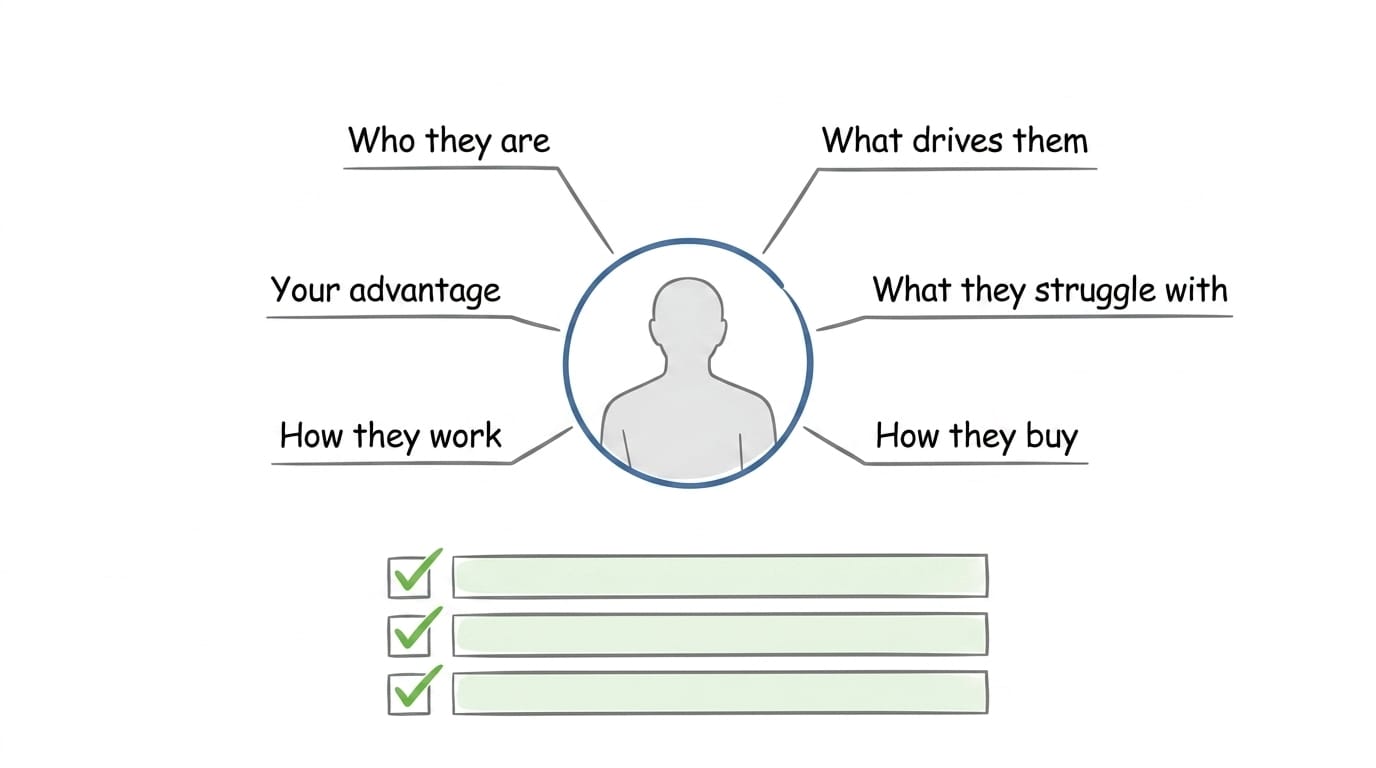
Who they are. What industry, company size, revenue range, geography, and role defines this buyer? Be specific enough that you could build a list. "SMBs" is not a customer type. "Owner-operated B2B services companies with 15-50 employees and $2M-$8M revenue in the northeast US" is getting closer.
What drives them. This is where Miller's StoryBrand framework is especially useful. What are they afraid of? What do they value most? What do they aspire to? Miller distinguishes between the external problem (what is visibly broken), the internal problem (how that makes them feel), and the philosophical problem (why it should not be this way). All three matter. A founder who is stuck in the day-to-day of their business has an external problem (no systems). But the internal problem is the one that drives the decision: the frustration of working harder than ever and feeling like they are running in place. Understanding this distinction is the difference between a profile that helps you sell and one that helps you connect.
What they struggle with. What are the challenges, frustrations, and pain points they experience? Not the ones you solve. The ones they have. The overlap between their problems and your capabilities is where the fit lives, but you need to see their full picture first. Miller calls this understanding the character's problem. The character is your customer. The problem is what sets the story in motion.
How they buy. Do they buy on emotion or logic? What is the sales cycle? Who influences the decision? A customer type that buys through a six-month RFP process is fundamentally different from one that decides after a single conversation, even if both need the same product.
How they work. What is their business model? How do they make money? What does their day-to-day look like? Understanding their operating reality helps you understand what "value" actually means to them. For a 10-person company, this might mean the founder is also the one evaluating your product, signing the check, and doing the implementation. The entire buying journey lives in one person.
Your advantage. Which of your strengths matter most to this customer type? Which can only you provide? If every competitor can match you on the things this customer cares about, you do not have an advantage. You have a commodity. Robert Bloom calls this your "uncommon offering" in The Inside Advantage. It is not what you do. It is what you do that matters to this specific buyer and that competitors cannot easily replicate.
The data narrows the field. The decision picks one. You are looking for clarity, not completeness. If you can describe each dimension in two or three sentences, that is enough to move forward.
For each of these, identify the top three needs. The things this customer type cares about most when choosing a provider like you. Not five. Not ten. Three. This is harder than it sounds. Most founders list what they think should matter rather than what actually matters. The question is not "what do we do well?" The question is "what does this customer evaluate when deciding whether to buy from us or from someone else?"
For each need, identify the benefit your company provides. Be honest about where you are strong and where you are weak. A Core Customer profile that shows all strengths and no gaps is not a profile. It is a brochure. The gaps are where the strategic work lives.
Core Customer Discovery
Walks you through the four questions, profile dimensions, persona naming, identity transformation, reachability and market size test, and behavioral criteria step by step. 30 min.
The Core Customer can be a distributor, a channel partner, or an end user. It is whoever buys from you and keeps buying from you. A manufacturing company that sells through distributors may define its Core Customer as the distributor, not the end consumer. A professional services firm that gets most of its work through referrals may define its Core Customer as the referring partner. If your business depends on referral sources, you may need to decide whether the Core Customer is the person who pays or the person who sends the person who pays. The answer determines where you invest. The question is not "who uses the product?" It is "who writes the check, and which type keeps writing it?"
Give them a name
Once the profile is built, name the person. Not a segment. A person. Give them a first name, a job title, and a one-paragraph description of their daily reality. This is the step that turns a customer type into someone the whole company can picture.
At Rise Vision, our Core Customer was Clay. Clay was the overworked, under-appreciated IT administrator inside a K-12 school or district in North America. He had been told to "make digital signage happen" on top of everything else he was already responsible for. He had no dedicated budget, no dedicated staff, and no patience for technology that required a specialist to run. He needed something that worked out of the box, that teachers could update themselves, and that did not create another support ticket in his queue. Every product decision, every support process, every piece of marketing was tested against one question: does this help Clay?
Donald Miller's Building a StoryBrand calls this the character. The character is not a demographic segment. It is a specific person with a specific problem living a specific day. When your team can describe your Core Customer's Tuesday morning, you have a persona. When they can only describe a revenue bracket, you have a spreadsheet.
Push for concrete detail. “Putting out fires” is a category. “Sitting in the truck at 6:45 AM answering texts from his foreman before the crew shows up” is a person. The test is not whether you can describe what they do. It is whether you can describe their Tuesday at 7 AM with enough detail that someone on your team would recognize that person if they walked in.

The named persona does something a profile cannot. It creates empathy and shared language. When someone on the team says "Clay would hate this," everyone knows exactly what that means. It becomes a shorthand for every decision. Would Clay find this? Would Clay pay for this? Would Clay recommend this to the IT admin in the next district? The name makes the Core Customer present in every conversation, even when no actual customer is in the room.
Bring your persona to every meeting. Literally. Put their name on the agenda. When the team is debating a product decision, a pricing change, a new feature, or a market to enter, ask the persona what they think. Would Clay choose this over what he has today? Would Clay understand why this matters? Would Clay tell the IT admin in the next district about it? If you cannot answer those questions from the persona's perspective, you do not understand the decision well enough to make it. The persona is not a reference document you pull out once a quarter. It is a voice at the table that represents the person who pays for everything.
There is one more dimension to the persona that turns a description into a story: who is this person before they work with you, and who do they become after? Before, Greg is overwhelmed, reactive, stuck. Working 60 hours a week, carrying every decision, solving everyone's problems. Unsure whether the business is building anything of lasting value or just keeping him busy. After, he is directed, deliberate, lighter. The business runs on rhythm instead of urgency. Priorities are clear. The team executes without him in every decision. He has built something genuinely valuable and it requires less of him, not more. This before-and-after is not a marketing exercise. It is a design specification. Every product decision, every service improvement, every piece of communication should move the customer from the before state to the after state. If it does not, it does not serve the Core Customer.
The reachability test
There is one more test. Can you walk into a room full of your Core Customer? Where is that room?
This is the question most founders skip, and it is the one that determines whether the Core Customer is actionable or theoretical. If you cannot name a single event, association, online community, LinkedIn group, publication, or channel where 50 or more of your Core Customer gather in one place, you have a problem. Not with your strategy. With your ability to execute it.
Where do they congregate? Do they refer each other? What is the most efficient way to get your message in front of them? If you cannot group them, you cannot reach them efficiently. And a Core Customer you cannot reach is an abstraction, not a strategy.
At Rise Vision, the room was clear. K-12 IT administrators gathered at state and national education technology conferences, subscribed to specific publications, participated in school district technology forums, and talked to each other constantly because they all faced the same problem. We could walk into a state-level ed-tech conference and be surrounded by our Core Customer. That reachability was what made the strategy executable, not just correct on paper.
There is one more test beyond reachability: market size. Can you estimate how many of your Core Customer exist? The number does not need to be precise — an order of magnitude is enough. Thousands? Tens of thousands? Hundreds of thousands? Once you have that estimate, compare it against your three-year revenue targets. How many customers would you need to hit your goal? What share of the addressable market does that represent? If the math does not work — if the population multiplied by a reasonable conversion rate and average deal size cannot support your revenue target — the Core Customer is either too narrow or the target is too ambitious. A Core Customer you can reach but who exists in insufficient numbers is a hobby, not a strategy.
The Market Map, which is the next tool in this series, will test this further. When you map the full marketplace, the channels, the relationships, the way buyers find providers, you will see whether your Core Customer is reachable through paths you can actually build or strengthen. If the Market Map shows that the channels to your Core Customer are controlled by competitors or do not exist, that is a signal. Either you need a different approach to reach them, or you need a different Core Customer.
The Core Customer statement
If the profile is the detailed picture, the Core Customer statement is the sentence that proves you actually understand it. The format comes from the work I do with founders in Entrepreneurs' Organization, and it draws on Miller's StoryBrand clarity of character and problem.
"I serve [specific type of customer] who struggle with [specific problem]. I solve it by [unique approach] which is different because [what only I can do]. The outcome they get is [desired result]."
At Rise Vision, ours would have been: "I serve K-12 school IT administrators who struggle with getting digital signage running without dedicated staff or budget. I solve it by providing a platform built specifically for schools, which is different because no one else builds content that is exclusive for K-12. The outcome they get is digital signage that works without needing a technologist to run it."
Six questions test whether the statement is sharp enough. Can everyone in the company repeat it? Would your best customer read it and recognize themselves? Does it help you say no to opportunities that do not fit? Can you name a room where 50 or more of this customer type gather? Is the problem specific enough that a competitor cannot copy-paste it into their own statement?
Sixth. Is the addressable market large enough to support your growth targets? If the Core Customer population cannot plausibly fund your three-year revenue target at a reasonable conversion rate, something needs to change — either the customer definition widens or the target adjusts.
If any answer is no, the profile needs more work. The statement is not a marketing tagline. It is a compression test. If you cannot fit the Core Customer into one sentence, you do not yet understand them well enough.
There is a final validation that connects the statement back to the evidence. The four questions you started with are not just discovery tools. They map to four behavioral criteria that confirm you have chosen the right customer type. Does this customer pay the premium without negotiating it down? Do they honor commitments and pay on time? Do they buy again, thinking in years rather than transactions? Do they refer others because they are connected in communities and talk about what works? If the answer to any of these is untested, note it. Untested is not wrong. It is a hypothesis that needs validation as the business matures. The behavioral criteria are the bridge between the qualitative profile and the quantitative evidence that will confirm or challenge it over time.
From profile to communication
The Core Customer profile tells you who to build for. The next question is how to talk to them. This is where Donald Miller's StoryBrand BrandScript becomes essential. The BrandScript takes everything you have built, the persona, their problems, what drives them, and turns it into a narrative framework where your customer is the hero and your company is the guide. At Rise Vision, the Core Customer exercise told us who Clay was. The BrandScript told us how to talk to him in his language, about his problem, from his perspective. That shift, from talking about ourselves to talking about Clay's problem, was when customers started using our words to describe their own needs back to us. If you have not read Building a StoryBrand by Donald Miller, read it. Then create a BrandScript for your Core Customer. The book walks you through the entire framework step by step. It is the bridge between knowing who your customer is and communicating with them in a way that actually connects.
Keeping it alive
The Core Customer profile is reviewed at every meeting. Not rebuilt. Reviewed. Has anything changed? Has new data come in that challenges the profile? Has something shifted in the market?
The first version is a hypothesis. Over subsequent months, you validate it with actual revenue data, retention data, and profitability data. Which customers renew? Which ones refer? Which ones pay on time? Which ones consume support resources disproportionate to their revenue? The answers sharpen the profile but the profile never gets "done." The market moves. Customer needs evolve. New competitors change what customers value. The discipline is continuous, not periodic.
Shannon recommends revisiting the Core Customer Analysis at every annual planning session with fresh eyes. Not updating the existing profile. Starting blank. If you build the profile from memory of last year, you will reproduce the same picture. Starting fresh forces a new assessment based on what is true now, not what was true twelve months ago.
When you first complete this exercise, compare the output against any existing customer-related documents — your BrandScript, strategy documents, prior ICP exercises. Flag contradictions. If a BrandScript already exists, the character in the BrandScript and the persona built here should be the same person. If they are not, one of the two needs to change. The most common drift is in revenue range and customer specificity.
The best test of whether the Core Customer profile is alive: when someone proposes a new initiative, does someone ask "does this serve the Core Customer?" If that question is reflexive, the profile is doing its job. If nobody asks, the profile is a document in a drawer. For a founder working alone, the test is whether you ask yourself that question before saying yes to the next opportunity that lands in your inbox.
A note on saying no
Defining a Core Customer does not mean refusing to serve other customers. You are not turning anyone away. You are deciding who you design the experience around. When you have to make a tradeoff, the Core Customer wins. When you have to choose between two features, you build the one that serves the Core Customer. When you have to choose between two prospects, you prioritize the one that matches the profile.
Most businesses drift toward serving anyone who will pay. The result is a company that is average at everything and exceptional at nothing. By choosing one Core Customer and becoming the obvious solution to their specific problem, you create an advantage that is impossible to replicate if you try to serve everyone.
The counterintuitive result: companies that define a Core Customer often grow faster, not slower. Saying no to the wrong customers frees capacity for the right ones. It reduces scope creep. It makes the message clearer. It makes pricing easier because you know what value you deliver to whom. For founders where cash flow is unpredictable because every customer is different and every project scope-creeps, the Core Customer is the structural fix. Not because it eliminates variation overnight. Because it gives you a filter for which opportunities to pursue and which to decline. Over time, the customer base shifts toward the profile. And with it, predictability improves.
Purpose tells you why. Financial targets tell you how big. Your Core Customer tells you who pays for all of it.
What comes next
The Core Customer profile you build at this stage is a stake in the ground. It is your best current answer, not your final answer. The next two tools will test it.
The Market Map will show you the full ecosystem your Core Customer lives in: every channel, every competitor, every supplier relationship. It will reveal whether you can actually reach your Core Customer, and whether the competitive dynamics of the marketplace support your choice. The Attribution Map will show you where you are differentiated and where you are not, and whether the white space in the market aligns with what your Core Customer needs. If the three pictures align, you have a strategy. If they do not, you come back and adjust.
Cross-references
The Key Function Flow Map shows what flows through the business internally. The Core Customer Analysis tells you who generates that flow. A KFFM without a Core Customer is a map of mechanics. A Core Customer without a KFFM is a target without a machine to serve it.
The 3HAG is a bet on where the company will be in three years. The Core Customer is who the bet is aimed at. A 3HAG that is not grounded in a clear Core Customer is a guess about direction without a target to aim at.
Core Customer Discovery
Identifies your most valuable customer type, builds a persona, tests reachability and market size, defines an identity transformation, and produces a Core Customer statement with behavioral criteria. 30 min.
The Core Customer concept draws from multiple sources. Shannon Susko's Core Customer framework in 3HAG WAY and Metronomics provides the foundation: the discipline of choosing one customer type, identifying their needs, mapping your benefits, and reviewing the profile continuously. Verne Harnish's Core Customer and Sandbox in the 7 Strata of Strategy from Scaling Up adds the concept of defining the market space you will dominate. Donald Miller's Building a StoryBrand provides the framework for understanding customers through their external, internal, and philosophical problems, and for building profiles that go beyond demographics into what actually drives the buying decision. Robert Bloom's The Inside Advantage contributes the concept of the uncommon offering, the thing you do that matters to your specific buyer and that competitors cannot easily replicate. What I describe here is a synthesis of all four, informed by running and coaching these systems in founder-led companies. I strongly recommend reading the originals.
- Values: How Not To Chase Your Tail
- How to Discover Your Company's Values Using AI
- How Your Company Makes Money
- Scoreboard Day And The Weekly Leadership Review
- Compensation
- Severance
- Skip Level Reviews
- The Eight Meetings That Run Your Company
- Who On Your Team Is An A-Player?
- Where Are You Going?
- Who Is Your Most Valuable Customer?
- Where Are You Playing?
- Who Are You Really Competing With?