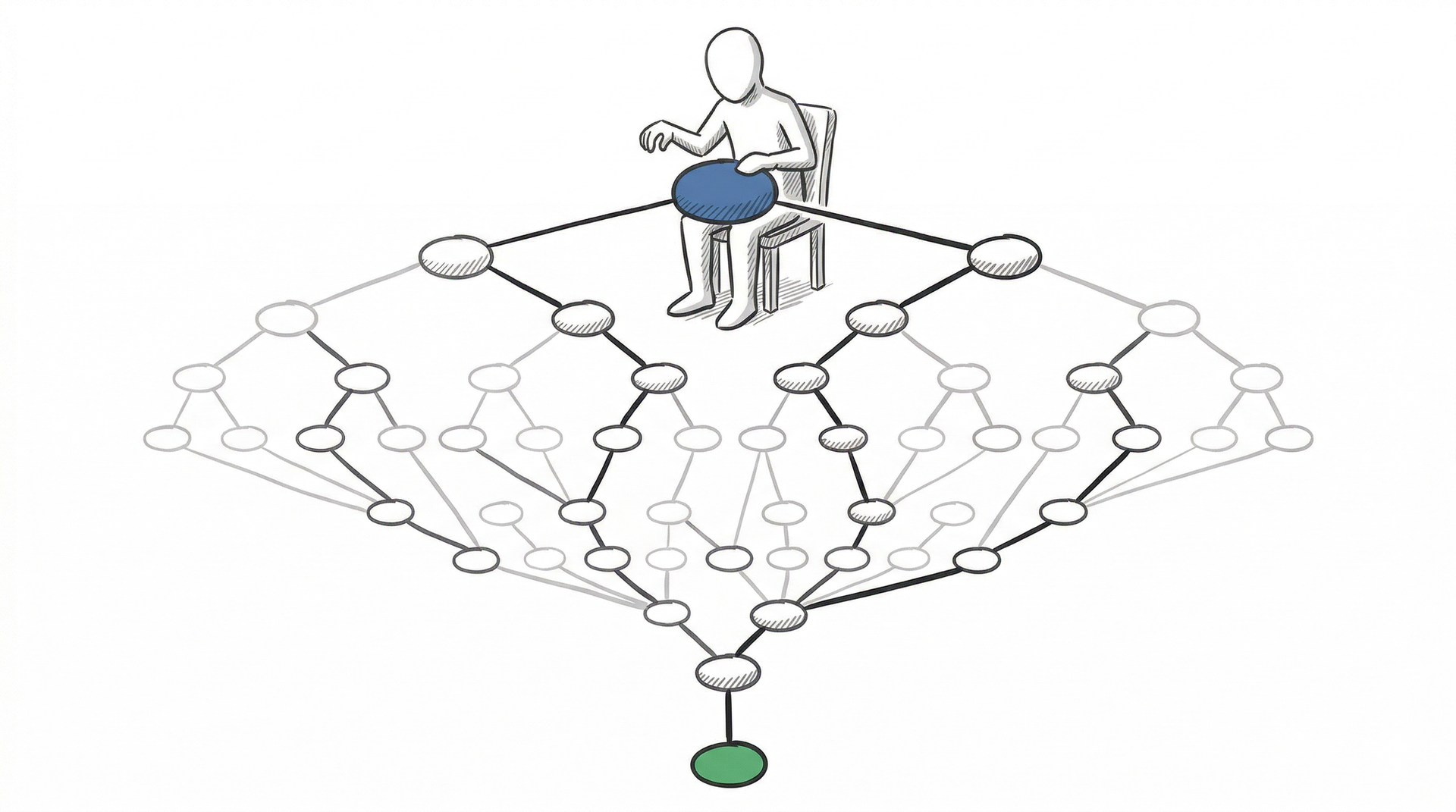
I wrote previously about Robert Fritz’s digital decision making – a process for turning agonizing decisions into clear yes/no calls by stripping away the story and forcing each factor into a binary state. That article explained the theory: analog versus digital thinking, the six steps, and why it works so well in EO Forum presentations.
This article is the tool. I have written an AI prompt that walks you through the entire digital decision making process conversationally, one question at a time. You paste it into any AI assistant and it interviews you. The process takes 10 to 20 minutes. Many decisions resolve in the first three.
If you already know what digital decision making is and just want the prompt, skip to the tools page.
Digital Decision Making
Run Robert Fritz’s digital decision making process with an AI that holds the frame and forces binary thinking. 10-20 min.
Why a prompt
I built AI prompts for the Owner’s Outcome, Core Purpose and BHAG, and Values Discovery because those exercises work best as structured interviews. The frameworks are well-defined. The questions follow a specific sequence. And the hardest part is not knowing what to do – it is doing it honestly, with someone who will not let you off the hook.
An AI assistant is surprisingly good at that. It does not get tired. It does not let you change the subject. It does not accept “it depends” when the question requires a yes or a no. And it has no opinion about what you should decide, which means it can hold the binary frame without flinching.
Digital decision making needs that frame held more than any of the other exercises. The entire value of the process depends on the facilitator refusing to let you slip back into analog thinking – the stories, the qualifications, the “but what about” loops that keep the decision from resolving. A good facilitator moves fast, enforces the binary, and reflects back the pattern without judgment. The prompt does exactly that.
What the prompt does
The prompt follows the same six-step structure I described in the original article, with facilitation logic built into each step.
Phase 1 – Frame the decision. The AI pushes until you state the decision as a single yes/no question with a timeframe. Not a situation. Not a dilemma. A decision. Most people cannot do this on the first try. The AI does not move on until it is clean.
Phase 2 – Identify the factors. You name the 3 to 5 factors that genuinely move the needle. The AI resists the instinct to brainstorm exhaustively. If you list more than five, it asks you to collapse. If a factor is vague, it asks you to sharpen it.
Phase 3 – Test whether a real decision exists. This is the extremes test. The AI asks what you would do if every factor were positive, then what you would do if every factor were negative. If your answer is the same in both scenarios, the decision is already made. The AI names it and gives you the choice to either accept it or examine why you have been pretending to deliberate.
A surprising number of decisions end here. The prompt is designed to let them.
Phase 4 – Reveal the value structure. This is the core of the process. The AI walks you through 6 to 10 hypothetical combinations of your factors, pairing them in opposition, and forces a yes or no on each one. It moves fast. It does not let you explain. When the combinations are done, it names the pattern – which factor is structurally dominant, which ones are secondary, and where your answers contradicted what you said you valued.
This is where most people learn something they did not expect. You might discover that you say no every time lifestyle fit is weak, regardless of financial upside. That tells you lifestyle is structurally dominant over money in your actual decision-making, even if your story is that you are building for growth. The prompt does not judge this. It maps it.
Phase 5 – Reality check. For each factor, the AI asks what is actually true right now – adequate or inadequate. It matches the real-world configuration to the closest hypothetical combination from Phase 4. If the pattern matches a combination where you said yes, the structural answer is yes. If it matches one where you said no, the structural answer is no.
Phase 6 – Announce the decision. The AI asks you to say it out loud. Not hedge. Not qualify. “My decision is: yes, I will do this” or “My decision is: no, I will not do this.” If you resist, it diagnoses the friction – either a factor is missing from the list, or you are not being honest about a reality assessment.
At the end, the AI produces a one-page summary: the decision, the answer, the factors, the dominant factor, the structural pattern, and any friction notes. The summary is designed to be kept. If the decision comes back – if you find yourself reopening it at 3 a.m. – you reread the summary before deliberating again. The structure does not change just because the anxiety returns.
Digital Decision Making
Walk through all six phases described above with an AI assistant that produces a one-page decision summary. 10-20 min.
How to use it in Forum
I described in the original article how digital decision making fits EO Forum presentations. The prompt makes that easier.
Run the prompt yourself before Forum. Bring the summary to the group. Present the binary decision, the factors, the pattern the combinations revealed, and the structural answer. Then ask the group: “Based on this, what do you see that I might be missing?”
The group’s job is not to decide for you. It is to challenge whether your factor list is complete and whether your reality assessments are honest. The structure does the rest.
If a Forum member is presenting a binary decision and has not run the process, you can also use the prompt live. One person reads the questions. The presenter answers. The group observes the pattern emerge in real time. It is a powerful way to spend a presentation slot because the structure prevents the conversation from drifting into story, politics, or advice.
What it does not do
The prompt is a decision tool, not a planning tool. It tells you yes or no. It does not tell you how to execute.
If the answer is yes, the next step is to define what specifically you will do, by when, and how you will measure it. That is where tools like the Owner’s Outcome quarterly review and strategic swim lanes take over.
The prompt is also only as good as the factors you include. If you omit something you care about – your health, a key relationship, your reputation – the structure will give you a clean but incomplete answer. The friction check in Phase 6 is designed to catch this, but it depends on you being willing to name what you left out.
And it does not fix bad values. If your priorities are unhealthy, this process will execute them faithfully. Clarity is not the same as wisdom. Digital decision making reveals what you actually value. Whether those values serve you well is a different conversation – one that tools like Values Discovery and the Owner’s Outcome are designed to address.
Go to the source
This prompt is my interpretation of Robert Fritz’s work on digital decision making and structural dynamics. The underlying theory is described in The Path of Least Resistance and The Path of Least Resistance for Artists. The concept of digital thinking – forcing structural elements into binary states – originates in Fritz’s training as a composer, where structural moves in music and theater are discrete. Fritz teaches the full technique in his Fundamentals of Structural Thinking (FST) course.
If this resonates with you, I strongly recommend going to Fritz’s original material. What I have built here is a tool that makes the process accessible for individual use and for EO Forum presentations. Fritz goes much deeper into the theory and the structural dynamics that underpin it.
Digital Decision Making
Get your decision, factors, value ranking, and reality check in one guided session. 10-20 min.
The prompt is available on the tools page.