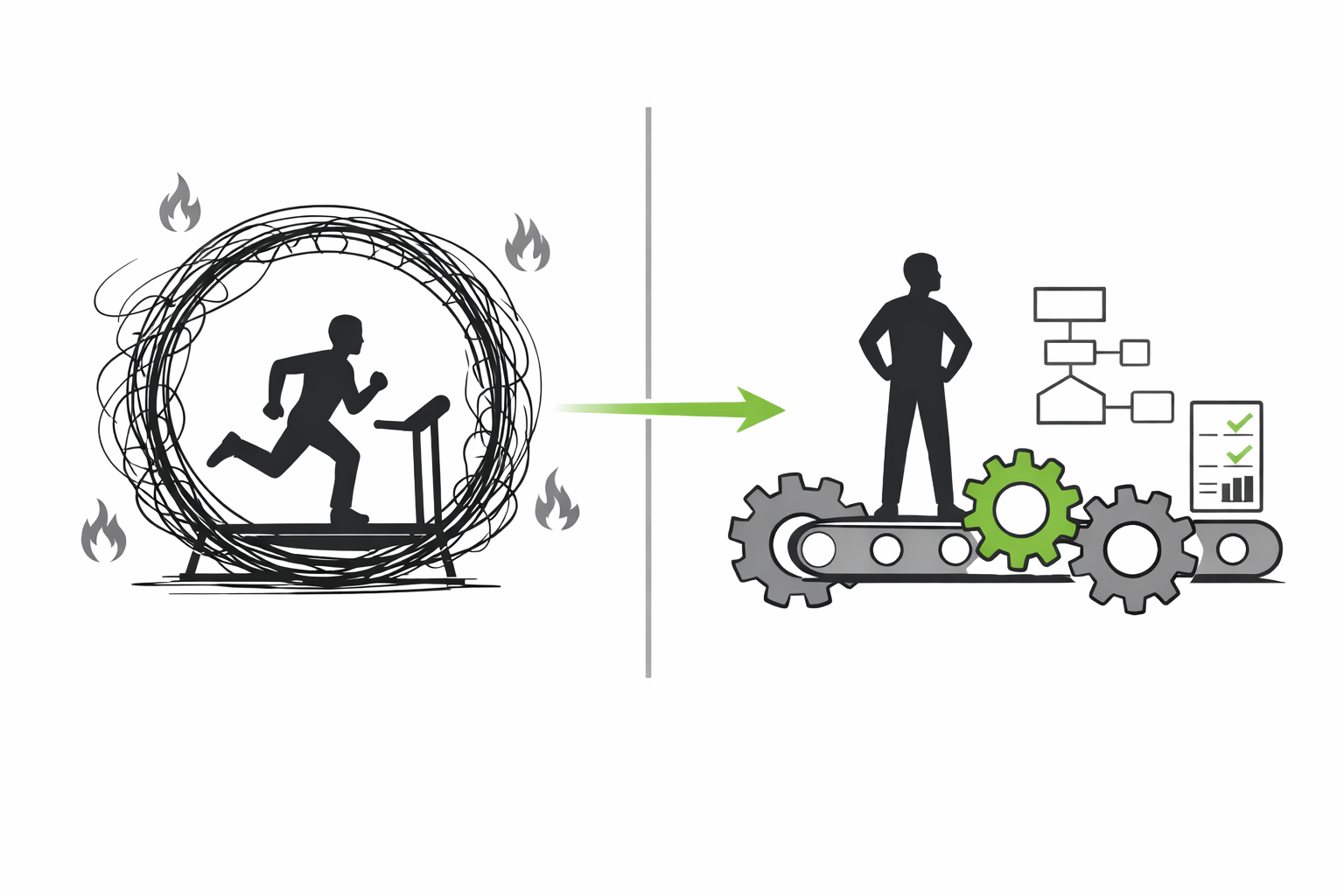
I didn't set out to do it the hard way.
Nobody does. But looking back across thirty years of building a company, I can see clearly now what I couldn't see then: I was working harder than I needed to, on the wrong things, without the tools to know the difference. And the most painful part is that the business was succeeding by most external measures. Real revenue. Real customers. A team that cared. We were growing. We were paying our bills. From the outside it probably looked like we had it figured out.
From the inside it felt like running in place.
Good months and bad months, with no reliable way to predict which was coming. Priorities that shifted because the urgent always beat the important. Fires that got extinguished only to reignite somewhere else a few weeks later. A team that was capable but inconsistent – not because they weren't trying, but because the system they were working inside didn't give them the clarity or accountability to be anything else. And at the center of all of it: me, carrying more than I should have, convinced that if I just worked harder or thought more clearly or hired the right person, things would finally smooth out.
They didn't. Not for a long time. And understanding why took longer than it should have.
The Myth of the Capable Founder
There's a story founders tell themselves, and I told it too. The story goes like this: the business is struggling because it's hard, and hard things require smart, driven people who are willing to outwork the problem. If results aren't where they should be, the answer is more effort, more focus, more of whatever got you here. You built this company. You know it better than anyone. Trust your instincts and keep pushing.
It's not a bad story. It's just incomplete.
What it leaves out is the structural reality that a certain size and complexity of business can no longer run on founder instinct and effort alone. Not because the founder isn't capable – they almost certainly are – but because the job has changed. In the early years, success comes from doing: selling, building, delivering, solving. The founder who is best at doing wins. But at some point the company needs a different kind of leadership. It needs someone who can design the system the business runs on, not just run harder inside a system that doesn't exist.
That transition is where most founder-led businesses quietly get stuck. Not visibly stuck – the revenue keeps coming in, the team keeps showing up, the founder keeps working. But stuck in the sense that the ceiling is low and invisible, and every time you push against it, it pushes back just as hard.
I was stuck there for years before I admitted it.
The Self-Implementation Trap
When I finally admitted that something needed to change, I did what most founders do. I went looking for answers in books.
I read everything I could find. Scaling Up. EOS. The Great Game of Business. Almost every book written on business operating systems made its way onto my desk. I worked through all of it, looking for the framework that would finally give the business the structure it needed. I eventually settled on Scaling Up, believed in it enough to commit fully, attended sessions, brought the language into the business, and for the better part of a year tried to install it from the inside.
The progress was limited.
At the time I told myself it was an execution problem – we just needed to be more disciplined, more consistent, more committed to the process. But looking back, I can see it clearly now: the failure wasn't about effort or discipline. It was structural. There were four specific reasons why self-implementation was never going to work, and I suspect they're the same four reasons it doesn't work for most founders who try.
The first is accountability. I was simultaneously the one building the system and the one the system was supposed to hold accountable. That's a structural impossibility. You cannot referee your own game. You cannot hold yourself to a standard with any real consequence when you also control the standard. The moment things got uncomfortable or inconvenient, there was nothing stopping me from quietly adjusting the target or deprioritizing the work. And that's exactly what happened, over and over, without me fully realizing it.
The second is perspective. When you're a player on the field, you cannot see the whole field. I was too close to everything – too embedded in the day-to-day to have the distance required to diagnose what was actually happening. I thought I knew where the constraints were. I was wrong about most of them, and I couldn't have known I was wrong because I had no vantage point from which to see it clearly. A founder inside their own business is almost always solving the wrong problems with great intensity, while the real bottlenecks go unaddressed.
The third is organizational skepticism. The team had watched me launch initiatives before. They'd seen new frameworks introduced with energy and conviction, and they'd watched those frameworks quietly fade as the urgency of daily operations took over. They weren't cynical people – they were rational ones. They'd learned from experience that waiting things out was a reasonable strategy. So when I brought in the next framework, they were polite and compliant in the meetings and mostly unchanged in their daily behaviour. Not out of resistance, but out of a completely justified belief that this too would pass.
The fourth is credibility. Without someone in the room who had visibly done it before – who had installed this specific system in a real company and gotten out the other side with measurable results – there was nothing to anchor the conviction that it would work. I believed in the framework theoretically. But belief without proof is thin when you're asking a team to change how they work, what they measure, and how they hold each other accountable. The quiet skepticism that this time would be any different wasn't irrational. It was honest. And I had no answer for it.
Understanding those four reasons didn't come quickly. It came later, looking back. But when it did, it changed how I thought about the whole problem.
The Decision to Ask for Help
In year 25 I did what I should have done much earlier. I hired a coach.
He guided us through the installation of Metronomics as our operating system. And almost immediately, things started to change in ways my solo attempts never had.
Within three quarters the volatility started settling. Not because the business had gotten easier – the external environment was no different – but because the internal environment had fundamentally changed. Fires stopped recurring because we had built the systems to address root causes rather than symptoms. Accountability took hold because there was now someone outside the organization whose specific role was to hold commitments and tell the truth when the team wouldn't. Priorities became clearer because we had a framework for deciding what mattered and a cadence for reviewing whether we were doing it.
For the first time, the business was running on a system instead of on me.
That shift is harder to describe than it sounds. It wasn't just operational improvement – though the operational improvements were real and significant. It was a change in what the business fundamentally was. Before, it was a collection of capable people organized around a founder who held everything together through force of will and presence. After, it was a system with its own logic, its own momentum, its own capacity to generate results without requiring the founder at the center of every decision.
What Five Years of Compounding Looks Like
The results over the following five years were measurable in ways I hadn't expected.
The business went from break even to 20% net profit margins, sustained over five consecutive years. Not a good year followed by a correction – a sustained, reliable, compounding improvement in profitability. Annual revenue growth accelerated from low single digits to 15–20% per year. Cash reserves built to many multiples of annual operating spend, which changed the psychology of the whole organization. When the business has real cash reserves, decisions get made differently. Investments get made that a cash-thin business would never make. The team behaves differently when the company is clearly healthy and growing.
My own involvement dropped from 60+ hours a week to under 10. And the business ran better than it ever had when I was there full time.
I want to sit with that for a moment, because it's the thing I still find most remarkable. The business was performing better with me less involved. Not because I had been the problem – though in some ways my overinvolvement had been limiting the team's development. But because the system had freed everyone, including me, to operate at a higher level. I wasn't putting out fires anymore. I wasn't in the middle of every decision. I had something I had never had in 25 years of running the business: a clear view of the whole field.
I could see what was coming before it arrived. I could see where the constraints were forming before they became crises. I could see the strategic moves that the urgency of daily operations had always crowded out. That clarity – the clarity that comes from being above the business rather than inside it – changed everything about how I led.
The Strategy Was Never Fixed
I pivoted at least half a dozen times over thirty years. But for most of that time, that was instinct, not science. I was reasonably good at watching the market, and when I felt it turning I moved fast. I didn't wait. I didn't overthink it. That served us well. But I'm honest enough to call it what it was: luck, wrapped in decent instincts. There was no systematic process behind it. I was making moves that felt right and happened to be right often enough to matter.
What the implementation of Metronomics changed was that it turned instinct into a discipline.
For the first time we had a structured process for understanding exactly what the market wanted, identifying precisely who we were targeting, and asking the question that most founder-led businesses never ask clearly enough: how do we make ourselves genuinely unique and valuable to that specific customer, in a way that the competition isn't? Not better at doing what everyone else does. Different. Occupying white space that is ours because we understand our market more clearly than our competitors do and we've built our position around that understanding.
And then – this was the hardest part, and the most important – learning to say no to everything that didn't contribute to that position. Every opportunity that looked attractive but pulled us sideways. Every customer who wanted something adjacent but didn't fit. Every direction the business could have gone that would have made us look more like everyone else. Saying no to those things felt wrong in the moment. It almost always does. But it's what kept the position clean and the differentiation real.
There's something else worth naming here that doesn't get talked about enough. A good operating system doesn't eliminate luck. It doesn't protect you from markets that shift or trends outside your control – and there are always plenty of those. But it gives you the tools to see what's happening more clearly and earlier, and to move with intention rather than just reacting. You're still subject to forces you can't control. But you're less of a victim to them. When the signal comes that something is changing, the discipline tells you to go back to the analysis – get clear on who you're targeting, what they actually need right now, and what attributes they're using to make purchasing decisions. That process gives you the answer with clarity rather than anxiety. And if a pivot is what it points to, you commit to it fully. Double down hard on what you now see the market needing, and say no to everything else.
Instinct alone got us through half a dozen pivots. The system made us better at all of them.
The COO Moment
Somewhere in the middle of those five years, something else happened that I hadn't fully anticipated.
The leadership team grew. Not just in skill and confidence, but in capacity. They were making decisions that previously would have required my input. They were holding each other accountable in ways that previously would have required my intervention. They were thinking strategically in ways that previously had been reserved for conversations with me.
And yet I was still working hard. Not because the business demanded it – the system was running well and the team was capable. It was more force of habit than necessity. Twenty-five years of founder instinct doesn't unwind overnight. I was still showing up with the same intensity I always had, still inserting myself, still carrying more than I needed to, even though the conditions that had made that necessary no longer existed.
It took my EO forum to show me what I couldn't see myself.
I was complaining at a forum meeting – something about the pace, the hours, the sense that I still couldn't fully let go – when one of my forum members stopped me. If they had my business with my systems, they said, they would not be working anything like as hard as I was. The room agreed.
It landed like a strike of lightning. I wasn't stuck because of the business. The business was fine. I was stuck in a rut of my own making – a habit of overwork so deeply ingrained that I had kept it running long after the reason for it had disappeared. It didn't have to be this way. I just hadn't stopped to notice.
That conversation changed something. I looked at my COO and saw clearly what I should have seen earlier: he was the right person to run this business day to day. Not because I was ready to step away, but because he was ready to step up – and because the system we had built gave him everything he needed to succeed in that role.
I promoted him to head of company and stepped back to work with the executive team in a different capacity. Not managing the business, but coaching the people running it. Asking questions instead of giving answers. Challenging assumptions instead of making decisions.
That was when I discovered something I hadn't expected. I loved that work.
The Mistake I Almost Didn't Recover From
When the pandemic arrived, I made what I now consider the biggest mistake of my business career. I panicked, and it was visible.
We went into retreat mode. We started cutting costs, consolidating, moving fast. And in the process I made a decision that I still shake my head at: I concluded that this was not the time for systems and discipline and quarterly planning. This was the time to park all of that and just work. Get our heads down, move as fast as possible, and grind our way through it.
We ended the coaching engagement. We stepped away from the operating rhythm we had spent years building. We traded discipline for urgency.
It was exactly the wrong call.
What I know now – and what I should have known then – is that difficult times are precisely when your system matters most. The chaos of a crisis is not a reason to abandon your operating discipline. It's the reason you built it in the first place. A good system doesn't just help you execute when conditions are favorable. It gives you the stability, the clarity, and the decision-making structure to navigate the moments when everything feels uncertain. Parking the system when things get hard is like taking off your seatbelt because the road is getting rough.
Fortunately, the stupidity didn't last long.
Within about six months I recognized the mistake clearly, and we course-corrected. We went back to everything we had learned. We re-adopted the system, the rhythms, the accountability structures – and this time we did it entirely on our own, without a coach. Because by then we knew exactly what to do. The system was ours. We had just temporarily forgotten that.
What happened next is the part that still surprises me. We picked up almost exactly where we had left off. The momentum came back quickly. The results resumed their trajectory. The brief detour into panic-driven urgency had cost us some time and some unnecessary stress, but it hadn't broken anything fundamental. The foundation was solid enough to recover from my own worst instincts.
That recovery – and the two and a half years of independent compounding that followed – eventually led to the exit. Which is, in its own way, the most important part of the lesson: even when you make a significant mistake, a well-built system is resilient enough to absorb it. The business didn't need me to be perfect. It needed the system to be sound. And despite my best efforts to undermine it, it was.
The Gap That Matters Most
Here's the part of the story that most people don't tell, and that I think matters more than any of the numbers.
The formal coaching engagement ended roughly two and a half years before the company sold.
The team had fully internalized the system. They didn't need a coach to keep running it. And so the engagement had ended, and the business continued on its own momentum – through a pandemic, through a period of founder stupidity, through a recovery, and all the way through to an exit.
In my thirtieth year, the company sold at greater than a 5x multiple of recurring revenue, with no earn-out and no employment clause. The total return on the coaching investment – the increase in enterprise value relative to what was spent on the coach over the course of the engagement – was approximately 270 times its cost. The team still runs and grows the business today.
That gap is the proof that matters most to me. Not the margins or the multiple or the hours reduction – though all of those matter. The gap. Because the gap tells you that what was built was real. A system that requires the coach to keep running isn't a system – it's a dependency. A system that runs and compounds and grows for two and a half years without the coach present, surviving a pandemic and a founder who briefly lost his mind, is a genuine transformation. That's what we built. And that's what the exit reflected.
What I'd Tell Myself at Year One
Looking back across thirty years, a few things stand out with a clarity that wasn't available to me at the time.
The first is that working harder is almost never the answer. At every stage where I felt stuck, my instinct was to increase effort – more hours, more focus, more intensity. And at almost every stage, the actual answer was to change the system, not increase the input. A broken system run harder is still a broken system. A good system run consistently will outperform heroic effort in a broken one every time.
The second is that the founder's overinvolvement is both the business's greatest strength and its most significant constraint. In the early years, founder energy and judgment are what make a company go. But at some point that same overinvolvement starts to cap the business's potential. The team can't develop fully when the founder is in every decision. The strategy can't get the attention it deserves when the founder is fighting fires. The business can't become what it's capable of becoming while it's still running through one person. Getting out of the way – deliberately and structurally, not just in theory – is one of the hardest and most important things a founder can do.
The third is that outside perspective is not a luxury. I thought of it that way for a long time. A coach was something you hired when things were broken, or something other people needed. What I know now is that outside perspective is the one resource a founder genuinely cannot generate internally. You cannot see your own blind spots. You cannot hold yourself accountable with real consequence. You cannot give your team the credibility of external validation. Those things require someone outside the building, with standing and experience, whose specific role is to tell you the truth you can't hear from inside.
The fourth is that when things get hard, you double down on your discipline – you don't abandon it. The pandemic taught me that lesson the hard way. Crisis is not a reason to park your system. It's the moment your system earns its keep. Every founder will face a version of this test. The ones who hold their discipline through it come out the other side faster, stronger, and with less damage than the ones who revert to urgency and instinct.
The fifth is that strategy is not something you set once and revisit annually. It requires constant tending. A good operating system gives you the tools to see the market clearly and earlier than you otherwise would – and to move with intention rather than just reacting. You're still subject to forces outside your control. Markets rise and fall. Trends shift. But the discipline makes you less of a victim to them. It gives you a structured process for getting clear on who you're targeting, what they actually need, and whether your position is still genuinely unique and valuable to them – or whether you've drifted into competing on the same terms as everyone else. And if the analysis points to a pivot, you commit to it fully. Double down hard on what you now see the market needing, and say no to everything else. The no is the hardest part. But saying yes to the wrong things is what turns a deliberate move into a drift.
The sixth is that the goal was never the exit. The exit was a consequence. The goal was to build a business that could run without me – that had its own systems, its own leadership, its own momentum. A business like that is worth owning. It turns out it's also worth selling. But more than either of those things, it's worth building – because the process of building it changes what the business gives the founder. Not someday, when the exit happens. Now, while you're still running it.
That's the thing I didn't understand for the first 25 years. And understanding it made all the difference.